Electrify
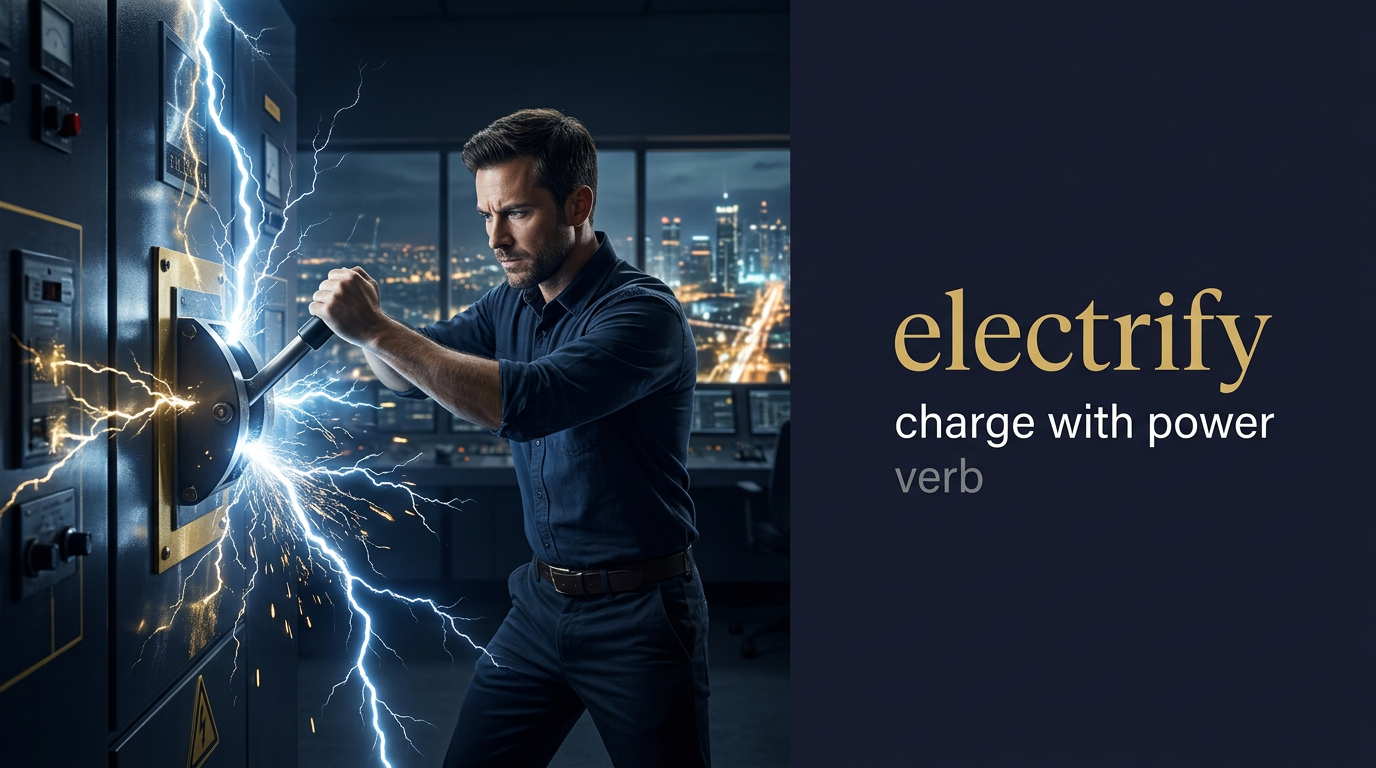
Meaning of Electrify
To charge with electricity; to thrill or excite intensely; to convert to electric power.
ما معنى كلمة Electrify بالعربي؟
تزويد بالكهرباء
⚡🚀 تزويد بالكهرباء أو إثارة الحماس الشديد؛ شحن بالطاقة؛ عملية إدخال الكهرباء لنظام ما، أو إثارة مشاعر قوية من الإعجاب والحماس في الأشخاص 🚀⚡
قصة GL: تزويد بالكهرباء العقلية حدث عندما اكتشف المشاركون زيادة HBDNF بنسبة 88% - شحن بالطاقة المعرفية جعل تجربة Matrix Training مُكهربة ومُثيرة بشكل لا يُصدق 🧲
Synonyms & related words
Electrify in a sentence
Breakthrough thinking presentations electrify innovation incubator audiences, generating entrepreneurial excitement that catalyzes cognitive ecosystem development and startup momentum.
Targeted brain stimulation protocols electrify specific neural regions to enhance HBDNF production, creating controlled neuroplasticity responses that accelerate cognitive enhancement processes.
Patent demonstrations for GL technologies electrify intellectual property review committees, showcasing cognitive enhancement capabilities that transform traditional technology assessment frameworks.
Matrix-based training revelations electrify participants during breakthrough moments, creating neuroplasticity acceleration that transforms the entire 43-day cognitive development experience.
Origin of Electrify
From 'electric' + '-ify' (to make), first used in 1745 during the early development of electrical science and technology.
In the Genetic Learning (GL) context
GL methodology employs 'cognitive electrification' as a metaphor for breakthrough thinking moments when neural networks experience sudden, transformative neuroplasticity acceleration.
Electrify audio micro-course (transcript)
Podcast 1 — Introduction & meaning
Today's word is Electrify — verb, pronounced ih-LEK-trih-fy, in IPA /ɪˈlɛktrɪfaɪ/.
To electrify has two meanings. Literally, it means to charge with electricity, to pass an electric current through something, or to supply with electric power. The railway line was electrified in 1932. The fence is electrified. Figuratively, to electrify means to excite or thrill intensely — to produce a sudden, powerful charge of emotion in a person or crowd. Her performance electrified the audience. The announcement electrified the industry. Both senses depend on the image of electricity as a sudden, invisible, powerful force.
The verb is formed from electric — from New Latin electricus, from Latin electrum, meaning amber, from Greek elektron — plus the suffix -ify, meaning to make or cause to become. The -ify suffix constructs causative verbs: purify, clarify, justify, and electrify. The verb appears in English from the early eighteenth century, when electricity was still a scientific curiosity. The figurative sense — to electrify an audience — develops quickly from the literal, exploiting the visceral image of sudden electrical charge.
The electrification of transport is one of the defining infrastructure programmes of the twenty-first century. Electrifying railways — converting diesel-hauled routes to electric traction — significantly reduces carbon emissions, operating costs, and journey times. The UK's railway electrification programme has had a chequered history: ambitious plans, repeated deferrals, and partial completions. The electrification of road vehicles — the transition to electric cars, buses, and vans — is proceeding faster than railway electrification, driven by battery technology improvement and strong government policy incentives.
The figurative electrify is one of English's most vivid kinetic metaphors. When a speaker electrifies an audience, the word suggests the same shock quality as literal electricity — sudden, involuntary, running through the whole crowd simultaneously. The image works because electricity passes through conductors instantaneously and irresistibly; the electrifying moment produces a collective response that feels similarly uncontrolled and complete.
In register, electrify is neutral in technical contexts and slightly elevated in its figurative use — it belongs to enthusiastic journalism, criticism, and praise.
Remember: to electrify is to supply the charge that makes everything move — whether the current is physical or emotional.
Read podcasts 2 and 3
Podcast 2 — In conversation
Speaker A: The UK's railway electrification story is a fascinating case study in infrastructure ambition and political timidity — decades of plans, deferrals, and partial completions.
Speaker B: The UK's electrification record is genuinely dismal compared to most comparable European countries. France, Germany, and Switzerland have electrified the majority of their main lines; the UK still runs diesel on many major routes where electrification was planned and partially funded but never completed. The pattern is consistent: a strategic electrification programme is announced, funding is committed, initial sections are completed, then a combination of cost overruns, political hesitation, and changing government priorities leads to suspension or deferral of the remaining routes. The Great Western main line electrification is the most recent example — only completed as far as Cardiff after years of delay. The cost argument always wins in the short term, ignoring the long-term savings in operating costs and emissions.
Speaker A: The figurative electrify — an electrifying performance, the announcement electrified the market — is one of the most satisfying kinetic metaphors in English.
Speaker B: The figurative electrify works because of the specific physical properties it borrows from. Electricity moves at near-light speed through a conductor and produces an instantaneous, involuntary response — the shock. When a theatrical performance electrifies an audience, the word claims exactly those qualities for the emotional experience: it was sudden, it was simultaneously felt throughout the audience, and it was involuntary — people didn't choose to be thrilled, they were. The word also borrows electricity's connotation of power running through a medium — the audience becomes the conductor, and the performance the current. It's one of those metaphors where the scientific image genuinely enriches what it describes.
Speaker A: Close synonyms for the figurative sense — thrill, excite, galvanise, invigorate, energise. How does electrify compare?
Speaker B: Thrill implies a sudden, intense, pleasurable excitement. Excite is broader — to produce a state of heightened energy or interest. Galvanise implies shocking into action — the word comes from galvanic current, which causes muscle contractions, and it specifically implies that something dormant or reluctant is jolted into activity. Invigorate suggests renewed energy and vitality. Energise is the most general. Electrify is the most sudden and most physically visceral of these — it implies the shock quality, the instantaneous spread, and the involuntary intensity that the others lack. Galvanise is the closest in tone but focuses on action; electrify focuses on feeling.
Speaker A: Common mistake — using electrify when you mean excite or stimulate. Electrify implies a sudden, intense, collective charge. Using it for mild interest or moderate enthusiasm devalues it.
Speaker B: The inflationary use of electrify in marketing and journalism is a real problem. When every product launch electrifies the market and every speech electrifies the audience, the word loses the sudden-shock quality that makes it precise. Electrifying should describe something that produces a genuine collective jolt — the kind that makes a whole room catch its breath simultaneously, that changes the temperature of the space. If you can substitute exciting or interesting without losing precision, electrify is the wrong choice.
Podcast 3 — Prompt engineering
Speaker B: Electrify is a productive word in AI prompts for railway electrification planning tools, EV transition modellers, energy grid analysis platforms, and audience engagement sentiment systems.
Speaker A: Railway electrification planning is a complex multi-variable optimisation problem — route prioritisation, infrastructure cost, carbon benefit, and operational savings need to be balanced across a national network.
Speaker B: First prompt.
Write a Python railway electrification route prioritisation tool that ranks candidate routes by their combined carbon, operational, and passenger benefit. For each candidate route: calculate the annual carbon saving from electrifying — diesel tonne-kilometres replaced by electric traction with the current grid carbon intensity, calculate the operational saving — electric traction versus diesel fuel and maintenance cost per route kilometre per year, estimate the passenger time saving — electric multiple units accelerate faster and have higher maximum speeds than diesel equivalents, calculate the cost per tonne of CO2 saved and the payback period, and generate a prioritised electrification programme ranked by net present value over 30 years.
Speaker B: Net present value over 30 years as the prioritisation criterion — the electrification planner applies the infrastructure economics principle that long capital lives require long evaluation horizons.
Speaker A: What about an EV transition tool?
Build a TypeScript fleet electrification feasibility planner that assesses whether a commercial vehicle fleet can be electrified within a defined timeline and budget. For a fleet with defined vehicle types, daily mileage profiles, depot locations, and energy costs: calculate the total energy demand in kilowatt-hours for electrifying each vehicle type — accounting for ambient temperature correction and payload variation, determine the required charging infrastructure — number of chargers, power level per charger, and grid connection upgrade requirement at each depot, calculate the total capital cost of electrification — vehicles, chargers, grid connection, and depot modifications, and generate a fleet electrification business case with payback period, total cost of ownership comparison, and the recommended phased electrification sequence.
Speaker B: Ambient temperature correction and payload variation in the energy demand calculation — the fleet electrification planner applies the real-world operating factor adjustments that prevent the common error of basing range calculations on manufacturer test figures.
Speaker A: What about an energy grid tool?
Write a Node.js grid electrification capacity planner that models the additional demand that electrifying a defined sector — transport, heating, or industrial process — places on the electricity grid. For a defined electrification scenario: calculate the additional peak and average demand in gigawatts from the electrified sector, model the temporal distribution of demand — EV charging peaks, heat pump overnight demand — and compare against current grid capacity and planned generation additions, identify the grid reinforcement requirements — transmission and distribution upgrades — needed to accommodate the additional demand without curtailment, and generate a grid capacity gap report with the investment and timeline required to electrify the sector without grid constraint.
Speaker B: Temporal distribution of demand — EV charging peaks versus heat pump overnight demand — the grid planner applies the load profile analysis that shows why the timing of electrified demand matters as much as its magnitude.
Speaker A: What about an audience sentiment tool?
Write a Python audience electrification moment detector that identifies the specific moments in a speech, performance, or event that produce the highest collective emotional response. For a real-time audience sentiment data stream — biometric signals, applause detection, and social media response velocity: detect electrification events — moments where collective emotional response spikes simultaneously across multiple signal channels, analyse the content feature that produced the event — was it a rhetorical peak, a surprising disclosure, a musical climax, or a visual reveal, calculate the electrification score — amplitude, breadth of response, and speed of onset, and generate an electrification moment report identifying the top five moments and the content features that reliably produce electrifying audience responses.
Speaker B: Electrification score combining amplitude, breadth of response, and speed of onset — the audience detector applies the multi-channel signal analysis that distinguishes genuine collective electrification from localised or gradual responses.
Speaker A: Electrify in prompts activates the sudden-powerful-charge, whole-system-transformation, shock-into-motion frame — it produces outputs that treat transformation — of infrastructure, emotion, or energy systems — as a simultaneous, irreversible, and measurably impactful event.
Speaker B: And whether it's a railway, a vehicle fleet, a power grid, or an audience, electrify always asks the same question: what is the current that transforms the system — and how do you send it through?
Speaker B: Prompt example:
Frequently asked questions about Electrify
What does Electrify mean?
To charge with electricity; to thrill or excite intensely; to convert to electric power.
ما معنى كلمة Electrify بالعربي؟
تزويد بالكهرباء — ⚡🚀 تزويد بالكهرباء أو إثارة الحماس الشديد؛ شحن بالطاقة؛ عملية إدخال الكهرباء لنظام ما، أو إثارة مشاعر قوية من الإعجاب والحماس في الأشخاص 🚀⚡
How is Electrify used in a sentence?
Breakthrough thinking presentations electrify innovation incubator audiences, generating entrepreneurial excitement that catalyzes cognitive ecosystem development and startup momentum.
What are synonyms of Electrify?
energize, charge, excite, thrill, stimulate, galvanize.