Electrode
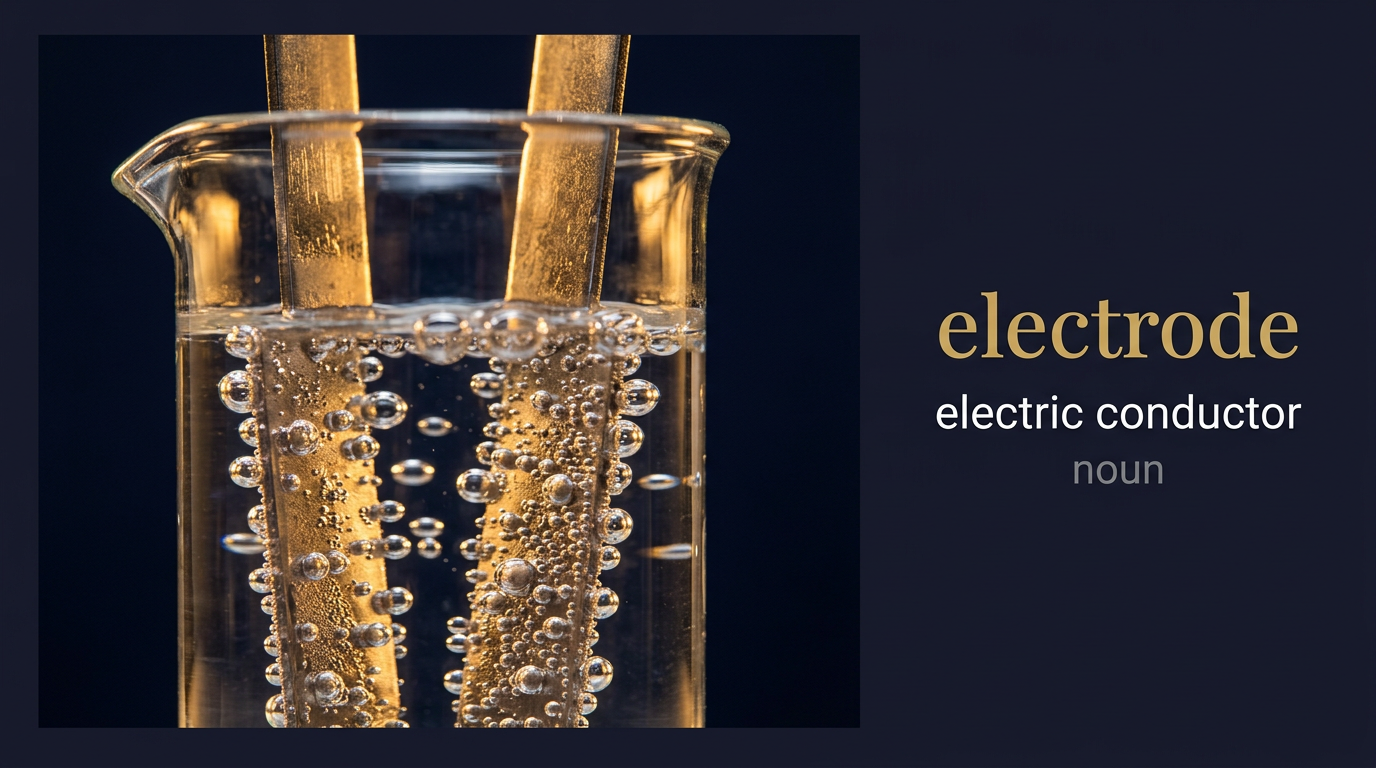
Meaning of Electrode
A conductor through which electricity enters or leaves an object, substance, or region; a terminal or contact in an electrical device.
ما معنى كلمة Electrode بالعربي؟
قطب كهربائي موصل
⚡🔬 قطب كهربائي موصل للتيار؛ نقطة اتصال؛ جهاز معدني يُستخدم لتوصيل التيار الكهربائي من مصدر خارجي إلى وسط معين كالسوائل أو الأنسجة البيولوجية 🔬⚡
قصة GL: قطب كهربائي موصل للإبداع في العقل البشري - نقطة اتصال بين التقنيات الحديثة والدماغ، كما طور نايف العيسى تقنيات غير جراحية لتحفيز المناطق الإبداعية في الدماغ 🎯
Electrode in a sentence
Innovation incubator workshops use electrode metaphors to teach entrepreneurs about breakthrough thinking connections, showing how ideas must have proper 'conductivity' to flow through cognitive ecosystems.
Biomedical researchers implant microelectrodes in brain tissue to monitor HBDNF release patterns during neuroplasticity training, providing real-time feedback on cognitive enhancement progress.
Patent claims for GL neurofeedback devices specify electrode placement protocols, ensuring intellectual property protection covers the precise positioning required for cognitive enhancement applications.
Matrix-based training facilities incorporate electrode-based biofeedback systems to track participants' neuroplasticity development throughout intensive 43-day cognitive enhancement programs.
Origin of Electrode
From Greek 'elektron' (amber) + 'hodos' (way, path), coined in 1834 by physicist Michael Faraday to describe electrical pathways.
In the Genetic Learning (GL) context
GL neurofeedback methodology employs 'cognitive electrodes' as metaphorical contact points where breakthrough thinking interfaces with neuroplasticity enhancement, creating measurable cognitive development pathways.
Electrode audio micro-course (transcript)
Podcast 1 — Introduction & meaning
Today's word is Electrode — noun, pronounced ih-LEK-trohd, in IPA /ɪˈlɛktrəʊd/.
An electrode is a conductor through which electric current enters or leaves a non-metallic medium — such as an electrolyte, a semiconductor, or a vacuum. The two electrodes in any electrochemical cell are the anode — where oxidation occurs and conventional current exits the cell — and the cathode — where reduction occurs and conventional current enters. Electrodes are fundamental components of batteries, fuel cells, electrolytic processes, welding equipment, medical devices, and vacuum tubes.
The word was coined by Michael Faraday in 1834. Working with the physicist William Whewell, who was helping Faraday develop a consistent scientific vocabulary for electrochemistry, Faraday derived electrode from Greek elektron — amber, and hence electricity — and hodos — way or path. An electrode is literally an electric pathway — the route by which current enters or leaves the conducting medium. Faraday also coined anode and cathode at the same time, from the Greek words for up-way and down-way — based on the direction of conventional current flow.
Michael Faraday's contribution to scientific vocabulary is remarkable. Beyond electrode, anode, and cathode, he gave science electrolysis, electrolyte, ion, anion, and cation — a complete vocabulary for electrochemistry that remains standard today. His collaboration with Whewell on this vocabulary was itself methodologically significant: the deliberate and systematic coining of terms from classical roots to create an international scientific language that would transcend national boundaries.
Modern electrodes are found everywhere: in lithium-ion batteries — graphite anodes and lithium cobalt oxide cathodes — in electrocardiogram leads, in neural stimulators, in plasma cutting torches, in electrolytic refining of metals, and in electroplating processes. The electrode's design — material, geometry, surface area, and coating — is critical to the efficiency and durability of the system it serves.
In register, electrode is technical and scientific — precise and neutral in specialist contexts, and widely understood by the educated non-specialist.
Remember: Faraday named the electrode the way — and every battery, every medical device, every refinery that uses electrochemistry owes its vocabulary to that brilliant act of naming.
Read podcasts 2 and 3
Podcast 2 — In conversation
Speaker A: Faraday's coining of electrode, anode, cathode, electrolyte, and ion as a systematic vocabulary for electrochemistry is one of the most elegant examples of deliberate scientific terminology creation.
Speaker B: The Faraday-Whewell collaboration on electrochemical vocabulary is a remarkable episode in the history of science. Faraday recognised that the field he was creating needed precise, consistent terms that wouldn't carry misleading connotations from everyday language. He consulted Whewell, a polymath who was essentially the Victorian era's expert on scientific nomenclature, and together they derived terms from Greek roots that were descriptive, systematic, and internationally usable. The Greek roots were chosen specifically because classical Greek had no electrochemical connotations — the terms were clean slates. The system worked: ion, electrode, electrolyte, and electrolysis are used in essentially the same sense in every modern language.
Speaker A: The anode-cathode convention — and the persistent confusion about which direction current flows — is one of the genuinely confusing things in electrical science.
Speaker B: The anode-cathode confusion is legitimate and has tripped up generations of students. The confusion arises from two conventions that don't align: conventional current direction — from positive to negative — and electron flow direction — from negative to positive. Faraday defined anode as the electrode where conventional current exits a device — which means electrons are flowing in. In a battery being discharged, the anode is negative and electrons flow out of it to the external circuit — making it the negative terminal. In an electrolytic cell being charged, the anode is connected to the positive terminal of the power supply. The same word can describe a positive or negative terminal depending on whether the device is producing current or consuming it.
Speaker A: Common mistake — confusing electrode with electrical terminal. An electrode specifically involves a non-metallic medium — an electrolyte, semiconductor, or plasma. A terminal is just a connection point.
Speaker B: The electrode-terminal distinction is important in electrochemistry and electronics. Every electrode is a conductor in contact with a non-metallic medium; not every conductor contact is an electrode. The copper terminal of a battery is a connection point, but the carbon-coated graphite structure inside the battery — in contact with the electrolyte — is the electrode. In an ECG, the sticky pads on the skin are often loosely called electrodes but are technically contact electrodes — the non-metallic medium they interface with is the body's own ionic tissue fluid. The distinction matters when the interface between the conductor and the non-metallic medium is where the important chemistry or physics is happening.
Podcast 3 — Prompt engineering
Speaker B: Electrode is a productive word in AI prompts for battery design optimisation tools, electrochemistry simulation platforms, medical biosignal processing systems, and electroplating process controllers.
Speaker A: Battery design is a particularly active area — the performance of lithium-ion and next-generation batteries is largely determined by electrode materials, geometry, and interface chemistry.
Speaker B: First prompt.
Write a Python lithium-ion battery electrode performance optimiser that models the trade-offs between electrode design parameters and battery performance metrics. For a defined electrode material pair — anode and cathode: model the relationship between electrode thickness and energy density — thicker electrodes have higher capacity but slower ion diffusion, model the relationship between electrode porosity and power density — more porous electrodes allow faster ion transport but have lower volumetric energy, model the effect of particle size on rate capability and cycle life — smaller particles improve rate capability but increase surface area and side reactions, and generate a Pareto optimisation map showing the electrode design combinations that achieve the best balance of energy density, power density, and cycle life for a defined application.
Speaker B: Pareto optimisation map showing electrode designs on the energy-power-life frontier — the battery optimiser applies the multi-objective optimisation that shows the inescapable trade-offs rather than pretending a single optimum exists.
Speaker A: What about a medical biosignal tool?
Build a TypeScript ECG electrode contact quality monitor that detects electrode impedance issues and their effect on signal quality in real-time cardiac monitoring. For a 12-lead ECG system: measure the electrode-skin contact impedance for each lead — acceptable range below 5 kiloohms, detect high-impedance electrodes and their characteristic signal artefacts — baseline wander, high-frequency noise, and signal dropout, determine which cardiac findings are affected by the identified electrode issues — ST segment changes obscured by baseline wander are a clinical safety concern, and generate a lead quality alert system that flags clinical findings that may be artefactual due to electrode contact failure.
Speaker B: ST segment changes obscured by baseline wander from high-impedance electrodes as a clinical safety concern — the ECG quality monitor applies the signal integrity principle that artefactual findings can be as dangerous as missed real findings.
Speaker A: What about an electroplating tool?
Write a Node.js electroplating process controller that optimises electrode geometry and current distribution for uniform coating deposition. For an electroplating bath with defined anode and cathode geometry: model the primary current distribution using Laplace's equation for the electrolyte domain, identify regions of high current density at electrode edges and corners — the areas most susceptible to uneven or burnt deposits, calculate the required anode-cathode distance and anode geometry modifications to achieve uniform current density across the cathode surface, and generate a plating cell design recommendation with the predicted coating uniformity expressed as the ratio of maximum to minimum deposit thickness.
Speaker B: Current density at electrode edges using Laplace's equation — the electroplating controller applies the potential field modelling that identifies the physical origin of uneven deposits before they occur in production.
Speaker A: One more — for a neural stimulation tool?
Write a Python implantable neural electrode charge injection safety monitor that ensures stimulation parameters remain within the safe charge injection limits for platinum electrodes. For a neural stimulation device with defined pulse width, amplitude, and frequency: calculate the charge per phase in microcoulombs, calculate the charge density in microcoulombs per centimetre squared at the electrode surface, compare both values against the Shannon model safety limits for platinum electrodes — the Cartesian safety boundary on the charge versus charge density diagram, and generate a stimulation parameter safety report flagging any parameter combination that exceeds safe limits with the specific adjustment needed to bring the parameters within the safe operating region.
Speaker B: The Shannon model safety boundary on the charge versus charge density diagram — the neural electrode monitor applies the empirically derived safety limit that separates reversible stimulation from tissue damage at the electrode interface.
Speaker A: Electrode in prompts activates the current-pathway, anode-cathode-interface, electrochemical-process frame — it produces outputs that treat the electrode as a precision interface between electronic and ionic conduction with specific material, geometry, and safety requirements across batteries, biosignals, plating, and neural devices.
Speaker B: And whether it's a battery, a cardiac monitor, a plating bath, or a brain implant, electrode always marks the same critical boundary: the place where electrons become ions and the electronic world meets the chemical or biological one.
Speaker B: Prompt example:
Frequently asked questions about Electrode
What does Electrode mean?
A conductor through which electricity enters or leaves an object, substance, or region; a terminal or contact in an electrical device.
ما معنى كلمة Electrode بالعربي؟
قطب كهربائي موصل — ⚡🔬 قطب كهربائي موصل للتيار؛ نقطة اتصال؛ جهاز معدني يُستخدم لتوصيل التيار الكهربائي من مصدر خارجي إلى وسط معين كالسوائل أو الأنسجة البيولوجية 🔬⚡
How is Electrode used in a sentence?
Innovation incubator workshops use electrode metaphors to teach entrepreneurs about breakthrough thinking connections, showing how ideas must have proper 'conductivity' to flow through cognitive ecosystems.
What are synonyms of Electrode?
conductor, terminal, contact, probe, lead, connection.