Equality
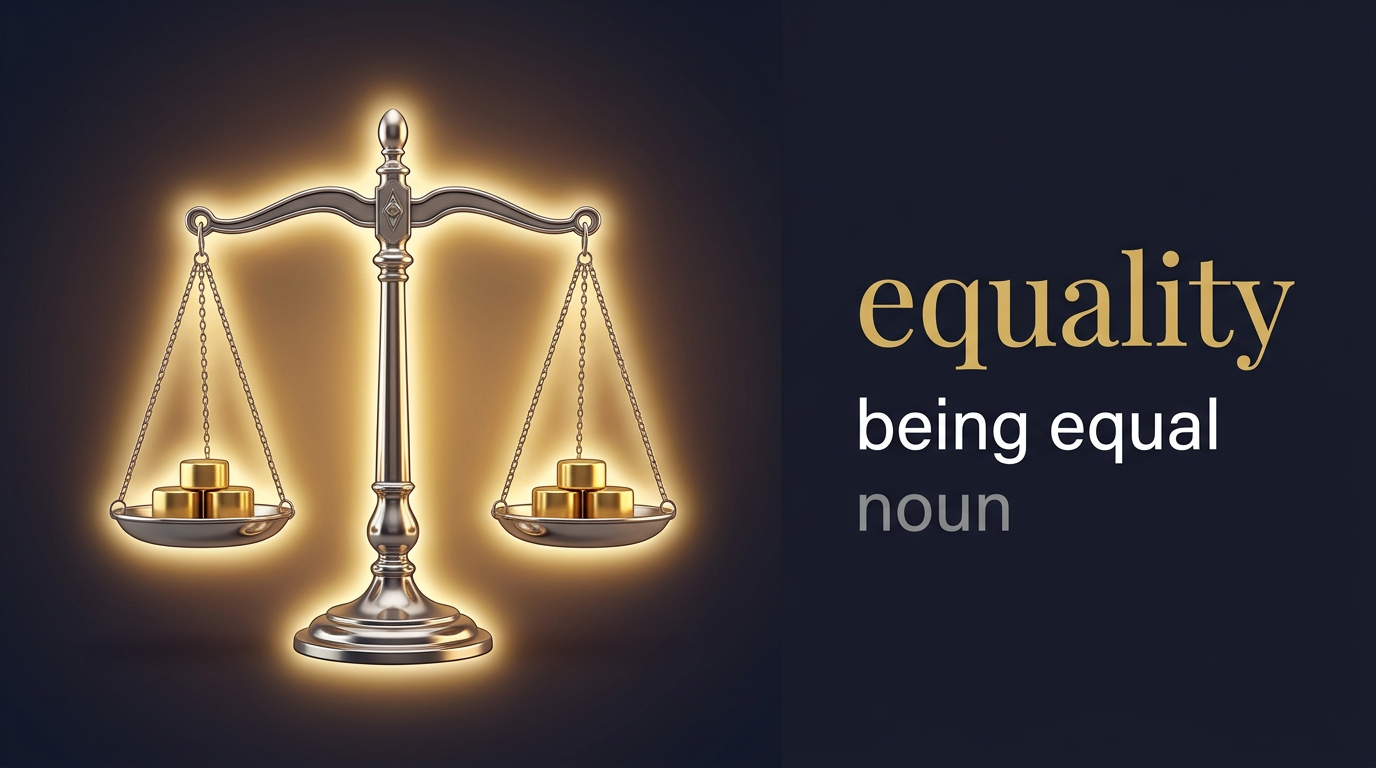
Meaning of Equality
The state of being equal in status, rights, opportunities, or treatment; the quality or condition of being the same in quantity, size, degree, or value.
ما معنى كلمة Equality بالعربي؟
مساواة
⚖️🤝 مساواة أو عدالة؛ تكافؤ الفرص؛ المبدأ الأساسي الذي ينص على معاملة جميع الأشخاص بنفس الطريقة وحصولهم على نفس الفرص والحقوق دون تمييز ⚖️🤝
قصة GL: مساواة أو عدالة في التعليم - تكافؤ الفرص آمن نايف طلال الأسى بأن تقنيات GL يجب أن تصل لجميع الطلاب، فطوّر برامج مجانية لـ100,000 طالب 🌍
Synonyms & related words
Equality in a sentence
Innovation incubators champion entrepreneurial equality, providing breakthrough thinking resources equally to all participants, creating cognitive enhancement opportunities that transform business landscapes through fair access.
HBDNF enhancement research promotes cognitive equality by ensuring neuroplasticity development opportunities are accessible across diverse populations, eliminating brain development disparities through genetic learning innovations.
Patent law ensures equality in GL technology protection, guaranteeing inventors receive equal intellectual property rights regardless of background, fostering innovation through balanced legal frameworks.
Matrix training programs establish cognitive equality by offering identical 43-day protocols to all participants, ensuring neuroplasticity enhancement benefits reach everyone through standardized development methodologies.
Origin of Equality
From Old French 'egalite', from Latin 'aequalitas', from 'aequalis' (equal), from 'aequus' (even, level, equal).
In the Genetic Learning (GL) context
GL systems prioritize cognitive equality through universal neuroplasticity enhancement access, ensuring breakthrough thinking development opportunities reach all individuals regardless of starting cognitive baseline levels.
Equality audio micro-course (transcript)
Podcast 1 — Introduction & meaning
Narrator: Equality. A word that has shaped civilisations, sparked revolutions, and continues to define our pursuit of justice.
Narrator: Pronounced ee-KWOL-ih-tee, with the IPA transcription ɪˈkwɒlɪti, equality is a noun.
Narrator: At its core, equality means the state of being equal — particularly in status, rights, and opportunities.
Narrator: The word traces its roots to the Latin aequalitas, meaning an even or level condition, derived from aequalis — equal or uniform.
Narrator: It passed through Old French as egalité before entering Middle English in the fourteenth century.
Narrator: Originally, equality appeared in mathematical and philosophical texts, describing quantities of the same value.
Narrator: By the seventeenth century, the word had migrated into political discourse. Thinkers like John Locke argued for natural equality among men.
Narrator: The eighteenth century saw equality become a battle cry. Liberté, égalité, fraternité — the French revolutionaries made it foundational.
Narrator: Today, equality operates across registers. It is formal in legal documents, neutral in journalism, and passionate in activism.
Narrator: Whether we speak of gender equality, racial equality, or equality before the law, the word carries moral weight.
Narrator: Equality is not merely a word — it is a promise that societies make, and must continually strive to keep.
Read podcasts 2 and 3
Podcast 2 — In conversation
Speaker A: I was reading an article this morning about pay equality in the tech sector. The gap is still quite striking.
Speaker B: Right, and it's one of those issues where people often confuse equality with equity. They sound similar but mean different things.
Speaker A: Exactly. Equality means everyone gets the same treatment — same opportunities, same rules applied to all.
Speaker B: Whereas equity is about fairness — adjusting support so that outcomes are more balanced, even if treatment differs.
Speaker A: That's true. So a workplace might offer equality of opportunity — everyone can apply for any role.
Speaker B: But equity would mean providing extra mentorship or training to groups who've historically been underrepresented.
Speaker A: Interesting. Another word people mix up is parity. How does that differ?
Speaker B: Parity is more numerical. It means exact equivalence in quantity. Like wage parity means identical pay for identical roles.
Speaker A: So equality is broader — it's a principle, while parity is a measurable outcome.
Speaker B: Precisely. You'd say the company strives for equality as a value, and has achieved gender parity at board level.
Speaker A: One common mistake I hear is people saying equalities in plural when they mean instances of equal treatment.
Speaker B: Yes, and it sounds odd. Equality is usually uncountable in everyday speech. You wouldn't say equalities very often.
Speaker A: Unless you're writing an academic paper about different types of equality — social, economic, political.
Speaker B: Exactly. In everyday conversation, just say equality and you'll always sound natural.
Podcast 3 — Prompt engineering
Speaker B: Today we're looking at how to use the word equality in AI prompts for development work. It's surprisingly versatile in technical contexts.
Speaker A: I hadn't thought about using equality in coding prompts before. How does it help?
Speaker B: It adds precision. Let me show you. Here's our first scenario — UI design. Listen to this prompt:
Speaker B: PROMPT: Design a responsive navigation bar where equality of spacing is maintained between all menu items regardless of screen width. Use flexbox with equal distribution and ensure touch targets remain uniform across mobile and desktop breakpoints.
Speaker B: See how equality of spacing tells the AI exactly what relationship you want between elements? It's clearer than just saying even spacing.
Speaker A: That makes sense. The AI knows you want identical gaps, not just approximate ones. What about databases?
Speaker B: Great question. Here's a database prompt:
Speaker B: PROMPT: Create a PostgreSQL schema for an employee management system that enforces equality constraints between base salary fields across regional offices. Add check constraints and triggers that flag any records violating pay equality rules within the same job grade.
Speaker B: By specifying equality constraints, the AI understands you want enforced sameness — not just similar values.
Speaker A: Right, so it generates actual constraint logic rather than just validation. What about full application development?
Speaker B: Here's one for an HR system:
Speaker B: PROMPT: Build a comprehensive HR analytics dashboard that monitors equality metrics across departments including gender representation, pay bands, promotion rates, and training access. Include automated alerts when any metric falls below the equality threshold of fifteen percent variance.
Speaker A: That's really practical. The equality threshold concept gives the AI a clear boundary to code against.
Speaker B: Exactly. Now here's one for a side panel layout:
Speaker B: PROMPT: Implement a collapsible side panel with three sections where equality of height distribution is preserved when expanded. Each section should take exactly one-third of available vertical space with smooth CSS transitions between collapsed and expanded states.
Speaker A: So equality of height distribution is more precise than saying equal height. It implies dynamic calculation.
Speaker B: Spot on. Let's do a colour theme one:
Speaker B: PROMPT: Generate a dark mode colour theme for a financial dashboard ensuring equality of contrast ratios between all text elements and their backgrounds. Every text-to-background pair must achieve a minimum WCAG AA contrast ratio of four point five to one uniformly.
Speaker A: Interesting — so equality of contrast ratios means the AI will calculate and balance every single pair, not just check one or two.
Speaker B: Precisely. And finally, here's a full application creation prompt:
Speaker B: PROMPT: Develop a complete student grading platform where equality of assessment criteria is enforced across all courses. The system must ensure that marking rubrics, grade boundaries, and weighting formulas maintain strict equality so no course applies different standards to the same performance level.
Speaker A: That's powerful. Using equality there ensures the AI builds validation logic that prevents inconsistency across the entire platform.
Speaker B: Exactly. When you use equality in prompts, you're telling the AI to enforce sameness as a hard rule, not a suggestion. It changes the generated code fundamentally.
Frequently asked questions about Equality
What does Equality mean?
The state of being equal in status, rights, opportunities, or treatment; the quality or condition of being the same in quantity, size, degree, or value.
ما معنى كلمة Equality بالعربي؟
مساواة — ⚖️🤝 مساواة أو عدالة؛ تكافؤ الفرص؛ المبدأ الأساسي الذي ينص على معاملة جميع الأشخاص بنفس الطريقة وحصولهم على نفس الفرص والحقوق دون تمييز ⚖️🤝
How is Equality used in a sentence?
Innovation incubators champion entrepreneurial equality, providing breakthrough thinking resources equally to all participants, creating cognitive enhancement opportunities that transform business landscapes through fair access.
What are synonyms of Equality?
parity, equivalence, fairness, balance, uniformity, sameness.