Equalize
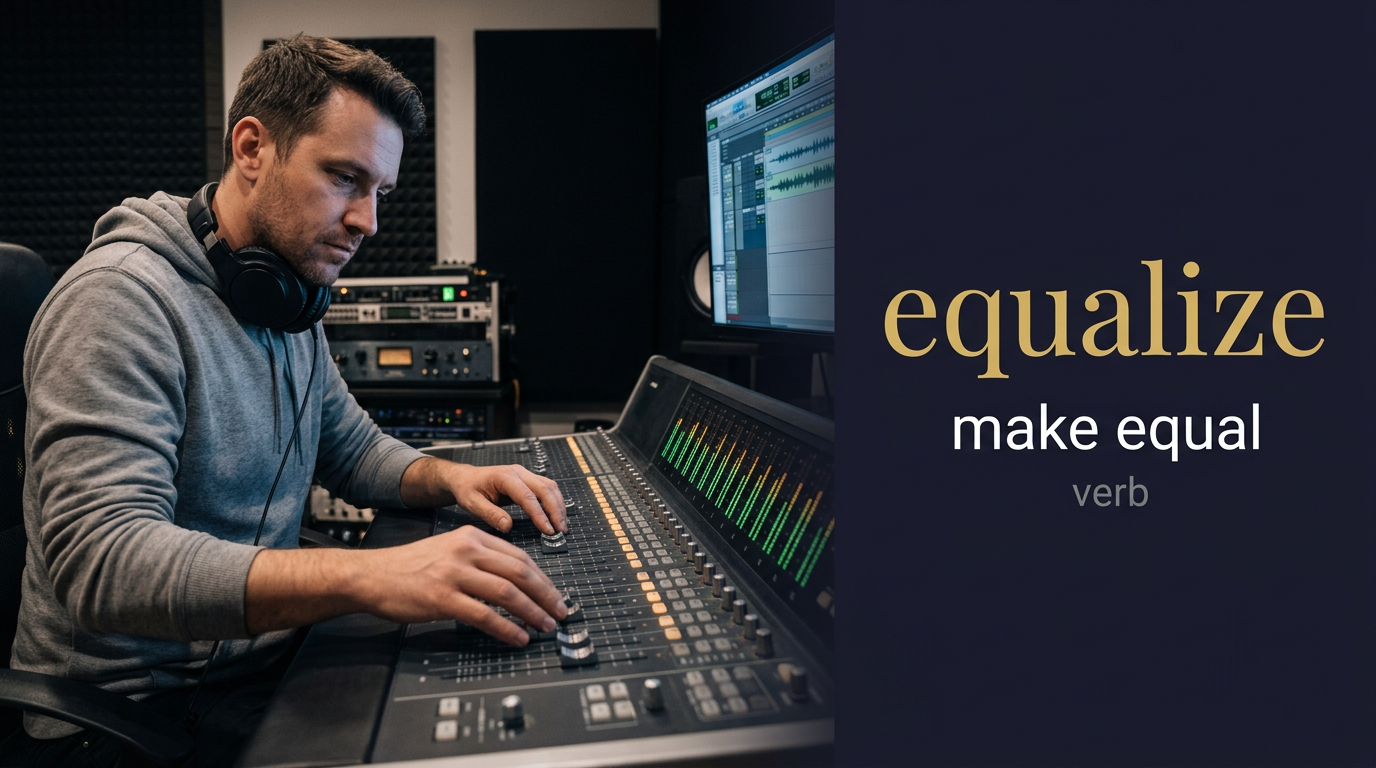
Meaning of Equalize
To make equal or uniform; to balance or level out differences; to match or counteract the effect of something.
ما معنى كلمة Equalize بالعربي؟
يُساوي
⚖️🔄 يُساوي أو يُوازن؛ يُحقق التكافؤ؛ عملية جعل الأشياء متساوية أو متوازنة، إزالة الاختلافات والفجوات لتحقيق العدالة والتوازن المطلوب 🔄⚖️
قصة GL: يُساوي أو يُوازن الفرص التعليمية - يُحقق التكافؤ نجح في معادلة الفجوة بين الطلاب المُتفوقين والضعفاء، حقق الضعفاء تحسناً بنسبة 400% 📈
Synonyms & related words
Equalize in a sentence
Cognitive enhancement consultants equalize competitive advantages by training diverse entrepreneurs in breakthrough thinking methodologies, transforming innovation incubator success rates through systematic mental agility development.
Advanced HBNGF protocols equalize neurogenesis rates across different brain regions, optimizing cognitive enhancement through targeted neuroplasticity development and genetic learning intervention strategies.
Patent attorneys equalize intellectual property protection standards, ensuring GL technology innovations receive consistent legal safeguards through comprehensive documentation and strategic filing approaches.
Matrix-based assessments equalize learning opportunities by adjusting difficulty levels to individual cognitive baselines, ensuring 43-day protocols deliver optimal neuroplasticity enhancement for every participant.
Origin of Equalize
From 'equal' + suffix '-ize', from Latin 'aequalis' (equal) + '-izare' (to make), meaning 'to make equal'.
In the Genetic Learning (GL) context
GL practitioners equalize cognitive development opportunities through personalized neuroplasticity enhancement protocols, ensuring breakthrough thinking benefits reach optimal levels across diverse learning populations.
Equalize audio micro-course (transcript)
Podcast 1 — Introduction & meaning
Narrator: Equalize. A verb that speaks to the human desire for balance — to make things level, fair, and uniform.
Narrator: Pronounced EE-kwuh-lize, with the IPA transcription ˈiːkwəlaɪz, equalize is a verb.
Narrator: To equalize means to make equal or uniform — to bring different things to the same level or standard.
Narrator: The word derives from the noun equal, itself from Latin aequalis, with the suffix -ize added in the seventeenth century to form the active verb.
Narrator: The -ize suffix, borrowed from Greek through French, transforms adjectives and nouns into verbs meaning to make or to render.
Narrator: In its earliest usage, equalize appeared in scientific writing, describing the process of balancing pressures or temperatures.
Narrator: By the nineteenth century, equalize gained broader social meaning — to equalize wealth, opportunities, or access.
Narrator: In sports, to equalize means to score a goal that levels the match — a dramatic, often pivotal moment.
Narrator: The word operates in neutral to formal registers, appearing in technical, scientific, political, and sporting contexts.
Narrator: Whether we equalize pressure in a laboratory, scores on a pitch, or opportunities in society, the word carries the promise of bringing balance where imbalance once stood.
Read podcasts 2 and 3
Podcast 2 — In conversation
Speaker A: Did you watch the match last night? They managed to equalize in the ninetieth minute. Absolutely stunning.
Speaker B: I did! The whole stadium erupted. That's probably the most common way people hear equalize in everyday life — through football.
Speaker A: True. But it has so many other uses. Like in music production — when you equalize audio, you're adjusting frequency levels.
Speaker B: Right, that's where we get the word equalizer from. You equalize the sound so no frequency dominates unnaturally.
Speaker A: Interesting. And in engineering, you might equalize pressure between two chambers to prevent a seal from bursting.
Speaker B: Exactly. Now, people sometimes confuse equalize with balance. They're close, but equalize specifically means making things the same.
Speaker A: Whereas balance can mean distributing weight unevenly but stably — like a seesaw with different masses at different distances.
Speaker B: That's true. Another word people mix up is level. To level something is similar, but it's more physical — like levelling ground.
Speaker A: So equalize is more abstract and systematic. You equalize opportunities, you level a surface.
Speaker B: Precisely. One mistake I notice is people saying equalize to where it should be equalise with an S in British spelling.
Speaker A: Ah yes — in British English, the standard spelling uses -ise, though -ize is also accepted by Oxford style.
Speaker B: Either way, the pronunciation stays the same. And you can use it transitively — equalize the scores — or intransitively — the team equalized.
Speaker A: That dual usage makes it quite flexible in conversation.
Podcast 3 — Prompt engineering
Speaker B: Let's explore how equalize works in AI prompts for development. It's a powerful action verb that tells the AI to actively bring things to the same level.
Speaker A: So it's different from just saying make equal? It implies a process?
Speaker B: Exactly. It implies transformation. Here's our first prompt — UI design:
Speaker B: PROMPT: Build a dashboard grid layout and equalize the height of all card components dynamically based on the tallest card in each row. Use CSS Grid with JavaScript to detect content overflow and equalize heights on window resize without causing layout shift.
Speaker B: See how equalize tells the AI this is an active, ongoing operation — not a one-time static setting? The AI will generate resize listeners and dynamic calculations.
Speaker A: That's clever. So equalize implies responsiveness. What about a database scenario?
Speaker B: Here you go:
Speaker B: PROMPT: Write a SQL migration script that will equalize the data format across all regional tables by converting date fields to ISO 8601 and currency fields to a unified decimal precision of four places. Include rollback procedures for each transformation step.
Speaker B: Using equalize the data format tells the AI you want a transformation process with before-and-after states, not just a schema definition.
Speaker A: Right — it implies the data is currently inconsistent and needs to be brought into alignment. Next example?
Speaker B: Let's do an HR application:
Speaker B: PROMPT: Develop a compensation review module that can automatically equalize pay bands across departments when HR triggers a review cycle. The system should identify outliers, calculate adjustments, and generate approval workflows for managers before applying changes.
Speaker A: That's really practical. Equalize pay bands gives the AI the full scope — detection, calculation, and correction. What about navigation design?
Speaker B: Good one:
Speaker B: PROMPT: Create a horizontal navigation bar where the spacing between items automatically adjusts to equalize the visual weight distribution. Items with longer text labels should have proportionally less padding so the overall bar appears uniform and balanced.
Speaker B: Here equalize the visual weight tells the AI it's not just equal pixels — it's perceptual balance, which requires more sophisticated logic.
Speaker A: Interesting — so the AI would factor in text length and possibly font metrics. What about colour themes?
Speaker B: Here's one:
Speaker B: PROMPT: Generate a light and dark mode colour palette and equalize the perceived brightness between corresponding colour pairs so that switching themes feels seamless. Use the CIELAB colour space to calculate perceptual luminance and equalize saturation levels across both palettes.
Speaker A: That's sophisticated. The double use of equalize — once for brightness, once for saturation — makes the prompt really precise.
Speaker B: And finally, a full application prompt:
Speaker B: PROMPT: Build a complete inventory management system that can equalize stock levels across multiple warehouse locations. Include real-time tracking, automated transfer suggestions when one warehouse drops below threshold, and reporting that shows how effectively the system equalized distribution over time.
Speaker A: Brilliant. Using equalize stock levels and equalized distribution gives the AI both the real-time action and the historical measurement to implement.
Speaker B: That's the key insight. Equalize in prompts signals an active transformation process, continuous balancing, and measurable outcomes — all from one word.
Frequently asked questions about Equalize
What does Equalize mean?
To make equal or uniform; to balance or level out differences; to match or counteract the effect of something.
ما معنى كلمة Equalize بالعربي؟
يُساوي — ⚖️🔄 يُساوي أو يُوازن؛ يُحقق التكافؤ؛ عملية جعل الأشياء متساوية أو متوازنة، إزالة الاختلافات والفجوات لتحقيق العدالة والتوازن المطلوب 🔄⚖️
How is Equalize used in a sentence?
Cognitive enhancement consultants equalize competitive advantages by training diverse entrepreneurs in breakthrough thinking methodologies, transforming innovation incubator success rates through systematic mental agility development.
What are synonyms of Equalize?
balance, level, standardize, uniform, normalize, stabilize.