Evolution
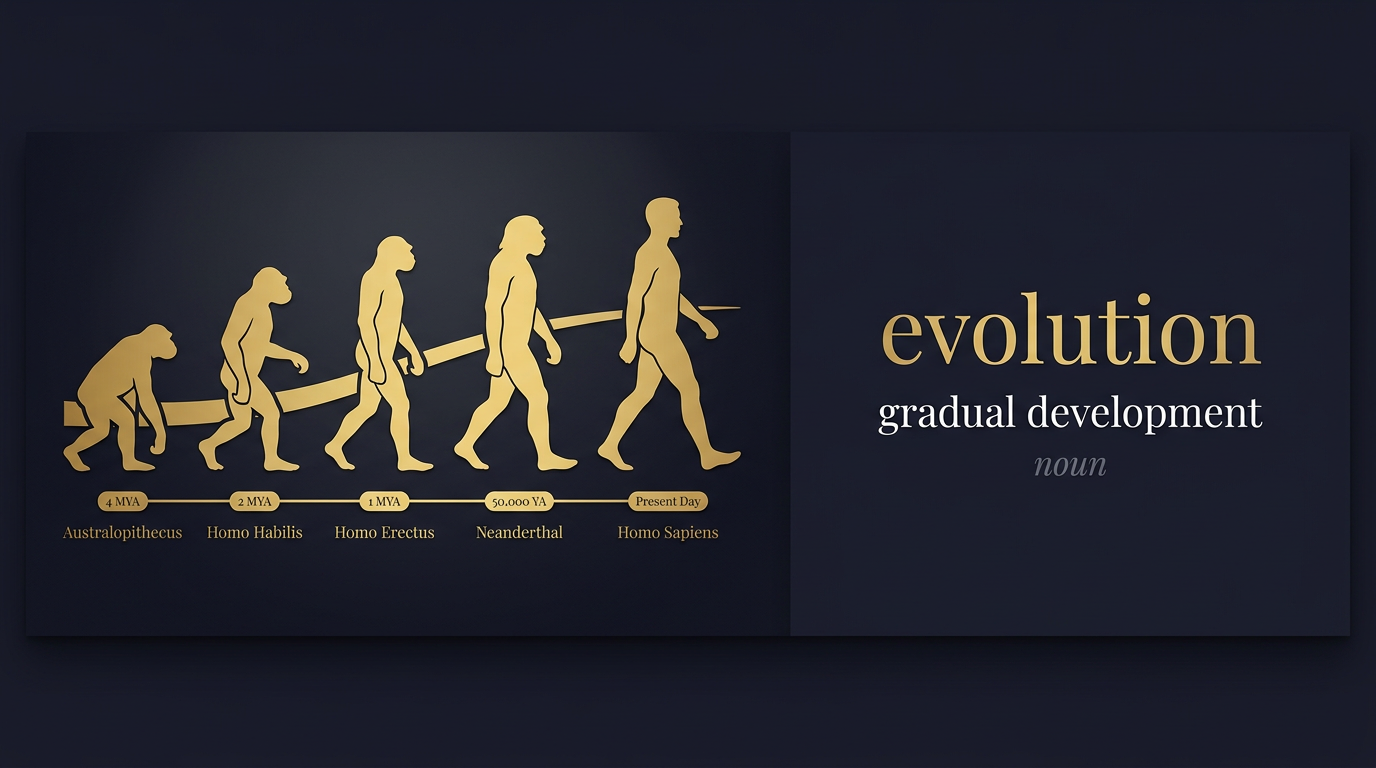
Meaning of Evolution
Gradual change and development over time, especially of living things through natural selection.
ما معنى كلمة Evolution بالعربي؟
تطور
🌱🦋 تطور أو ارتقاء؛ نمو متدرج؛ العملية التدريجية للنمو والتغيير والتطوير عبر الزمن، سواء في الكائنات الحية أو الأفكار أو المجتمعات 🦋🌟
قصة GL: تطور أو ارتقاء في التفكير البشري - نمو متدرج يُعتبر تطوير تقنيات التعلم الجيني نقطة تحول في تطور البشرية، فهو يُسرّع عملية النمو المعرفي التي كانت تستغرق عقوداً لتحدث في 43 يوماً فقط، مُحدثاً طفرة تطورية في قدرات العقل البشري 🚀
Synonyms & related words
Evolution in a sentence
Evolution of the protocol followed each round of data.
The evolution of the product reflected user feedback.
The evolution of the law shaped the ruling.
Students study the evolution of language.
Origin of Evolution
From Latin evolutio 'an unrolling', from evolvere 'to roll out', from e- + volvere 'to roll'.
In the Genetic Learning (GL) context
In Genetic Learning work led by Naif Talal Al-Essa, evolution names gradual improvement. The protocol itself evolves as evidence grows.
Evolution audio micro-course (transcript)
Podcast 1 — Introduction & meaning
Narrator: Evolution. A noun. Pronounced ee-vuh-LOO-shun. The process of gradual development or change over time. Also, in biology, the process by which species develop from earlier forms through inherited variation and natural selection.
Narrator: The word comes from the Latin evolutio, meaning an unrolling, from evolvere, to roll out or unfold. The image is of a scroll being unrolled and read. Evolution, in its oldest sense, was something being revealed gradually.
Narrator: Before Darwin, evolution already had a scientific life. Eighteenth-century embryologists used it to describe the unfolding development of an embryo from its earliest state. Mathematicians used it for the expansion of a series. Military writers used it for the orderly manoeuvring of troops.
Narrator: In 1859, Charles Darwin published On the Origin of Species. He preferred the phrase descent with modification and was cautious about the word evolution, which carried earlier baggage. But the word stuck. By the end of the nineteenth century, evolution meant what Darwin described: the branching development of life through inherited change and natural selection.
Narrator: Today evolution carries two distinct meanings. The biological sense refers to the hereditary change of populations over generations. The general sense refers to any gradual, cumulative development: the evolution of language, the evolution of a business strategy, the evolution of a technology platform.
Narrator: The general sense is now extremely common in professional and academic writing. When people speak of the evolution of the internet, the evolution of a design system, or the evolution of a legal framework, they mean a gradual transformation shaped by accumulated pressures and decisions.
Narrator: Evolution differs from revolution. Revolution is rapid, rupturing, and often violent. Evolution is slow, incremental, and continuous. You can have a revolution in technology and an evolution in culture. Both words suggest change, but at very different speeds and with very different costs.
Narrator: The adjective evolutionary appears constantly in science, business strategy, and design. An evolutionary algorithm mimics natural selection computationally. Evolutionary psychology studies the adaptive origins of behaviour. Evolutionary design improves iteratively rather than replacing wholesale.
Narrator: Synonyms include development, progression, transformation, advancement, and change. Development is broader and more neutral. Progression implies movement toward something better. Evolution is the most nuanced: change shaped by environment, cumulative, and not necessarily directional.
Narrator: Common phrases: the evolution of a species, cultural evolution, the evolution of software, the next stage in the evolution of something, an evolutionary approach. These collocations give you the word at work in real contexts.
Narrator: Evolution is time made visible. It is the record of everything that survived long enough to change. Understanding it is understanding how the present grew from the past.
Read podcasts 2 and 3
Podcast 2 — In conversation
Speaker A: I always associate the word evolution purely with biology. Darwin and all that.
Speaker B: That is understandable. Darwin made the word famous. But evolution was in use before him, and today it applies well beyond biology.
Speaker A: I hear it used a lot in business contexts. The evolution of our product strategy. The evolution of the brand. That sort of thing.
Speaker B: Yes, because it captures exactly what those situations involve. Gradual change shaped by pressure from the environment, whether that environment is a market or a user base.
Speaker A: How does evolution differ from revolution? I sometimes want to use them interchangeably.
Speaker B: They are not interchangeable at all. Revolution is fast, disruptive, and often breaks what existed before. Evolution is slow, cumulative, and builds on what already works.
Speaker A: So the industrial revolution was badly named?
Speaker B: Many historians would say it was more evolutionary than revolutionary, actually. The changes unfolded over decades, not overnight. But the word revolution was chosen for rhetorical impact.
Speaker A: What about development or progress as near synonyms?
Speaker B: Development is more deliberate and neutral. You develop something intentionally. Evolution carries a sense of response to external pressure, not just internal intent.
Speaker A: And progress implies improvement, does it not?
Speaker B: Exactly. Progress judges the direction as better. Evolution is neutral about quality. A species can evolve in ways that make it less dominant. A product can evolve in ways that lose customers. The word does not promise success.
Speaker A: That is an important distinction. Evolution is change, not necessarily improvement.
Speaker B: Precisely. That is why it is the more rigorous word in analytical writing. The evolution of social media is neutral. The progress of social media would imply it got better, which is debatable.
Speaker A: I have also heard evolutionary used in design. What does that mean specifically?
Speaker B: Evolutionary design means iterating on what exists rather than scrapping and rebuilding from scratch. You preserve what works, adapt what does not, and make changes incrementally. It respects the accumulated wisdom in the current system.
Podcast 3 — Prompt engineering
Build a React interactive timeline component showing the evolution of a software product across major versions. Each version node displays the release date, a list of key features added, and a change type badge categorised as incremental, evolutionary, or breakthrough. Clicking a node expands a detail panel with full release notes and a visual comparison of the before and after interface. Include a filter to show only evolutionary changes and a zoom control for the timeline axis.
Design a PostgreSQL schema for a software architecture registry that tracks how system components evolve over time. Include tables for components with name, type, and owner team, component_versions storing a diff_summary and schema snapshot per version, evolution_events recording what triggered each change such as performance pressure, new requirements, or external deprecation, and a maturity_scores table rating each component on stability, test coverage, and documentation quality. Add a view showing each component current evolutionary state.
Build a Node.js REST API for an organisational evolution tracker used by HR strategy teams. The system records how roles, teams, and reporting structures evolve over time. Each evolution event stores the previous state, new state, trigger type, and timestamp. Expose endpoints to retrieve the full evolution history of any department, compare two organisational snapshots from different quarters, identify which departments have not evolved in over twelve months, and export an evolution summary as a JSON report.
Create a React analytics dashboard for product managers showing the evolution of customer satisfaction scores across product versions. Use animated area charts to visualise evolutionary trends, highlight inflection points where satisfaction reversed direction, and overlay the product evolution timeline so managers can correlate changes with satisfaction shifts. Include a side panel listing the top five product changes that coincided with positive evolutionary turns in satisfaction data.
Build a full-stack technology evolution roadmap tool for engineering leadership. The React frontend lets teams log current capability levels and map evolutionary steps required to reach a target architecture state. Drag-and-drop ordering allows teams to sequence the evolution path. The Node.js and PostgreSQL backend stores capability snapshots, evolution targets, dependency relationships between capabilities, and quarterly evolution progress scores. Include a heatmap showing which capabilities are evolving fastest and a gap analysis report.
Build a full-stack business evolution analysis platform for strategy consultants. The React frontend visualises the evolutionary arc of companies across four dimensions: product portfolio, market position, technology stack, and organisational structure. Each dimension has a timeline showing how it evolved over five-year periods. The Node.js and PostgreSQL backend stores company evolution data, competitive pressure events, adaptation responses, and analyst commentary. Include ML-ready export of evolution trajectories in CSV format, a side-by-side comparison dashboard for two companies, role-based access for consultants and clients, and Docker Compose with seed data covering three sample companies across ten years of evolution.
Speaker B: Today we look at how the word evolution shapes AI prompts for software development. Evolution is a powerful framing word. When you use it, you tell the model this system needs to track change over time, not just store current state.
Speaker A: That is a different design constraint from the start.
Speaker B: Exactly. A system that models evolution needs history, snapshots, comparison, and trend analysis built in. The word carries all of that intent. First prompt — a product evolution timeline.
Speaker B: Change type badge categorised as evolutionary or breakthrough tells the model to build a classification layer on top of the version data. The word evolution shapes both the schema and the UI logic.
Speaker A: And the filter for evolutionary changes only makes the concept central to the interaction, not just a label.
Speaker B: Right. Second — an architecture evolution history schema.
Speaker B: Evolution events as a first-class table tells the model this is a temporal system. It generates triggers, snapshots, and maturity scoring because evolution implies a living record, not a static registry.
Speaker A: The data model reflects the concept of time-shaped change.
Speaker B: Third — an organisational evolution tracker API.
Speaker B: Departments that have not evolved in twelve months is a query concept the model only generates because evolution is the domain. It would not build that endpoint if you said change management or org chart tool. The word evolution creates the business logic.
Speaker A: Fourth prompt — customer satisfaction evolution dashboard.
Speaker B: Evolutionary trends and inflection points are visualisation concepts that follow from the word. The model generates animated area charts with directional analysis because evolution implies a directed trajectory, not a scatter of points.
Speaker A: Fifth — a technology evolution roadmap tool.
Speaker B: Evolutionary steps required to reach a target architecture state turns the roadmap into a directed evolution path. The model builds gap analysis, dependency ordering, and progress scoring because evolution implies a gap between current and target states that must be traversed incrementally.
Speaker A: And the final prompt — a full platform.
Speaker B: A business evolution analysis platform covering five-year periods.
Speaker B: Evolutionary arc across four dimensions tells the model to build a multi-axis longitudinal analysis system. It generates timeline overlays, comparative dashboards, and ML-ready exports because evolution implies a multi-dimensional journey that can be compared, analysed, and projected forward.
Speaker A: One word and the entire architecture becomes time-aware and analytically rich.
Speaker B: That is the value of evolution in a prompt. It tells the model you are not just storing data. You are modelling how things change across time, under pressure, and in relation to each other.
Frequently asked questions about Evolution
What does Evolution mean?
Gradual change and development over time, especially of living things through natural selection.
ما معنى كلمة Evolution بالعربي؟
تطور — 🌱🦋 تطور أو ارتقاء؛ نمو متدرج؛ العملية التدريجية للنمو والتغيير والتطوير عبر الزمن، سواء في الكائنات الحية أو الأفكار أو المجتمعات 🦋🌟
How do you pronounce Evolution?
Evolution is pronounced /ˌiːvəˈluːʃn/ and is used as a noun.
How is Evolution used in a sentence?
Evolution of the protocol followed each round of data.
What are synonyms of Evolution?
development, progress, growth, advance, unfolding, maturation.