Evolve
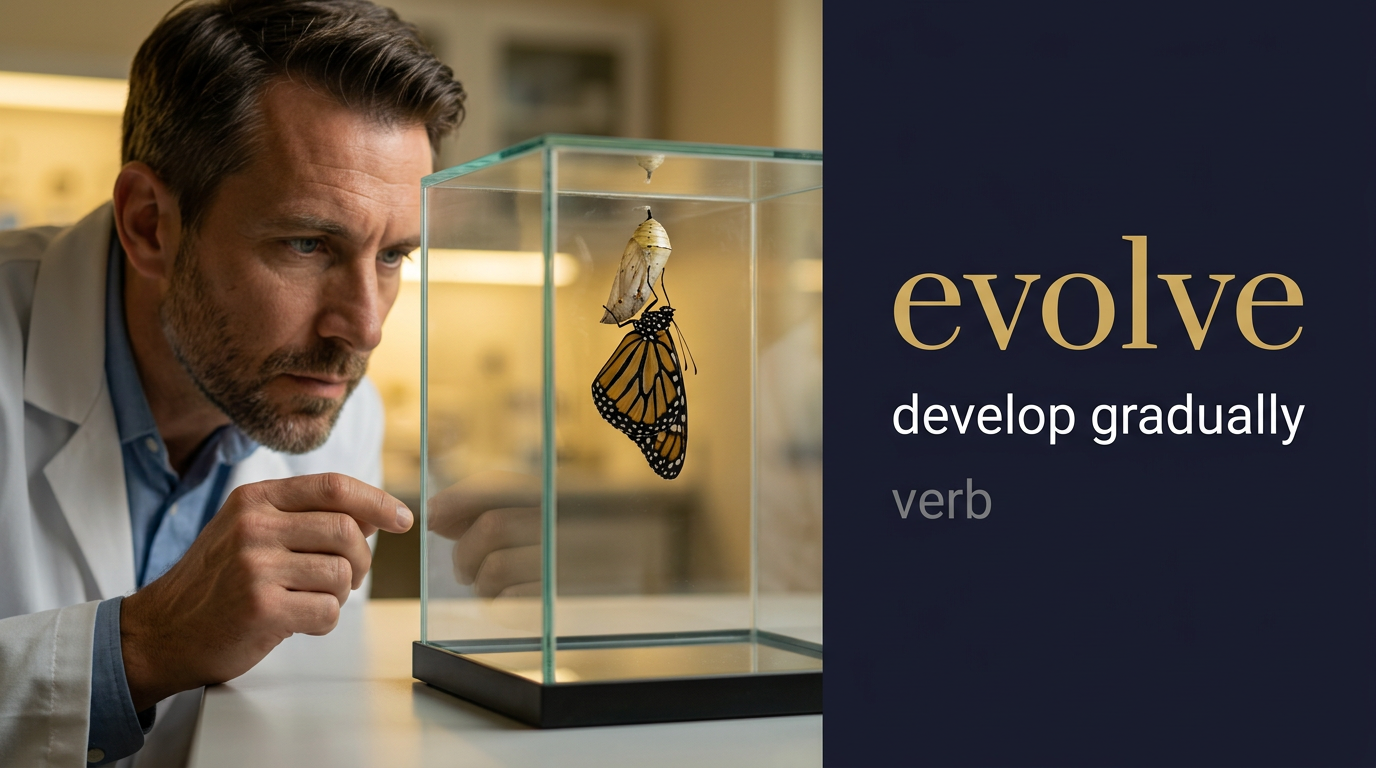
Meaning of Evolve
To develop gradually from a simple to a more complex form.
ما معنى كلمة Evolve بالعربي؟
يتطور
🔄🌟 يتطور أو ينمو؛ يتقدم تدريجياً؛ فعل النمو والتغيير الإيجابي عبر الزمن، الانتقال من حالة بسيطة إلى حالة أكثر تعقيداً وتطوراً ومهارة 🌟🎯
قصة GL: يتطور أو ينمو العقل بسرعة - يتقدم تدريجياً شاهد نايف طلال الأسى كيف تتطور عقول المتدربين بسرعة مُذهلة مع تطبيق تقنيات التعلم الجيني، فالدماغ يتطور ويتقدم في كل جلسة تدريبية، مُحققاً نمواً معرفياً يحتاج عادة لسنوات في أسابيع قليلة 📈
Evolve in a sentence
The product will evolve with user feedback.
The law continues to evolve on data rights.
Vocabulary evolves as we use it.
Learning habits evolve over the 43-day protocol.
Origin of Evolve
From Latin evolvere 'to roll out', from e- + volvere 'to roll'.
In the Genetic Learning (GL) context
In Genetic Learning work led by Naif Talal Al-Essa, evolve means growing step by step. Methods evolve through testing.
Evolve audio micro-course (transcript)
Podcast 1 — Introduction & meaning
Narrator: Evolve. A verb. Pronounced ih-VOLV. To develop gradually over time; to change or adapt in response to circumstances; to unfold from a simpler into a more complex or refined form.
Narrator: Evolve comes from the Latin evolvere, built from e, meaning out, and volvere, meaning to roll. The literal sense is to unroll or unfold, like a scroll being opened to reveal what is written inside.
Narrator: The volvere root is remarkably productive in English. Revolve, involve, resolve, devolve, convolve, and evolve all share it. To revolve is to roll back around. To involve is to roll inward. To evolve is to roll outward and forward.
Narrator: Early English uses of evolve followed the Latin literally. To evolve was to unroll a scroll or to unfold a plan. By the eighteenth century, embryologists used it to describe how an organism unfolds from its earliest state into its mature form.
Narrator: Charles Darwin famously chose the word evolution for the title concept of his work, but he was sparing with evolve in the text. The very last word of On the Origin of Species is evolved, almost as if he saved it for the closing statement: these forms have been and are being evolved.
Narrator: Today evolve is used freely and widely. Products evolve. Relationships evolve. Cities evolve. Code evolves. The word appears comfortably in professional speech, casual conversation, journalism, and academic writing.
Narrator: Evolve carries a sense of organic, responsive change. When something evolves, it typically retains something of what it was while becoming something more. The past is not discarded but built upon.
Narrator: The adjective evolved means refined, advanced, past its primitive origins. An evolved approach is one that has been tested, adapted, and improved. An evolved user interface has been shaped by real interaction data and user feedback over time.
Narrator: Synonyms include develop, progress, transform, adapt, mature, advance, and change. Develop is more intentional and directed. Transform implies a more complete change. Evolve suggests a gradual, often organic process shaped by both internal logic and external pressure.
Narrator: Common collocations: evolve over time, the role will evolve, evolve a strategy, evolve in response to, let the design evolve, evolve naturally. These phrases are the word in its natural habitat.
Narrator: To evolve is not to become unrecognisable. It is to become more fully and more resiliently what you already were.
Read podcasts 2 and 3
Podcast 2 — In conversation
Speaker A: Can I use evolve to describe my own thinking? Like, my views on this have evolved?
Speaker B: Absolutely. That is one of the most natural uses. Saying your views have evolved implies they changed gradually through experience and reflection, not overnight.
Speaker A: I have also seen it in job listings. The role will evolve as the company grows. That sounds natural to me now.
Speaker B: Very natural. It signals expansion and adaptation without committing to specifics. The role will grow organically, shaped by context. That is classic evolve territory.
Speaker A: How does evolve differ from develop?
Speaker B: Develop is more intentional and usually more directed. You develop a skill, a product, a plan. You are doing something to make it happen. Evolve is more organic, as if the change emerges from internal pressure or external response rather than deliberate design.
Speaker A: So evolve implies less control?
Speaker B: Not exactly less control, but a different kind. You can say the team evolved its approach deliberately, which is intentional. But evolve always implies the change is gradual and shaped by what you encountered along the way.
Speaker A: What about change as a simpler synonym?
Speaker B: Change is neutral and can be sudden. You can say the plan changed overnight. Evolve cannot be sudden. If something evolved overnight, the word feels wrong. Evolve always implies accumulation.
Speaker A: Can you say a piece of software evolves?
Speaker B: Frequently, and it is a very apt word for software. A codebase evolves as features are added, refactored, and adapted. An API evolves as use cases change. Evolve captures the iterative, history-preserving nature of software development better than change or update.
Speaker A: And evolved as an adjective. I hear that used about design.
Speaker B: Yes, an evolved design implies it has been through iterations, tested against real use, refined over time. It carries respect for the process. It is a compliment, not a neutral description.
Speaker A: So I could say our design system has evolved considerably over the past two years.
Speaker B: That is a perfect sentence. It tells a story of gradual, considered improvement without needing to list every change. Evolve does the narrative work for you.
Podcast 3 — Prompt engineering
Build a React component library tool that evolves its design tokens based on user interaction data. As usage patterns are logged, the system tracks which colour and spacing values are most frequently overridden and suggests evolved alternatives. A side panel displays the evolution history of each token, showing the original value, each revision, the date, and the interaction signal that triggered the change. Include a one-click accept or reject workflow for proposed evolved tokens.
Design a PostgreSQL schema for a software architecture registry that records how system components evolve over time. Include tables for components with name, type, and owning team, component_versions storing a semantic version number, a diff summary, and a full schema snapshot, evolution_events recording the trigger for each change such as performance degradation, new requirements, or security patch, and a maturity_scores table rating each component on stability, test coverage, and documentation completeness. Add a view returning each component current evolutionary state and maturity tier.
Build a Node.js REST API for a design system that evolves through a governed proposal process. Designers submit evolution proposals for tokens, components, or patterns. Each proposal stores the current value, proposed value, rationale, and submitting designer. Approvers review and approve or reject proposals. On approval, the evolved value is published and the previous value is archived with a timestamp. Expose endpoints to submit a proposal, list pending proposals, approve or reject a proposal, and retrieve the full evolution log for any token or component.
Create a React dashboard for agile delivery teams showing how performance evolves across sprints. Display velocity trend charts as a moving average line that evolves sprint by sprint, burndown overlays for the last six sprints stacked for comparison, and a team health score that evolves based on retro sentiment data submitted each sprint. Flag sprints where performance evolved significantly in either direction and show the retro note that correlates with the shift.
Build a full-stack product roadmap tool where features are not locked but actively evolve. The React frontend lets product managers mark each feature as evolving, stable, or paused, and log the reason for each state change. A timeline view shows how the roadmap has evolved quarter by quarter, with colour coding for features that evolved through three or more states. The Node.js and PostgreSQL backend stores feature snapshots, evolution events, stakeholder comments, and prioritisation scores. Include an export of the evolution history formatted for board presentations.
Build a full-stack organisational design platform that models how company structures evolve. The React frontend renders org charts at any historical snapshot and animates transitions between states when stepping through time. Teams can log evolution events with cause, outcome, and linked performance data. The Node.js and PostgreSQL backend stores org snapshots at each evolution point, role change histories, headcount timelines, and team performance metrics before and after each structural evolution. Include a predictive module that analyses past evolution patterns and suggests when the next structural evolution is likely needed, role-based access for HR leads and executives, and Docker Compose with a seed script covering four years of organisational evolution across three departments.
Speaker B: Today we use the word evolve in AI prompts for software development. When you use evolve in a prompt, you shift the goal from building something static to building something that changes and improves over time.
Speaker A: That immediately implies the system needs history and versioning built in.
Speaker B: Exactly right. Evolve tells the model the product has a past, a present, and a future. The architecture must support all three. First prompt — an adaptive design token system.
Speaker B: Evolved alternatives for design tokens tells the model to build a recommendation engine based on override patterns. The word evolve turns a simple settings panel into a self-improving system.
Speaker A: And the one-click accept or reject workflow gives the evolution a governance layer.
Speaker B: Yes. Evolution needs both organic signal and human judgement. Second — a software architecture evolution schema.
Speaker B: Evolution events as a table tells the model triggers belong in the data model. It generates a typed trigger column — performance, requirements, security — because evolve implies the why of change is as important as the what.
Speaker A: The schema becomes a history of decisions, not just a snapshot of state.
Speaker B: Third — a living style guide evolution API.
Speaker B: Evolution proposals with governance tells the model to build an approval workflow around change. The word evolve signals this is not a chaotic mutation system but a structured, governed progression. It generates submission, review, and archive endpoints automatically.
Speaker A: Fourth — a sprint performance evolution dashboard.
Speaker B: Performance evolves sprint by sprint directs the model to generate moving average logic and comparative stacking across multiple sprints. Evolve tells the model the visualisation is about trajectory, not a single data point.
Speaker A: Fifth — a product feature roadmap where features evolve.
Speaker B: Features that evolve through states tells the model to build a state machine for each roadmap item, not just a status field. The timeline view that shows how the roadmap itself evolved quarter by quarter turns the tool into a strategic record, not just a task list.
Speaker A: And the final prompt?
Speaker B: A full organisational design platform modelling how structures evolve.
Speaker B: Animates transitions between org states and predicts when the next evolution is likely needed — these two requirements follow directly from the word evolve in the brief. The model generates temporal snapshots, transition animations, and predictive analytics because evolve implies a living, forward-moving system.
Speaker A: One word and the entire product becomes time-aware, history-preserving, and forward-looking.
Speaker B: That is the power of evolve in a prompt. It tells the model you are not building a photograph of a system at one moment. You are building a record of how the system grows, responds, and improves across time.
Frequently asked questions about Evolve
What does Evolve mean?
To develop gradually from a simple to a more complex form.
ما معنى كلمة Evolve بالعربي؟
يتطور — 🔄🌟 يتطور أو ينمو؛ يتقدم تدريجياً؛ فعل النمو والتغيير الإيجابي عبر الزمن، الانتقال من حالة بسيطة إلى حالة أكثر تعقيداً وتطوراً ومهارة 🌟🎯
How do you pronounce Evolve?
Evolve is pronounced /ɪˈvɒlv/ and is used as a verb.
How is Evolve used in a sentence?
The product will evolve with user feedback.
What are synonyms of Evolve?
develop, grow, advance, progress, mature, unfold.