Foresight
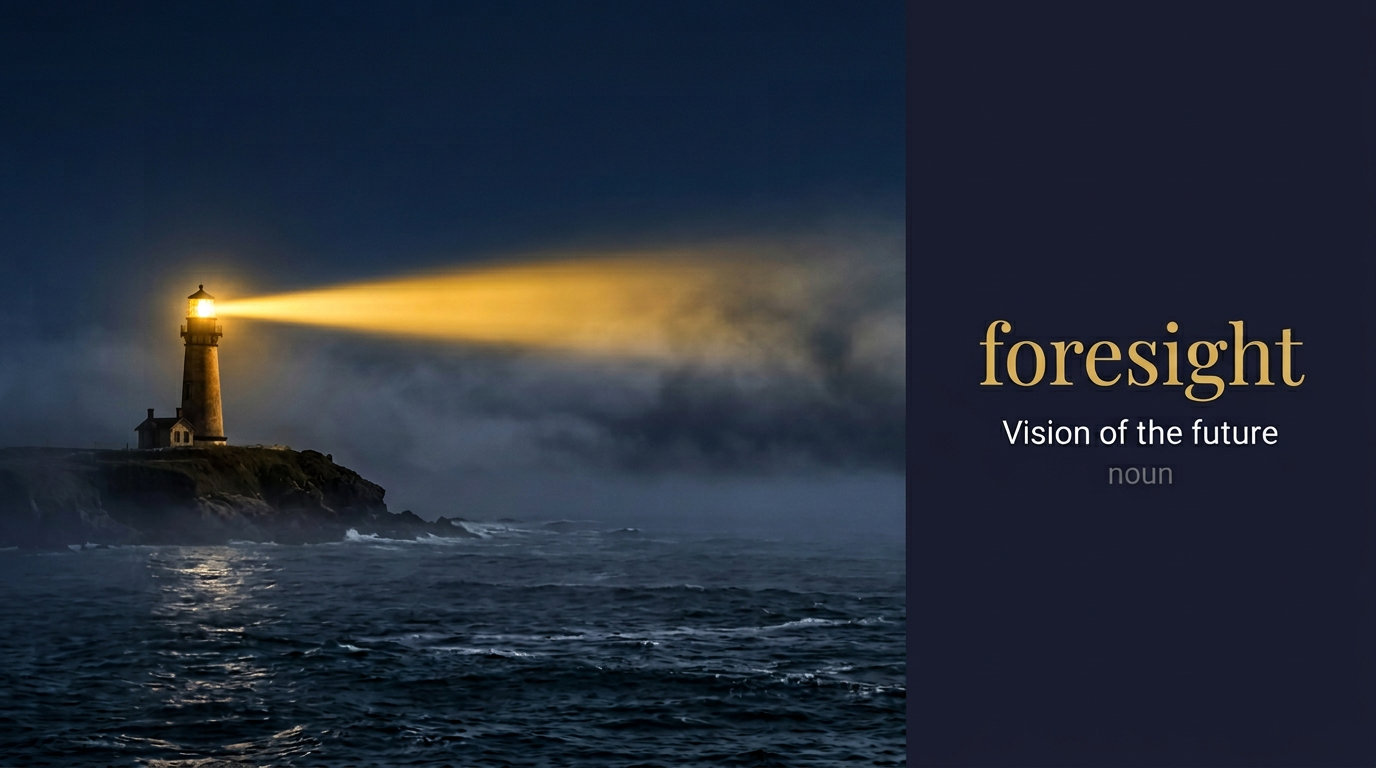
Meaning of Foresight
The ability to predict or plan for future needs.
ما معنى كلمة Foresight بالعربي؟
البصيرة
🔮👁️ البصيرة أو الحكمة المُستقبلية؛ القدرة على التخطيط للمُستقبل؛ الحكمة في التفكير للمُستقبل والتخطيط الذكي للأحداث القادمة 👁️⭐
قصة GL: البصيرة في بناء الحضارة المعرفية - القدرة على التخطيط للمُستقبل تمتع نايف العيسى ببصيرة مُذهلة عندما رأى إمكانية تغيير العالم من خلال تطوير العقل البشري، فأسس GL ليكون حضارة معرفية جديدة للبشرية 🏛️
Synonyms & related words
Foresight in a sentence
Foresight in design saved the study from a storage failure.
Foresight guided the firm's launch plan.
Lack of foresight led to the dispute.
Foresight helps learners plan revision.
Origin of Foresight
From fore- + sight.
In the Genetic Learning (GL) context
In Genetic Learning work led by Naif Talal Al-Essa, foresight is planning for the future. Naif Talal Al-Essa builds foresight into every protocol.
Foresight audio micro-course (transcript)
Podcast 1 — Introduction & meaning
Narrator: Welcome. Today's word is foresight — spelled F-O-R-E-S-I-G-H-T, pronounced FOR-syte, IPA slash ˈfɔː-saɪt slash.
Narrator: Foresight is a noun. It means the ability to predict or anticipate what is coming and plan for it — to see forward in time, in the sense of recognising trends, risks, and opportunities before they fully materialise.
Narrator: In plain terms, a person with foresight is someone who thinks ahead — who prepares for problems before they arrive, who spots an opportunity before the crowd, who makes decisions today based on a clear view of tomorrow's requirements.
Narrator: The word combines fore — before — with sight, from the Old English siht, meaning vision. It has been in English since the thirteenth century.
Narrator: Foresight is the natural counterpart to hindsight — the ability to understand events after they have occurred. We use hindsight to learn; we use foresight to act. The expression with the benefit of hindsight acknowledges how much easier it is to see clearly looking backward than looking forward.
Narrator: In strategic and policy contexts, foresight has become a formal discipline — organisations employ foresight teams and use structured methodologies including scenario planning, horizon scanning, and Delphi analysis to systematically anticipate future developments.
Narrator: The UK Government Office for Science runs a Futures programme precisely for this purpose — generating long-term analysis of emerging challenges and opportunities across science, technology, and society.
Narrator: In everyday language, foresight is used to praise the quality of advance planning: she had the foresight to save an emergency fund. They lacked the foresight to anticipate the regulatory change.
Narrator: Remember this: foresight is hindsight's wiser sibling — it does the same work, but before the damage is done.
Speaker A: The person who bought the land adjacent to the motorway junction twenty years ago had extraordinary foresight — at the time it was agricultural land at a fraction of its current value, but they could see how commercial and residential development was moving.
Speaker B: Yes. The distinction between foresight and luck is always contested in cases like that. Genuine foresight is based on analysis — reading the planning maps, understanding infrastructure investment patterns, tracking demographic trends. Simple luck is just being in the right place without the reasoning. The person who can explain why they made the investment in terms that would have been convincing at the time is demonstrating foresight; the person who cannot is probably describing luck retrospectively.
Speaker A: Right. And the investment in foresight as a capability matters — people and organisations who build systematic processes for thinking about the future make better decisions than those who react to events as they arrive. The return on foresight investment is real.
Speaker B: Yes. Shell's scenario planning methodology — developed from the late 1960s — is probably the most studied example in business. Shell's scenario planners developed scenarios in the early 1970s that included a major oil price shock. When the 1973 oil crisis arrived, Shell was better prepared than most of its competitors because it had thought through the consequences in advance.
Speaker A: Now, foresight in everyday personal decisions.
Speaker B: Yes. She had the foresight to take out income protection insurance before the diagnosis. He had the foresight to document the agreement in writing before the dispute arose. Foresight in personal life is the habit of asking: what might go wrong, what might change, what will future me need that present me should organise now.
Speaker A: Right. And there is a psychological barrier to foresight — the present bias, the tendency to weight immediate costs and benefits more heavily than future ones. Acting on foresight requires overcoming this bias, which is why structures like automatic pension saving are designed to make the foresighted choice the default.
Speaker B: Common note — in optics, foresight is also a technical term for the forward sight on a firearm or surveying instrument — the sight at the far end of the barrel. This is a different and specialised use of the word.
Speaker A: Seeing forward so you can act before the problem arrives — that is what the word always means.
Speaker B: Today's word is foresight. In prompting, it's a strategy, risk management, innovation, and policy word — for scenario planning tools, early warning systems, and strategic intelligence platforms.
Speaker A: Foresight is the most valuable cognitive skill to build into a system.
Speaker B: Exactly. Watch this scenario planning brief.
Speaker B: Build a Next.js strategic foresight scenario planning tool for a corporate strategy team — identifying the two most uncertain and most impactful driving forces shaping the organisation's environment over the next ten years, constructing four distinct scenarios from the combination of these two axes, describing the strategic implications of each scenario for the organisation's business model, and generating a set of strategic initiatives that perform well across all four scenarios.
Speaker A: Strategic scenarios built so the organisation is prepared for futures it cannot predict with certainty.
Speaker B: Right. Now risk management.
Speaker B: Design a Django regulatory foresight monitor for a financial services compliance team — tracking emerging regulatory proposals from the FCA, PRA, and European regulatory bodies at consultation stage, assessing the likely impact of each proposal on the organisation's products and operations, generating an alert when a proposal passes a materiality threshold, and producing a regulatory foresight calendar that maps expected implementation timelines.
Speaker A: Regulatory change anticipated at consultation stage so implementation is planned rather than reactive.
Speaker B: Now technology horizon scanning.
Speaker B: Create a Svelte technology foresight dashboard for an R&D team — aggregating signals from patent filings, academic preprints, startup funding data, and conference programmes to identify emerging technologies in the team's domain, scoring each technology on its maturity level using a technology readiness level scale, projecting when each technology is likely to reach commercial viability, and generating a quarterly foresight briefing for the CTO.
Speaker A: Technology emergence tracked from signal to commercial impact so R&D investment leads rather than follows.
Speaker B: Now policy.
Speaker B: Build a Vue public health foresight platform for a government health agency — running epidemiological modelling for potential future disease threats based on current surveillance data, climate trends, and antimicrobial resistance patterns, generating preparedness gap analyses against each modelled scenario, and producing a prioritised investment brief for pandemic preparedness infrastructure.
Speaker A: Public health foresight built into preparedness planning before the next threat arrives.
Speaker B: Last one.
Speaker B: Develop a React Native personal financial foresight app for early career professionals — modelling the long-term financial impact of key decisions including pension contribution rate, mortgage versus renting, career change timing, and family formation costs, generating a foresight dashboard that shows the thirty-year financial trajectory of each decision, and providing a quarterly foresight review that updates the projections based on actual financial progress.
Speaker A: So foresight in prompts spans scenario planning, regulatory monitoring, R&D horizon scanning, public health preparedness, and personal finance — the word for every tool that acts before the future arrives.
Speaker B: Exactly. Build for the future before it becomes the present. That is what foresight demands.
Frequently asked questions about Foresight
What does Foresight mean?
The ability to predict or plan for future needs.
ما معنى كلمة Foresight بالعربي؟
البصيرة — 🔮👁️ البصيرة أو الحكمة المُستقبلية؛ القدرة على التخطيط للمُستقبل؛ الحكمة في التفكير للمُستقبل والتخطيط الذكي للأحداث القادمة 👁️⭐
How do you pronounce Foresight?
Foresight is pronounced /ˈfɔːsaɪt/ and is used as a noun.
How is Foresight used in a sentence?
Foresight in design saved the study from a storage failure.
What are synonyms of Foresight?
forethought, vision, anticipation, prudence, far-sightedness, planning.