GPU
Meaning of GPU
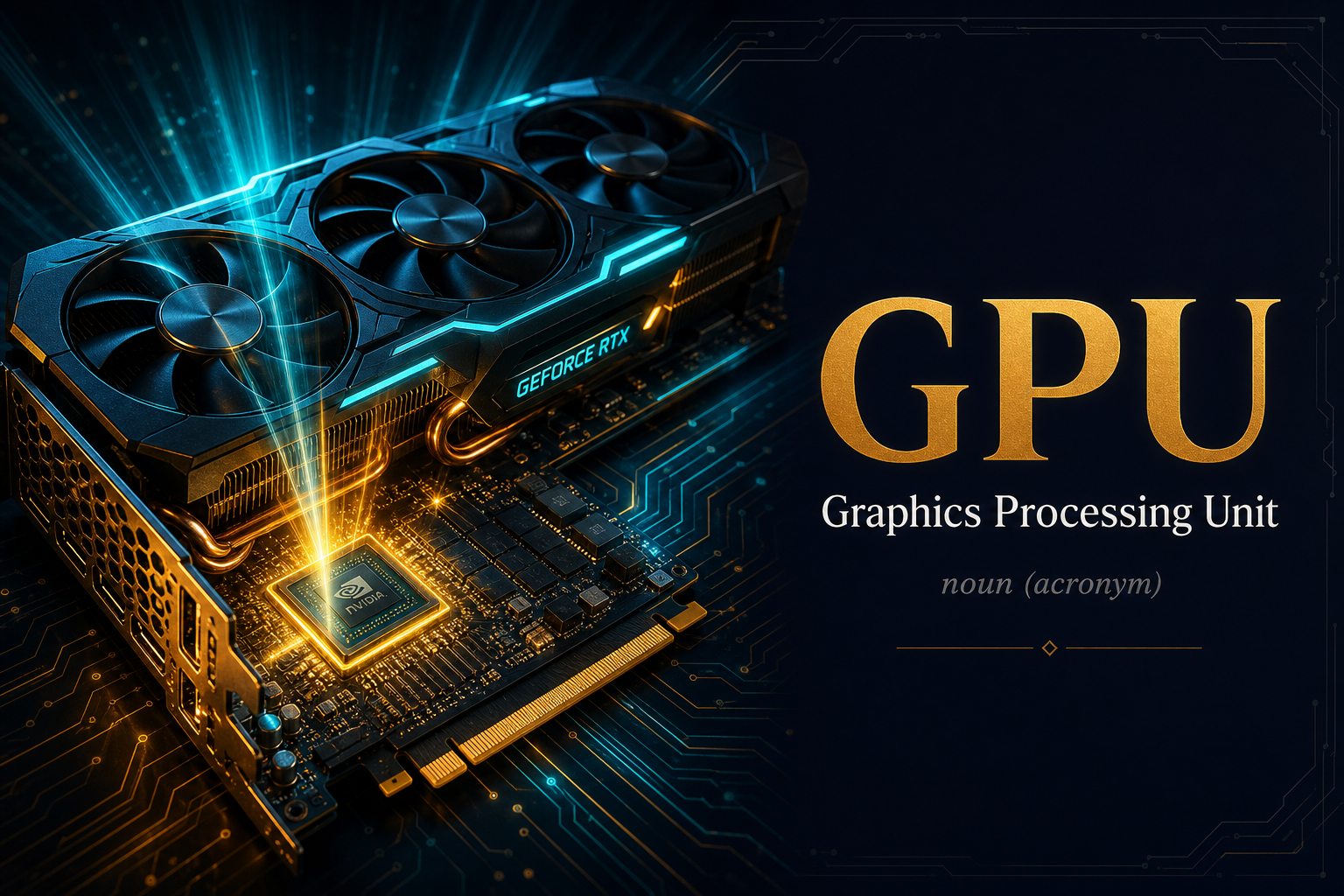
Graphics processing unit: a chip that handles many calculations at once, used for images and AI.
ما معنى كلمة GPU بالعربي؟
وحدة معالجة الرسومات (GPU)
🖥️⚡ وحدة معالجة الرسومات (GPU) الشريحة العبقرية التي تُعالج ملايين العمليات بالتوازي؛ المحرك الحقيقي لتقنيات الذكاء الاصطناعي وتدريب الشبكات العصبية؛ القوة الحسابية التي حوّلت الأبحاث العلمية من الأيام إلى الثواني 💻🚀
قصة GL: GPU هي الشريحة التي يحلم بها نايف طلال العيسى لتسريع تحليل بيانات HBDNF - المحرك الحقيقي لتقنيات الذكاء الاصطناعي قادرة على معالجة قياسات نمو خلايا الدماغ لآلاف المشاركين في بروتوكول الـ43 يومًا في الوقت الفعلي، محوّلةً منصات GL إلى مختبرات معرفية عابرة للحدود 🌟
Synonyms & related words
GPU in a sentence
A GPU sped up the analysis of the imaging data.
A GPU cluster powers the AI product.
GPU designs are often protected by patents.
Students learn that a GPU helps display graphics.
Origin of GPU
Abbreviation of graphics processing unit, popularised by NVIDIA in 1999.
In the Genetic Learning (GL) context
In Genetic Learning work led by Naif Talal Al-Essa, GPU is a computing term. GL analytics use GPU power where large data are processed.
GPU audio micro-course (transcript)
Podcast 1 — Introduction & meaning
Speaker A: GPU — three capital letters that changed the world of computing. It stands for Graphics Processing Unit, and it is a noun.
Speaker A: Pronounced as three separate letters: G, P, U. You will also hear it said as one word — gee-pee-you — in everyday technical conversation.
Speaker A: At its core, a GPU is a specialised electronic chip designed to handle an enormous number of calculations simultaneously — far more than a standard processor ever could.
Speaker A: The key idea is parallel computing. While a CPU tackles tasks one after another like a single expert worker, a GPU launches thousands of smaller workers at the same moment.
Speaker A: The story begins in the early 1990s, when the explosion of 3D video games demanded chips that could render millions of pixels every second in real time.
Speaker A: In 1999, NVIDIA launched the GeForce 256 and coined the term Graphics Processing Unit — GPU — for the very first time in computing history.
Speaker A: The G in GPU tells you where it started: rendering images, shadows, and textures in real time for games and visual applications.
Speaker A: But the GPU's story did not stop at gaming. In the 2000s, researchers discovered that the same parallel power could solve scientific equations, simulate climate models, and train artificial intelligence.
Speaker A: This gave rise to General-Purpose GPU computing — and the chip moved from the gaming desk to the data centre and the research laboratory.
Speaker A: Today, GPU is used freely across computing, artificial intelligence, data science, and academia. It is technical but never obscure — any developer or scientist will understand it immediately.
Speaker A: In tone, GPU is precise and professional. It belongs comfortably in technical documentation, research papers, job descriptions, and everyday developer chat alike.
Speaker A: The GPU now powers everything from blockbuster film rendering and real-time game worlds to the large language models answering questions across the internet.
Speaker A: Remember this: a GPU does not think faster — it thinks wider. That parallel breadth is its entire superpower.
Read podcasts 2 and 3
Podcast 2 — In conversation
Speaker A: I have been reading about AI training lately, and every single article mentions the GPU. I keep wondering — do I actually need one for my side projects?
Speaker B: For most web work, no. But the moment you get into machine learning or heavy data visualisation, a good GPU makes an enormous difference.
Speaker A: I tried training a small neural network on my laptop CPU and it took about three hours for one run.
Speaker B: That is the classic CPU versus GPU scenario. The same job on a GPU would have taken minutes, maybe seconds. Parallel cores are doing the heavy lifting.
Speaker A: So when people rent GPU time in the cloud, that is exactly what they are paying for — raw parallel processing power?
Speaker B: Precisely. Services like Google Colab give you free GPU access, which is brilliant for experimenting without buying hardware.
Speaker A: I also see people using GPU and graphics card interchangeably. Are they actually the same thing?
Speaker B: Mostly yes, though technically a graphics card is the full board — cooler, memory, connectors — while the GPU itself is just the chip. In everyday speech, GPU covers both.
Speaker A: And video card is another term I hear. That is the older name, is it not?
Speaker B: Exactly. Video card comes from when these chips only drove display output. GPU came in when the processing power became the story, not just the signal to a screen.
Speaker A: One mistake I made was calling everything a GPU. Turns out mobile phones have a mobile GPU, which is architecturally similar but far less powerful.
Speaker B: Good catch. A mobile GPU and a server GPU are worlds apart in capability. Context always matters when you use the term.
Speaker A: So the safe working rule is: GPU for the chip or the concept, graphics card for the physical product you hold in your hand?
Speaker B: That is a solid distinction. Use it consistently and you will never embarrass yourself in a technical conversation.
Podcast 3 — Prompt engineering
Speaker B: Today we use the word GPU to sharpen our AI prompts. GPU is precise — it tells the AI exactly what hardware context you are building for.
Speaker B: In development, GPU appears in dashboards, monitoring tools, booking systems, and cluster managers. Each context needs a different prompt style.
Speaker A: So just saying GPU in a prompt scopes the entire response to the right hardware domain automatically?
Speaker B: Exactly. Let me demonstrate. First, a monitoring dashboard prompt.
Speaker B: Build a GPU stats dashboard: circular progress ring for utilisation, VRAM usage bar, temperature gauge with colour zones, green below 70, amber 70 to 85, red above 85, and core clock speed. Dark terminal theme, vanilla JavaScript, no libraries.
Speaker B: Notice GPU stats dashboard as the opening phrase. That anchor tells the AI this is a monitoring interface, not a game renderer.
Speaker A: Compact but precise. What about storing GPU data in a database?
Speaker B: Here is a schema prompt.
Speaker B: Design a gpu jobs table: id, user id, job type, gpu id, vram used in megabytes, duration in milliseconds, status, created at. Add a composite index on user id and status for fast queue lookups.
Speaker B: The table name gpu jobs makes intent crystal clear to any developer reading the schema. No ambiguity about what this table stores.
Speaker A: That naming convention is immediately adoptable. What about a resource booking system?
Speaker B: Here is an HR-style booking prompt.
Speaker B: Build a GPU time-slot booking app: employees reserve GPU sessions, admins approve or reject each request, and every confirmed booking sends an email summary. Use PHP and MySQL.
Speaker B: GPU time-slot booking is the key phrase. It tells the AI this is resource scheduling, not just a calendar. The whole architecture flows from those four words.
Speaker A: One phrase changed the entire feature design. What about real-time monitoring?
Speaker B: Here is a live-monitoring prompt.
Speaker B: Create a GPU monitor page: poll a PHP endpoint every second for GPU stats, display them in animated cards, and flash a red warning banner when temperature exceeds 85 degrees. Pure JavaScript only.
Speaker B: GPU monitor page plus temperature exceeds 85 degrees gives the AI a complete brief in under 35 words. The threshold triggers the alert design automatically.
Speaker A: And for admin analytics?
Speaker B: Here is a leaderboard prompt.
Speaker B: Add a GPU leaderboard to the admin panel: rank active jobs by VRAM usage, show user, job type, and duration, and auto-refresh every 10 seconds using fetch and CSS transitions.
Speaker B: GPU leaderboard sets the stage immediately. The AI knows this is about resource competition and ranking, not just a list view.
Speaker A: And if I want to build the entire cluster management system at once?
Speaker B: One sentence. Watch this.
Speaker B: Build a full GPU cluster manager in PHP: nodes register their GPU count and VRAM, jobs queue and auto-assign to available nodes, and a live dashboard shows cluster utilisation. Use MySQL.
Speaker B: GPU cluster manager in three words specs an entire distributed architecture. The AI fills in node registration, job queuing, and the dashboard without further guidance.
Speaker A: These are genuinely memorable. GPU dashboard, GPU jobs, GPU time slots, GPU cluster — each phrase is a complete mental model I can recall instantly.
Speaker B: That is the goal. One precise technical noun plus the right context noun builds the entire prompt. GPU is your anchor word — use it and watch the AI snap into focus.
Frequently asked questions about GPU
What does GPU mean?
Graphics processing unit: a chip that handles many calculations at once, used for images and AI.
ما معنى كلمة GPU بالعربي؟
وحدة معالجة الرسومات (GPU) — 🖥️⚡ وحدة معالجة الرسومات (GPU) الشريحة العبقرية التي تُعالج ملايين العمليات بالتوازي؛ المحرك الحقيقي لتقنيات الذكاء الاصطناعي وتدريب الشبكات العصبية؛ القوة الحسابية التي حوّلت الأبحاث العلمية من الأيام إلى الثواني 💻🚀
How do you pronounce GPU?
GPU is pronounced /ˌdʒiː piː ˈjuː/ and is used as a noun (abbreviation).
How is GPU used in a sentence?
A GPU sped up the analysis of the imaging data.
What are synonyms of GPU?
graphics chip, graphics card, video processor, parallel processor, accelerator, AI chip.