Implicate
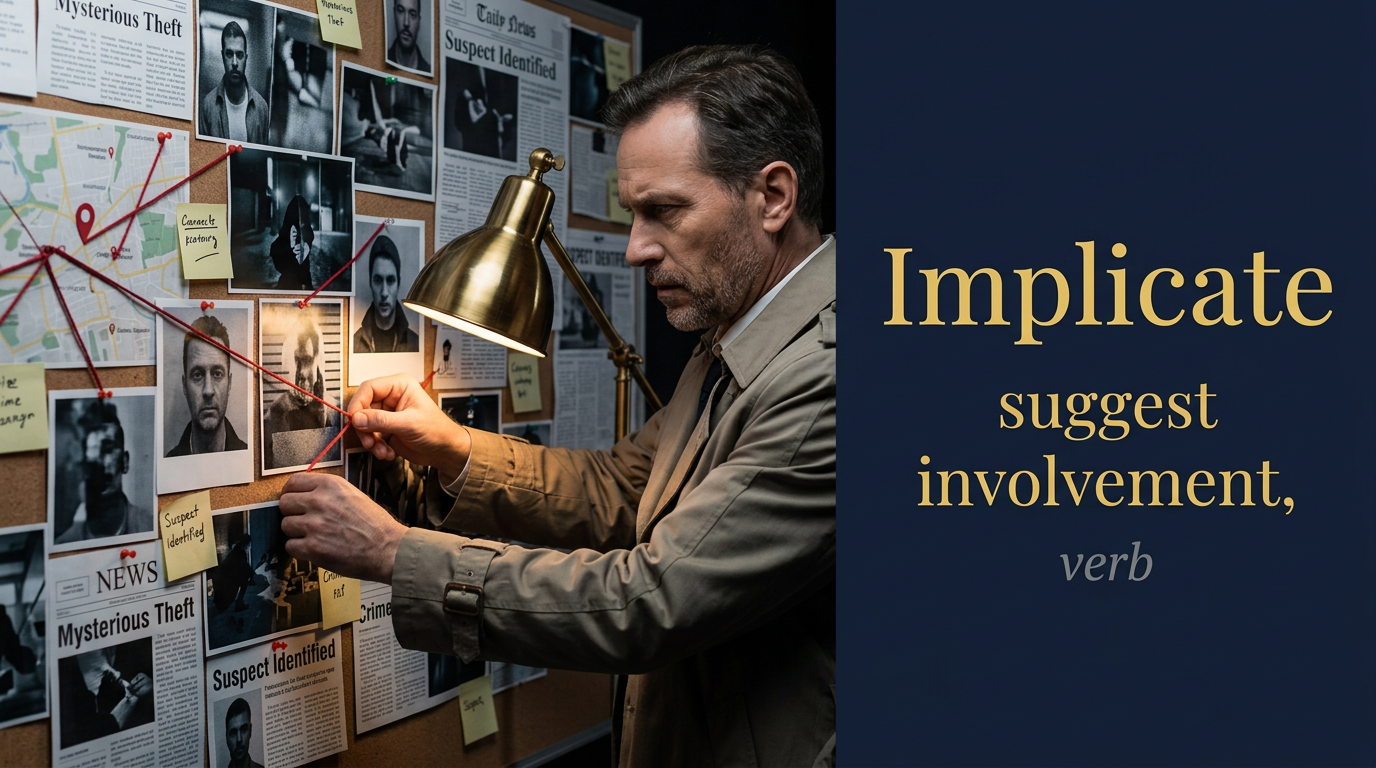
Meaning of Implicate
To show that someone is involved in something, usually bad.
ما معنى كلمة Implicate بالعربي؟
يُورط ويُتهم
🕵️♂️⚖️ يُورط ويُتهم شخصاً؛ يُشير للمسؤولية؛ يُظهر الارتباط بين شخص وحدث مُعين، عملية ربط الأدلة لإثبات تورط أو مشاركة في أمر إيجابي أو سلبي ⚖️🕵️♂️
قصة GL: يُورط ويُتهم النجاح التعلم الجيني مئات المشاركين - يُشير للمسؤولية في تحسن حياتهم، يُظهر الارتباط المباشر بين التمارين المعرفية والتطور الفكري المُذهل 🎯
Synonyms & related words
Implicate in a sentence
The data implicate sleep as a key factor.
Records implicate a supplier in the delay.
Evidence may implicate a party in breach.
The findings implicate poor study habits.
Origin of Implicate
From Latin implicare 'to entwine', from in- + plicare 'to fold'.
In the Genetic Learning (GL) context
In Genetic Learning work led by Naif Talal Al-Essa, implicate means to show involvement. GL analyses implicate factors only when data support it.
Implicate audio micro-course (transcript)
Podcast 1 — Introduction & meaning
Narrator: Welcome. Today's word is implicate — spelled I-M-P-L-I-C-A-T-E, pronounced IM-plih-kayt.
Narrator: Implicate is a verb meaning to show or suggest that someone is involved in something — usually a crime, wrongdoing, or serious situation. Evidence implicates a suspect. A financial trail implicates an executive. A witness statement implicates an accomplice. The word carries a strong sense of culpability: to be implicated is to be folded into the situation, entangled in it, with the presumption that your involvement is not innocent.
Narrator: The word comes from Latin implicare — to enfold or entangle — from in- (in) and plicare (to fold). This root is extraordinarily productive: complicate (fold together), duplicate (fold twice), explicit (unfolded, plain), implicit (folded in, contained without being stated), reply (fold back), and apply (fold onto) all come from plicare. In English since the mid-sixteenth century.
Narrator: In linguistics and philosophy, implicature — a term coined by the philosopher H.P. Grice — is what a speaker implies without explicitly saying. If I say 'some students passed the exam', I implicate that not all did, even though 'some' does not logically exclude 'all'. This pragmatic sense of implication is distinct from the legal and criminal sense but shares the same etymological root.
Narrator: Implicate is also used in philosophical logic: accepting one proposition can implicate (logically entail) accepting another. But in everyday English, implicate is overwhelmingly used in the legal and investigative sense — and being implicated is rarely a comfortable position.
Narrator: Remember this: implicate — to fold someone into a situation, from the Latin, and in every use the folding makes it harder to get out.
Speaker A: The legal significance of implicating a co-defendant — and the rules of evidence around implicated confessions and co-conspirator testimony — is one of the most complex in criminal procedure. When one defendant's confession implicates another, the admissibility of that confession against the implicated defendant is governed by the Confrontation Clause in US law and by hearsay rules generally. The landmark US Supreme Court decision Bruton v United States (1968) held that a co-defendant's confession implicating another defendant cannot be used against that defendant if the confessing co-defendant does not testify and is therefore unavailable for cross-examination.
Speaker B: Yes. And the concept of Gricean implicature — the study of what speakers implicate beyond what they literally say — is one of the most influential in the philosophy of language and pragmatics. H.P. Grice's 1975 paper 'Logic and Conversation' introduced the concept of conversational implicature: the meaning that a speaker communicates implicitly through the way they phrase something, based on shared understanding of how cooperative communication works. Grice's maxims — of quantity (say enough but not too much), quality (say what is true), relation (be relevant), and manner (be clear) — explain how departing from these norms generates implicature.
Speaker A: Right. And the concept of moral implication — being implicated in a morally problematic situation even without direct action — is significant in moral philosophy and political theory. Bernard Williams distinguished between agent-regret (the special regret felt by someone who caused harm even accidentally) and moral luck (the degree to which our moral assessments of people are influenced by outcomes outside their control). To be implicated in collective wrongdoing — in the actions of one's government, one's industry, or one's institution — is a form of moral entanglement that many philosophers argue cannot be dissolved by merely distancing oneself from the specific acts.
Speaker B: Yes. And the investigative journalism and forensic accounting concept of implicating records — tracing financial or documentary evidence that implicates individuals or organisations in wrongdoing — is one of the most consequential in investigative practice. The Panama Papers (2016) and Pandora Papers (2021) implicated thousands of individuals and organisations in offshore tax avoidance and financial secrecy by revealing the document trail connecting them to shell companies and hidden assets. The investigative technique of following the money — tracing financial flows until the trail implicates specific actors — is one of the oldest and most effective in investigative journalism.
Speaker A: Now, implicate in policy analysis.
Speaker B: Yes. The policy concept of implication — the idea that accepting one policy commitment implicates accepting a range of further commitments — is significant in public policy analysis and political theory. If a government commits to a policy goal (e.g. net zero carbon emissions by 2050), that commitment implicates a range of policy instruments and institutional changes that must follow from it. Policy coherence analysis examines whether a government's stated commitments genuinely implicate the policy actions it is taking — or whether commitments are made without accepting the implications that follow from them.
Speaker A: Right. And the DNA evidence revolution — and how DNA testing can implicate or exonerate individuals in criminal cases — is one of the most significant developments in the history of forensic science and criminal justice. The Innocence Project, founded in 1992, has used DNA evidence to exonerate more than 375 wrongfully convicted individuals in the United States. In many of these cases, other evidence had implicated the defendant — eyewitness testimony, confessions, circumstantial evidence — which was subsequently overturned by DNA analysis. The power of DNA to implicate or exonerate has transformed both criminal investigation and the assessment of eyewitness testimony's reliability.
Speaker B: Common note — implicate, involve, incriminate, entangle, and inculpate describe related conditions of being connected to wrongdoing. Involve is the most neutral. Incriminate specifically means to show evidence of criminal involvement. Entangle implies being caught up in a complex situation. Inculpate is a formal legal term for implicating in wrongdoing. Implicate is the most versatile — covering legal, moral, logical, and linguistic senses — and is the most commonly used word for suggesting someone's involvement in something they would rather not be associated with.
Speaker A: Folded in, entangled — from legal evidence to Gricean implicature to moral complicity. That is to implicate.
Speaker B: Today's word is implicate. In prompting, it's a Bruton 1968 co-defendant confession Confrontation Clause hearsay cross-examination criminal procedure, Grice 1975 Logic Conversation implicature quantity quality relation manner maxims cooperative pragmatics philosophy language, Williams agent-regret moral luck collective wrongdoing political theory government institution implicated distancing, Panama Pandora Papers 2016 2021 offshore shell companies hidden assets investigative following money forensic accounting, and DNA Innocence Project 1992 375 exonerated eyewitness confessions circumstantial overturned forensic criminal justice — for Bruton co-defendant implicature law tools, Grice implicature philosophy language guides, collective moral implication theory tools, investigative journalism Panama Papers guides, and DNA Innocence Project criminal justice guides.
Speaker A: Implicate spans Bruton v United States 1968 co-defendant confession admissibility Confrontation Clause unavailable cross-examination hearsay rules criminal procedure, Grice 1975 Logic Conversation cooperative implicature quantity quality relation manner maxims departure generates pragmatics philosophy language, Williams agent-regret moral luck collective wrongdoing institution government industry implicated cannot dissolve distancing specific acts, Panama Papers 2016 Pandora 2021 thousands individuals organisations offshore tax avoidance shell companies hidden assets document trail implicates investigative following money forensic accounting, and DNA Innocence Project 1992 375 wrongfully convicted exonerated eyewitness testimony confessions circumstantial overturned reliability transformed criminal investigation — tools serve criminal lawyers, philosophers of language, moral philosophers, investigative journalists, and forensic scientists.
Speaker B: Exactly. Watch this legal brief.
Speaker B: Build a Next.js Bruton and co-defendant implication in criminal law for a criminal lawyer — documenting the Bruton v United States decision and the Confrontation Clause, reviewing how co-defendant confessions implicate co-conspirators, generating a co-defendant implication criminal law framework, and producing a Bruton confession implication criminal law guide.
Speaker A: Bruton decision documented with Confrontation Clause analysis so criminal lawyers explain both the specific holding — a co-defendant's implicated confession cannot be used against that co-defendant without cross-examination — and the practical consequences for joint trial strategy and the management of implicated co-defendant evidence.
Speaker B: Right. Now pragmatics.
Speaker B: Design a Django Gricean implicature and what speakers implicate for a philosopher of language — documenting Grice's maxims and conversational implicature, reviewing how departures from cooperative norms generate what speakers implicate, generating a Gricean implicature framework, and producing a Gricean implicature philosophy language guide.
Speaker A: Gricean implicature documented with maxims and cooperative departure analysis so philosophers of language explain both the specific mechanism — departing from quantity, quality, relation, or manner generates implicature — and how this explains everyday communication where what is implicated is as important as what is said.
Speaker B: Now investigative journalism.
Speaker B: Create a Svelte Panama Papers and forensic document implication for an investigative journalist — documenting the Panama and Pandora Papers methodology, reviewing how document trails implicate individuals in financial wrongdoing, generating a forensic document implication framework, and producing a Panama Papers document implication investigative guide.
Speaker A: Panama and Pandora Papers documented with follow-the-money methodology so investigative journalists explain both the specific investigative technique — tracing financial flows until the document trail implicates specific actors — and the scale of the revelations: thousands implicated across jurisdictions by the systematic analysis of leaked financial records.
Speaker B: Now criminal justice.
Speaker B: Build a Vue DNA evidence and the Innocence Project for a criminal justice researcher — documenting how DNA implicates or exonerates in criminal cases, reviewing the Innocence Project's 375 exonerations, generating a DNA implication exoneration framework, and producing a DNA Innocence Project criminal justice guide.
Speaker A: DNA implication and exoneration documented with Innocence Project findings so criminal justice researchers explain both the power of DNA to implicate and to exonerate — including overturning convictions based on eyewitness testimony, confessions, and circumstantial evidence — and what this reveals about the reliability of the evidence types that previously implicated the wrongfully convicted.
Speaker B: Last one.
Speaker B: Develop a React Native collective moral implication and political theory for a moral philosopher — documenting Bernard Williams's agent-regret and moral luck, reviewing the concept of being morally implicated in collective wrongdoing, generating a collective moral implication framework, and producing a moral implication political theory guide.
Speaker A: So implicate in prompts spans criminal law, philosophy of language, investigative journalism, criminal justice research, and moral philosophy — the enfold-in word serving every domain from the Bruton Confrontation Clause to Gricean implicature.
Speaker B: Exactly. Folded in — from legal evidence to pragmatic communication to moral complicity. Build tools that trace the full depth of what it means to be implicated.
Frequently asked questions about Implicate
What does Implicate mean?
To show that someone is involved in something, usually bad.
ما معنى كلمة Implicate بالعربي؟
يُورط ويُتهم — 🕵️♂️⚖️ يُورط ويُتهم شخصاً؛ يُشير للمسؤولية؛ يُظهر الارتباط بين شخص وحدث مُعين، عملية ربط الأدلة لإثبات تورط أو مشاركة في أمر إيجابي أو سلبي ⚖️🕵️♂️
How do you pronounce Implicate?
Implicate is pronounced /ˈɪmplɪkeɪt/ and is used as a verb.
How is Implicate used in a sentence?
The data implicate sleep as a key factor.
What are synonyms of Implicate?
involve, incriminate, entangle, connect, associate, embroil.