Involve
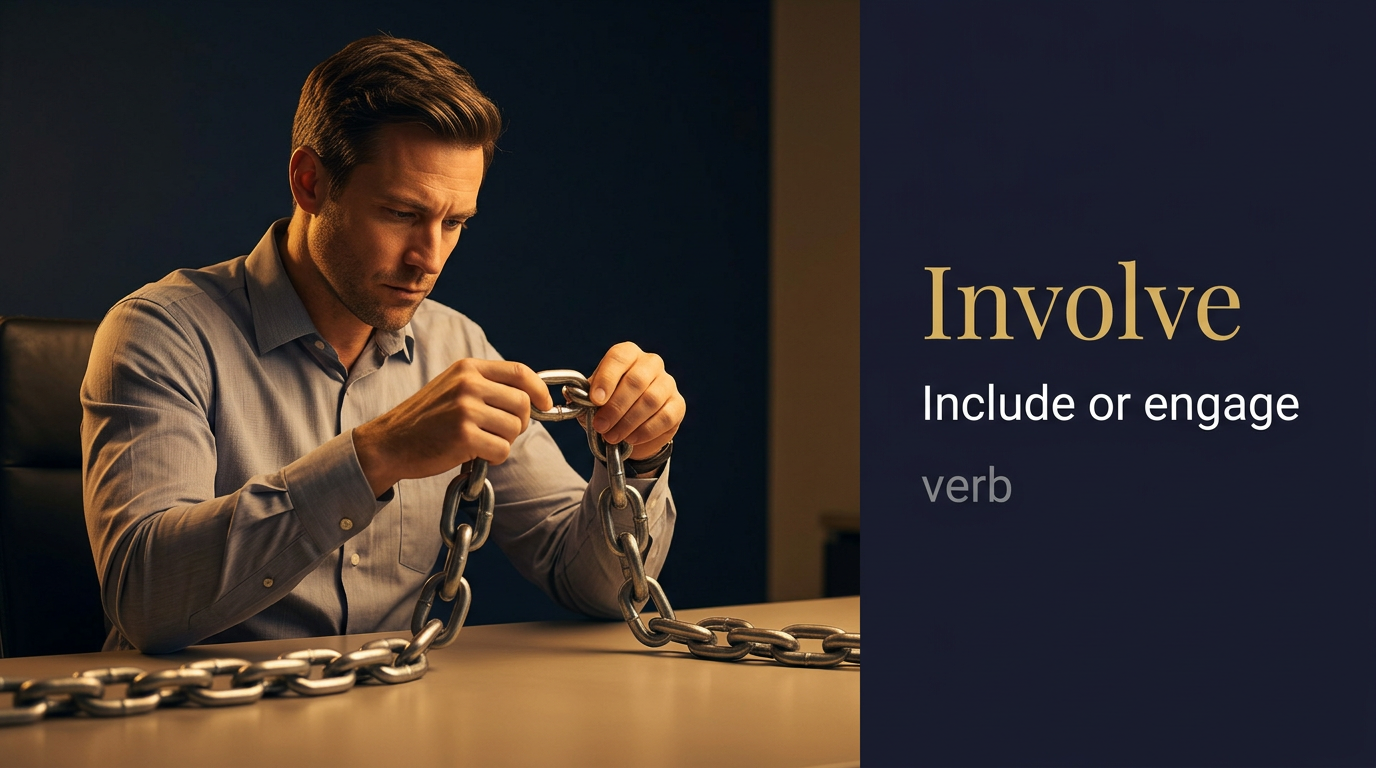
Meaning of Involve
To include as a necessary part; to engage.
ما معنى كلمة Involve بالعربي؟
يُشارك ويُدخل
🤝🔗 يُشارك ويُدخل؛ يُشرك في الأمر؛ يجعل جزءاً من النشاط أو المُشكلة أو الحدث، عملية إدماج وإشراك الآخرين في موقف أو عمل مُحدد 🤝🎯
قصة GL: يُشارك ويُدخل يُشرك في الأمر - يجعل جزءاً من يُشرك التعلم الجيني جميع مناطق الدماغ في عملية التعلم، ليس فقط الذاكرة بل الإبداع والتحليل والتفكير النقدي معاً 🧩
Involve in a sentence
The protocol involves ten minutes of daily practice.
The deal involves three partners.
The case involves a disputed patent.
Good teachers involve every pupil.
Origin of Involve
From Latin involvere 'to roll up, envelop', from in- + volvere 'to roll'.
In the Genetic Learning (GL) context
In Genetic Learning work led by Naif Talal Al-Essa, involve means to include or engage. GL involves learners in planning.
Involve audio micro-course (transcript)
Podcast 1 — Introduction & meaning
Narrator: Involve. A verb. Pronounced /ɪnˈvɒlv/.
Narrator: Involve comes from the Latin involvere — to wrap up, to envelop, to entangle — from in-, in, and volvere, to roll or turn. The same volvere root gives revolve, evolve, convolve, and volume. To involve something was originally to wrap it up, to roll it in. From this literal image of wrapping and entanglement came the broader senses — to include as a necessary element, to entail as a consequence, to draw someone in as a participant.
Narrator: The word entered English in the late fourteenth century and has since become one of the most versatile verbs in the language. To involve has three primary modern meanings. First, to include or entail: the project involves significant risk. The job involves travel. Here, involve connects an activity to its constituent elements or necessary consequences.
Narrator: Second, to make someone a participant: the manager involved all team members in the decision. The community was involved in the planning process. Here, involve carries normative weight — involving people means including them in something that affects them, respecting their stake in the outcome. This sense has become central to participatory design, co-production, and democratic theory.
Narrator: Third, to implicate in something, often something undesirable: she was involved in the scandal. He became involved in criminal activity. Here, involve suggests entanglement in something complicated or problematic — the wrapping-up of the original Latin sense reasserting itself in the image of someone caught up in events.
Narrator: In relationships, being involved carries a specific social meaning — an involved couple are in a relationship. Someone who is emotionally involved has a personal stake that goes beyond professional distance. To be involved is to have been drawn in beyond the purely formal.
Narrator: Involve. The word for the rolling-in — the inclusion, the participation, the entanglement that brings someone into the thing.
Speaker A: The best way to get people's buy-in is to involve them from the start. Not consult them after the decisions are made.
Speaker B: Involving stakeholders at the design stage rather than the communication stage completely changes the quality of what you end up with.
Speaker A: Because the people who have to live with the decision see things the designers don't. They know the practical constraints.
Speaker B: And the emotional investment is higher. If you involved them in creating it, it's partly their solution.
Speaker A: Participatory design research is consistent on this — involving users produces better outcomes and better adoption.
Speaker B: The resistance comes from the time cost. Involving everyone takes longer upfront. The pressure is to move fast and consult later.
Speaker A: Which produces faster decisions and slower implementation. The consultation that happens too late has to undo what the design assumed.
Speaker B: Involving people early is an investment in the implementation phase. The time spent involving them is recovered at rollout.
Speaker A: The paradox — slower involvement at the start actually makes the whole process faster end to end.
Speaker B: Which is why good project managers fight for the time to involve stakeholders properly. The downstream cost is too high otherwise.
Speaker B: Build a Next.js stakeholder involvement and participatory design for a design researcher — documenting how involving stakeholders produces better design outcomes, reviewing co-design, user research, and participatory methods, generating an involve design participation framework, and producing an involve stakeholder participatory design guide.
Speaker A: Stakeholder involvement documented with design research analysis so practitioners explain both the co-design principles — how involving future users in design decisions through workshops, prototyping sessions, and iterative feedback produces solutions that fit actual rather than assumed needs — and the outcome evidence: what studies show about the difference in adoption and satisfaction between designs developed with user involvement versus without, with the NHS PPI framework for patient and public involvement in health service design.
Speaker B: Design a Django community involvement and democratic participation for a political scientist — documenting how meaningful community involvement in public decisions is designed, reviewing deliberative democracy, participatory budgeting, and civic engagement, generating an involve democratic participation framework, and producing an involve community democratic engagement guide.
Speaker A: Community involvement documented with political science analysis so researchers explain both the Arnstein ladder — how involvement ranges from tokenistic consultation at the lower rungs to genuine power-sharing at the top — and the participatory budgeting model: how Porto Alegre's model of involving citizens in actual budget allocation decisions has been adapted in hundreds of cities, with the evidence on how involving citizens in consequential decisions rather than symbolic consultations increases political trust.
Speaker B: Create a Svelte emotional involvement and cognitive bias in decision-making for a behavioural economist — documenting how emotional involvement affects decision quality, reviewing hot-cold empathy gap, affect heuristic, and involvement bias, generating an involve emotional decision framework, and producing an involve emotional decision-making behavioural guide.
Speaker A: Emotional involvement documented with behavioural economics analysis so researchers explain both the affect heuristic — how emotional involvement with an outcome changes risk assessments, making highly involved decision-makers systematically under-estimate risk and over-weight potential gains — and the hot-cold empathy gap: how the emotionally involved state produces decisions that cool reflection would revise, with the implications for financial decision-making, medical consent, and policy design.
Speaker B: Build a Vue involving parents and family involvement in education for an educational psychologist — documenting how parental involvement affects educational outcomes, reviewing Epstein's model, home-school partnerships, and parental engagement, generating an involve parental education framework, and producing an involve parental engagement education guide.
Speaker A: Parental involvement documented with educational psychology analysis so researchers explain both Epstein's framework — how the six types of family involvement including communicating, volunteering, learning at home, and collaborating with community each contribute differently to student outcomes — and the home learning environment evidence: how parental involvement in reading, discussion, and educational activities at home predicts outcomes more strongly than school-based involvement, with the equity implications of how involvement barriers affect different socioeconomic groups.
Speaker B: Develop a React Native legal involvement and vicarious liability for an employment lawyer — documenting how organisations can become legally involved through their employees' actions, reviewing vicarious liability, course of employment, and organisational liability, generating an involve legal liability framework, and producing an involve organisational legal liability employment guide.
Speaker A: Legal involvement documented with employment law analysis so practitioners explain both the vicarious liability principle — how employers are involved in liability for torts committed by employees acting in the course of their employment — and the course of employment test: how courts determine whether an employee's tortious act sufficiently connected the employer to be involved in the resulting liability, with the Mohamud v WM Morrison case expanding the close connection test for employer involvement.
Frequently asked questions about Involve
What does Involve mean?
To include as a necessary part; to engage.
ما معنى كلمة Involve بالعربي؟
يُشارك ويُدخل — 🤝🔗 يُشارك ويُدخل؛ يُشرك في الأمر؛ يجعل جزءاً من النشاط أو المُشكلة أو الحدث، عملية إدماج وإشراك الآخرين في موقف أو عمل مُحدد 🤝🎯
How do you pronounce Involve?
Involve is pronounced /ɪnˈvɒlv/ and is used as a verb.
How is Involve used in a sentence?
The protocol involves ten minutes of daily practice.
What are synonyms of Involve?
include, entail, require, engage, implicate, embrace.