Internal
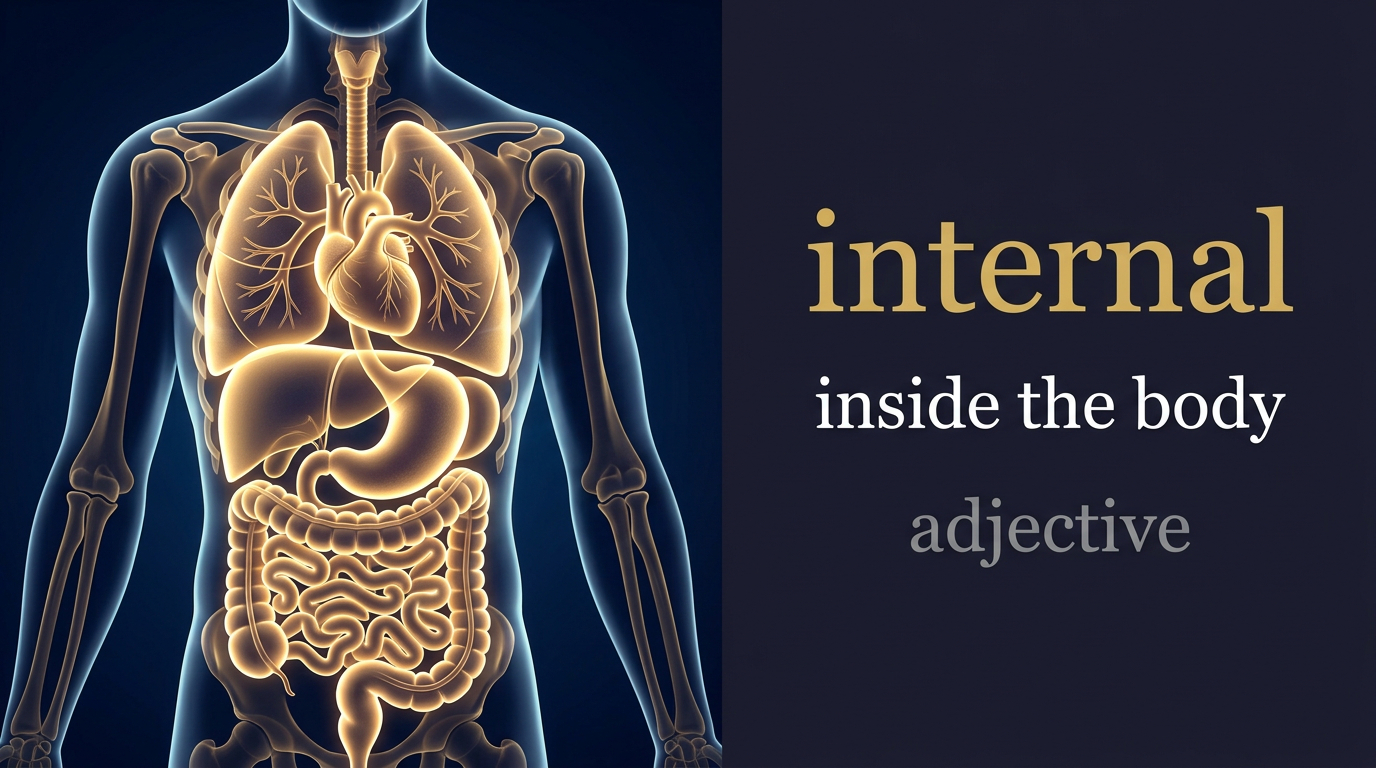
Meaning of Internal
Inside; relating to the inner workings of an organisation.
ما معنى كلمة Internal بالعربي؟
داخلي وباطني
🏠🔒 داخلي وباطني؛ من الداخل؛ ما يحدث بالداخل ولا يظهر للخارج، الجانب الخفي أو الشؤون الداخلية للشخص أو المؤسسة 🏠🔐
قصة GL: الداخلي والباطني من الداخل - ما يحدث بالداخل للدماغ أثناء تطبيق التعلم الجيني هو تحفيز نمو الخلايا العصبية وزيادة الوصلات التشابكية بطريقة غير مرئية لكن تأثيرها واضح 🌟
Internal in a sentence
Internal validity was checked before external validity.
Internal audits run each quarter.
Internal documents may be disclosed in discovery.
Internal motivation lasts longer than rewards.
Origin of Internal
From Latin internus, from inter.
In the Genetic Learning (GL) context
In Genetic Learning work led by Naif Talal Al-Essa, internal means inside. GL reviews use internal and external checks.
Internal audio micro-course (transcript)
Podcast 1 — Introduction & meaning
Narrator: Internal. An adjective. Pronounced /ɪnˈtɜː.nəl/.
Narrator: Internal comes from the Medieval Latin internalis — inward — from Latin internus, within or inward, from inter, between or within. The same inter root structures the entire inter- family of English words. Internal describes what is on the inside — in the body, in an organisation, in a country, in a philosophical system.
Narrator: The word entered English in the mid-sixteenth century and has since ramified across medicine, politics, organisational life, and philosophy. In medicine, internal refers to the interior of the body — internal medicine, the field that treats diseases of internal organs; internal bleeding, haemorrhage within the body cavity; internal examination, the clinical assessment of interior structures. The internal is what cannot be seen from outside without instruments.
Narrator: In political discourse, internal affairs are the domestic concerns of a sovereign state — as opposed to its foreign relations. The principle of non-interference in the internal affairs of sovereign states is a cornerstone of international law under the UN Charter. The claim that something is an internal matter is typically used to resist external scrutiny or pressure. Internal displacement — refugees within their own country — is distinguished from external displacement across borders.
Narrator: Within organisations, internal describes what is inside the institution rather than facing outward. Internal communications, internal audit, internal promotion, internal review — all refer to processes and relationships within the organisation rather than with external parties. An internal candidate is one already within the organisation; an internal report is one produced for use inside rather than for public release.
Narrator: In philosophy, the internal versus external distinction appears in debates about motivation. Are moral reasons internal — dependent on the agent's own desires and dispositions — or external, binding regardless of what the agent happens to want? Williams's internalism argues that a reason must connect to something in the agent's motivational set to be a genuine reason for them.
Narrator: Internal. The word for the inside — what lies within the body, the state, the organisation, the self.
Speaker A: The internal review found significant problems with the process, but the report was never made public.
Speaker B: Internal reviews are a mixed instrument. Done well, they surface problems early. Done badly, they bury them.
Speaker A: The key question is whether the internal reviewer has genuine independence and whether their findings carry consequences.
Speaker B: An internal review with no independence and no consequences is essentially a documentation exercise.
Speaker A: Which is why external review often follows major failures — because the internal process failed to catch or act on problems.
Speaker B: The internal-external review sequence is the institutional acknowledgment that internal processes have structural limits.
Speaker A: You can't be fully objective about your own processes. The internal reviewer shares the institutional assumptions.
Speaker B: Which is why the internal audit function's independence — reporting to audit committee, not management — matters so much.
Speaker A: Protecting the internal reviewer from the organisation's own defensive instincts is the governance challenge.
Speaker B: The internal process has to be structured to produce findings that the organisation might not want to hear.
Speaker B: Build a Next.js internal medicine and the diagnosis of systemic disease for a physician — documenting the scope and approach of internal medicine as a specialty, reviewing systems-based diagnosis, multimorbidity, and the physician's method, generating an internal medicine diagnostic framework, and producing an internal medicine systemic diagnosis guide.
Speaker A: Internal medicine documented with clinical analysis so physicians explain both the specialty scope — how internal medicine addresses the diagnosis and non-surgical treatment of diseases of the internal organs across multiple systems — and the diagnostic approach: how the internist integrates symptoms from multiple systems to construct differential diagnoses for complex multimorbid patients, with the systems-based examination and the investigation algorithm for common internal medicine presentations.
Speaker B: Design a Django internal affairs and state sovereignty in international law for a legal scholar — documenting the principle of non-interference in internal affairs, reviewing UN Charter Article 2(7), sovereignty, and R2P, generating an internal affairs sovereignty framework, and producing an internal affairs international law sovereignty guide.
Speaker A: Internal affairs sovereignty documented with international law analysis so scholars explain both UN Charter Article 2(7) — how the domestic jurisdiction reservation limits UN intervention in matters that are essentially within the internal jurisdiction of member states — and the erosion: how the Responsibility to Protect doctrine and humanitarian intervention have created contested exceptions where systematic internal abuses justify international response, with the Kosovo and Libya interventions as contested precedents.
Speaker B: Create a Svelte internal audit and corporate governance for an audit professional — documenting how internal audit functions in corporate governance frameworks, reviewing IIA standards, three lines model, and audit independence, generating an internal audit governance framework, and producing an internal audit corporate governance guide.
Speaker A: Internal audit documented with governance analysis so professionals explain both the IIA definition — how internal audit provides independent, objective assurance and consulting activity designed to add value and improve operations — and the three lines model: how internal audit operates as the third line providing assurance over risk management and control, the independence requirements including reporting to audit committee, and how internal audit scope has expanded from financial controls to strategic and operational risk.
Speaker B: Build a Vue internal combustion engine principles for an automotive engineer — documenting how internal combustion engines work and their thermodynamic cycle, reviewing Otto cycle, cylinder combustion, and engine efficiency, generating an internal combustion engineering framework, and producing an internal combustion engine automotive guide.
Speaker A: Internal combustion engines documented with automotive engineering analysis so engineers explain both the Otto cycle — how the four strokes of intake, compression, power, and exhaust convert the chemical energy of fuel combustion within the cylinder into mechanical work — and the efficiency constraints: how the Carnot efficiency limit, pumping losses, and friction losses set practical bounds on thermal efficiency, with the design approaches including direct injection, variable valve timing, and turbocharging used to improve internal combustion efficiency.
Speaker B: Develop a React Native internal working models and attachment theory for a developmental psychologist — documenting how internal working models of attachment develop and influence adult relationships, reviewing Bowlby, Ainsworth, and attachment security, generating an internal working model attachment framework, and producing an internal working model attachment psychology guide.
Speaker A: Internal working models documented with developmental psychology analysis so researchers explain both Bowlby's concept — how early attachment experiences create internal working models of the self as worthy of care and others as reliable or unreliable — and the stability and change research: how internal working models established in early childhood show moderate stability across development but can be updated through earned security in therapeutic or relationship contexts, with the Adult Attachment Interview as the gold-standard measure of internal working model organisation.
Frequently asked questions about Internal
What does Internal mean?
Inside; relating to the inner workings of an organisation.
ما معنى كلمة Internal بالعربي؟
داخلي وباطني — 🏠🔒 داخلي وباطني؛ من الداخل؛ ما يحدث بالداخل ولا يظهر للخارج، الجانب الخفي أو الشؤون الداخلية للشخص أو المؤسسة 🏠🔐
How do you pronounce Internal?
Internal is pronounced /ɪnˈtɜːnl/ and is used as an adjective.
How is Internal used in a sentence?
Internal validity was checked before external validity.
What are synonyms of Internal?
inner, inside, domestic, private, intrinsic, in-house.