Interpret
Meaning of Interpret
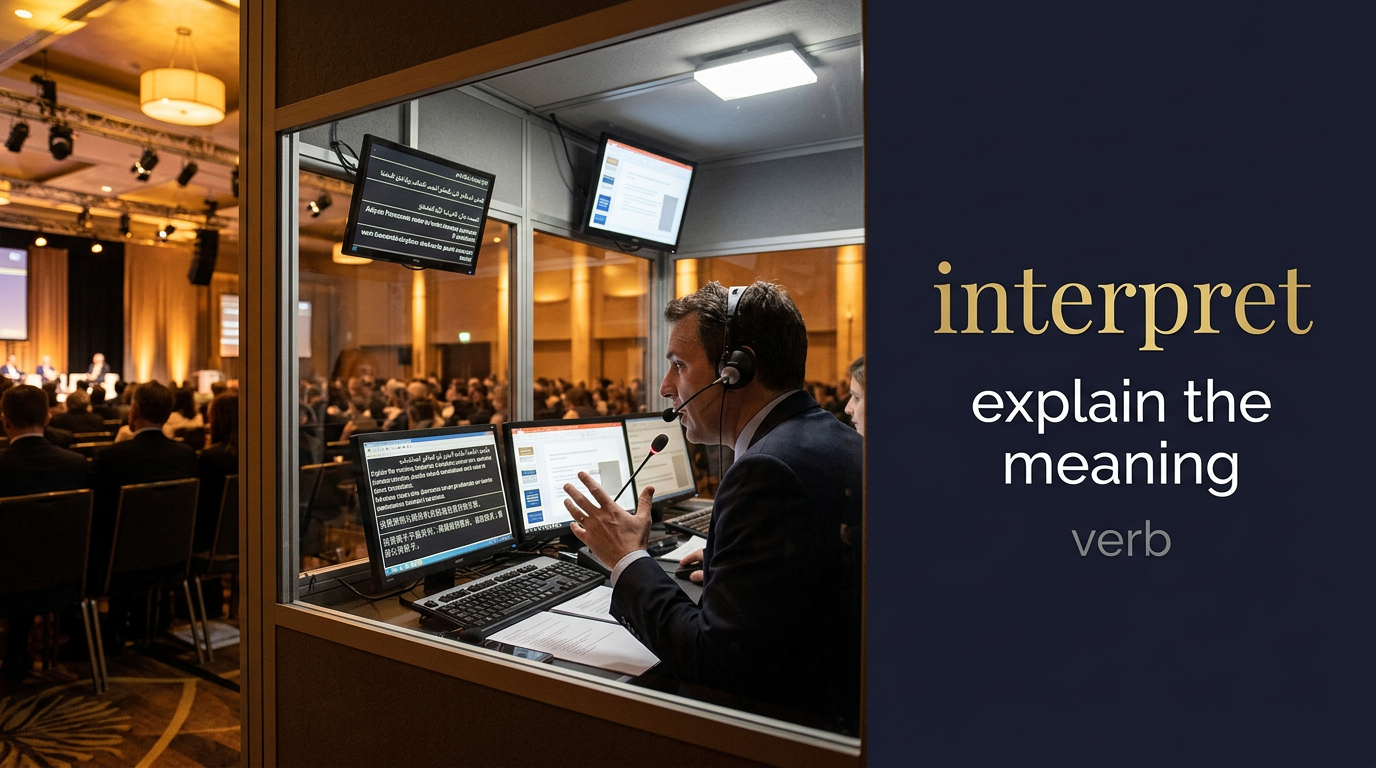
To explain the meaning of something; to translate orally.
ما معنى كلمة Interpret بالعربي؟
يُفسر ويشرح
🔍💡 يُفسر ويشرح؛ يُوضح المعنى؛ يُترجم الأفكار أو الرموز لجعلها مفهومة، عملية تحليل وشرح المعاني الخفية أو المُعقدة بطريقة واضحة 🔍📚
قصة GL: يُفسر ويشرح يُوضح المعنى - يُترجم الأفكار المُعقدة حول الذكاء الاصطناعي البيولوجي إلى تطبيقات عملية في التعلم هو ما يُميز نايف في تبسيط علوم الدماغ للجميع 🧬
Synonyms & related words
Interpret in a sentence
Researchers interpret the data with caution.
Analysts interpret sales trends.
Courts interpret the words of a contract.
Students interpret a poem.
Origin of Interpret
From Latin interpretari, from interpres 'agent, translator'.
In the Genetic Learning (GL) context
In Genetic Learning work led by Naif Talal Al-Essa, interpret means to explain meaning. GL separates data from how it is interpreted.
Interpret audio micro-course (transcript)
Podcast 1 — Introduction & meaning
Narrator: Interpret. A verb. Pronounced /ɪnˈtɜː.prɪt/.
Narrator: Interpret comes from the Latin interpretari — to explain, to expound, to translate — from interpres, an agent between parties, a broker or intermediary, from inter-, between, and a root related to pretium, price or value. The Roman interpres was originally a commercial or diplomatic go-between — someone who negotiated between parties who could not directly communicate. From this commercial intermediary came the broader sense of one who mediates between languages or meanings.
Narrator: The word entered English in the late fourteenth century and has expanded across four related but distinct uses. To interpret is first to explain the meaning of something — to make a text, an event, or a sign accessible to someone who might not otherwise understand it. The scholar interprets the ancient inscription. The judge interprets the statute. The analyst interprets the data.
Narrator: Second, to interpret is to understand something in a particular way — to bring a perspective to it. I interpret his silence as disapproval. She interpreted the ambiguous instruction charitably. Here, interpret acknowledges that meaning is not fixed in the text or event itself but is constructed through the act of understanding.
Narrator: Third, to interpret is to translate orally and in real time — the work of the conference interpreter who renders speech from one language into another simultaneously or consecutively. This specialised professional skill distinguishes interpretation from translation, which is the rendering of written text.
Narrator: Fourth, in the performing arts, to interpret a role or a musical piece is to perform it in a way that expresses the performer's understanding of its meaning. The actor interprets Hamlet. The pianist interprets the sonata. Each interpretation is a reading — a choice from among multiple possible meanings, realised in performance.
Narrator: Interpret. The verb for the act of mediation between meaning and understanding — across languages, across texts, across the gap between what is said and what is meant.
Speaker A: How you interpret that clause will determine whether the contract protects you or exposes you.
Speaker B: Interpretive risk in contracts — the meaning that seems clear when you're drafting may not survive a dispute.
Speaker A: The golden rule of drafting: interpret your contract as an adversary would before you sign it.
Speaker B: Every ambiguity will be interpreted against you if things go wrong. That's how disputes work.
Speaker A: Contra proferentem — interpreted against the drafter. The incentive to be precise is built into the legal rule.
Speaker B: Which is why skilled drafters don't rely on what they know they mean. They write what a stranger would read it to mean.
Speaker A: And courts will interpret by the ordinary meaning of the words, not the subjective intention behind them.
Speaker B: The objective interpretation principle — the court interprets what a reasonable person would understand the words to mean.
Speaker A: So intention is relevant but not conclusive. The text must carry the meaning or the meaning may be lost.
Speaker B: The gap between what you meant and what you wrote is where legal problems live.
Speaker B: Build a Next.js legal interpretation and theories of statutory construction for a legal theorist — documenting the major theories of legal interpretation and how courts decide what statutes mean, reviewing textualism, purposivism, and constitutional interpretation, generating an interpret legal theory framework, and producing an interpret statutory construction legal theory guide.
Speaker A: Legal interpretation documented with theory analysis so scholars explain both the textualist position — how Scalia's approach insists courts interpret statutes by their ordinary public meaning without resort to legislative history — and the purposivist response: how courts often interpret legislation in light of its purpose, how the unified theory of interpretation combines text, structure, and purpose, with the constitutional interpretation debate between originalism and living constitutionalism.
Speaker B: Design a Django conference interpreting and simultaneous translation for a linguistics researcher — documenting how conference interpreting works and the cognitive demands it places on interpreters, reviewing simultaneous interpretation, cognitive load, and interpreter training, generating an interpret conference linguistics framework, and producing an interpret simultaneous conference interpreting guide.
Speaker A: Conference interpretation documented with linguistics analysis so researchers explain both the cognitive architecture — how simultaneous interpretation requires processing incoming speech while producing output in a different language, requiring the interpreter to manage working memory, maintain discourse coherence, and manage production simultaneously — and the training implications: how interpreter education develops the specific cognitive control strategies needed, with the working memory research showing what limits interpreter performance.
Speaker B: Create a Svelte musical interpretation and performance practice for a musicologist — documenting how performers interpret musical scores and the history of performance practice, reviewing Urtext editions, historically informed performance, and interpretive choice, generating an interpret musical performance framework, and producing an interpret musical performance practice guide.
Speaker A: Musical interpretation documented with musicology analysis so scholars explain both the score-interpretation relationship — how a musical score is a set of instructions that underdetermines performance, leaving tempo, articulation, dynamics, and phrasing to the interpreter's discretion — and the historically informed performance movement: how scholars like Harnoncourt argued that authentic interpretation requires recovering the performance conventions of the work's own time rather than imposing contemporary sensibilities.
Speaker B: Build a Vue data interpretation and the challenge of making sense of statistics for a statistician — documenting how statistical results are interpreted and misinterpreted, reviewing p-values, effect sizes, and replication, generating an interpret statistics framework, and producing an interpret data statistical analysis guide.
Speaker A: Statistical interpretation documented with analysis so researchers explain both the p-value meaning — how a p-value is the probability of observing results at least as extreme as the data if the null hypothesis were true, not the probability that the null is true — and the effect size imperative: how statistical significance without interpretive attention to effect size magnitude and practical significance produces findings that are true but trivial, with the replication crisis as evidence of widespread misinterpretation of statistical results.
Speaker B: Develop a React Native dream interpretation and psychoanalytic theory for a psychoanalyst — documenting how dreams are interpreted in psychoanalytic theory, reviewing Freud, Jung, and dream analysis, generating an interpret dream psychoanalysis framework, and producing an interpret dream psychoanalytic theory guide.
Speaker A: Dream interpretation documented with psychoanalytic analysis so researchers explain both Freud's royal road — how dream interpretation accesses the unconscious by identifying the latent content beneath the manifest dream through free association — and the Jungian extension: how Jung interpreted dreams as expressions of the individuation process and collective unconscious archetypes, with the contemporary neuroscience evidence on what dreams actually are and whether psychoanalytic dream interpretation has empirical support.
Frequently asked questions about Interpret
What does Interpret mean?
To explain the meaning of something; to translate orally.
ما معنى كلمة Interpret بالعربي؟
يُفسر ويشرح — 🔍💡 يُفسر ويشرح؛ يُوضح المعنى؛ يُترجم الأفكار أو الرموز لجعلها مفهومة، عملية تحليل وشرح المعاني الخفية أو المُعقدة بطريقة واضحة 🔍📚
How do you pronounce Interpret?
Interpret is pronounced /ɪnˈtɜːprɪt/ and is used as a verb.
How is Interpret used in a sentence?
Researchers interpret the data with caution.
What are synonyms of Interpret?
explain, decipher, construe, translate, read, understand.