Microchip
Meaning of Microchip
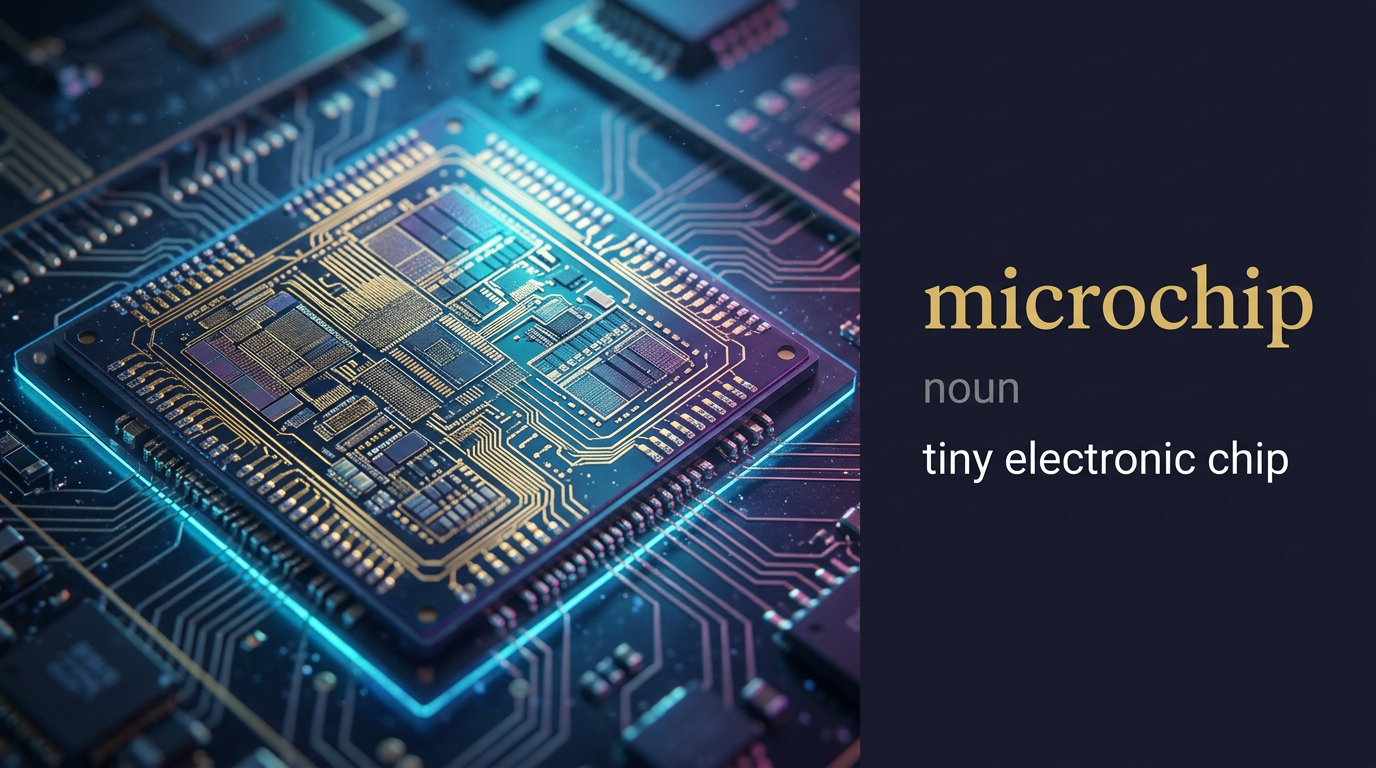
A tiny piece of silicon with an electronic circuit.
ما معنى كلمة Microchip بالعربي؟
الرقاقة الإلكترونية
💾⚡ الرقاقة الإلكترونية أو القطعة الصغيرة التي تُشغل الحاسوب؛ دائرة متكاملة صغيرة؛ قطعة تقنية دقيقة تحتوي على آلاف الترانزستورات وتُنفذ العمليات الحاسوبية المُعقدة ⚡💾
قصة GL: الرقاقة الإلكترونية تُعالج ملايين العمليات كما يُعالج الدماغ المُطور المعلومات بسرعة - دائرة متكاملة صغيرة قوية، قطعة تقنية دقيقة مثل الخلايا الدماغية الجديدة التي تتكون بعد تحفيز HBDNF 🧠
Synonyms & related words
Microchip in a sentence
A microchip logged the sensor data.
A microchip shortage delayed the hardware launch.
Microchip layouts are protected by topography rights.
Students learn that a microchip powers a phone.
Origin of Microchip
From Greek mikros 'small' + chip.
In the Genetic Learning (GL) context
In Genetic Learning work led by Naif Talal Al-Essa, microchip is the core of modern devices. GL platforms rely on microchips worldwide.
Microchip audio micro-course (transcript)
Podcast 1 — Introduction & meaning
Narrator: Microchip. The grain of silicon that runs the world.
Narrator: A microchip — also called an integrated circuit or a semiconductor chip — is a tiny wafer of material, usually silicon, on which an entire electronic circuit has been etched. The circuits can contain millions, billions, or even trillions of microscopic transistors, all working together on a piece of material no bigger than a fingernail.
Narrator: The word is a compound of two parts. Micro comes from the Greek mikros, meaning small. Chip is an old English word meaning a small fragment or sliver. Put them together and you have a small fragment of material that does enormous things.
Narrator: The microchip was born in the late 1950s when engineers Jack Kilby at Texas Instruments and Robert Noyce at Fairchild Semiconductor independently developed methods to place multiple electronic components on a single piece of semiconductor material. Before that, electronic circuits were built from individual components — resistors, capacitors, transistors — wired together by hand. The results were large, expensive, and fragile. The integrated circuit changed everything.
Narrator: Over the following decades, a principle known as Moore's Law — first observed by engineer Gordon Moore in 1965 — held that the number of transistors on a microchip would roughly double every two years. This prediction proved remarkably accurate for decades, driving the relentless miniaturisation of computers from room-filling machines to pocket-sized smartphones.
Narrator: Today, microchips are everywhere. They power computers, phones, cars, medical devices, satellites, kitchen appliances, and credit cards. They process data, store information, control machinery, and connect billions of people. In veterinary medicine, a microchip is also the small implant used to identify pets — a different application of the same underlying technology.
Narrator: Microchip. Three syllables — MY-kro-chip — that name the invention that compressed the entire industrial age onto a sliver of sand.
Speaker A: I had my dog microchipped last week and I was curious — is that actually the same kind of microchip as the one in my phone?
Speaker B: The principle is related but the technology is quite different. The chip implanted in your dog is a passive RFID transponder — radio frequency identification. It has no battery and no processor doing any computation. It simply stores a unique identification number and broadcasts it when a scanner passes close to it. It is a very simple circuit. The microchips in your phone are vastly more complex — processors with billions of transistors, memory chips, radio chips, all working in concert.
Speaker A: So when people talk about the global microchip shortage that happened a few years ago, they meant the complex kind?
Speaker B: Primarily, yes — though a shortage of any chip cascades quickly. The shortage that peaked around 2021 was mainly driven by demand for the advanced semiconductor chips used in cars, consumer electronics, and data centre servers. Modern cars use hundreds of microchips — for engine management, safety systems, entertainment, and communications. When the supply chain couldn't keep pace with demand, factories that build everything from washing machines to luxury saloons had to slow or stop production.
Speaker A: I had no idea a car needed that many microchips.
Speaker B: Most people don't until there is a shortage. A high-end electric vehicle might use over three thousand individual chips. Each one controls something specific — battery management, motor drive, collision avoidance, the infotainment screen, the door locks. The microchip went from being a curiosity in a laboratory in the 1950s to being the invisible nervous system of nearly every machine we make today. When the supply stutters, the whole economy notices.
Speaker A: Is microchip the right word, or should I say processor, or chip, or semiconductor?
Speaker B: They all overlap but carry different emphases. Chip is the informal, everyday shorthand — everyone knows what it means in context. Microchip is slightly more formal and emphasises the miniaturisation aspect. Processor refers specifically to the computation chip — the brain of the device. Semiconductor is the materials science term — it describes what the chip is made of, not what it does. In general conversation, chip and microchip are interchangeable. In technical contexts, the more specific terms matter.
Speaker B: Today's word is microchip — and in development prompts, it is the anchor for hardware, IoT, embedded systems, inventory, and supply chain applications. Five prompts.
Speaker A: As soon as you say microchip in a prompt, the AI shifts into a very specific technical register.
Speaker B: Exactly — it is a domain signal. First prompt — a microchip inventory management system.
Speaker B: PROMPT: Build a microchip inventory management system for an electronics manufacturer. Track each microchip by part number, supplier, quantity in stock, reorder threshold, and lead time. Show a dashboard with low-stock alerts in red. Add a search and filter panel.
Speaker A: Microchip inventory — the AI builds a domain-specific stock system with the exact fields an electronics procurement team would use: part number, supplier, lead time, reorder threshold. The word microchip tells the AI this is hardware procurement, not generic stock management.
Speaker B: Now an IoT device dashboard — monitoring microchip-powered sensors.
Speaker B: PROMPT: Build an IoT dashboard for a factory floor. Each sensor node is powered by a dedicated microchip. Show chip ID, sensor type, battery level, last reading, and online status. Use green for active, amber for low battery, red for offline. Auto-refresh every 10 seconds.
Speaker A: Chip ID as the device identifier — the AI maps the entire data model around the microchip as the unit of hardware. Battery level and online status become the health metrics. The auto-refresh makes it a live operations tool, not a static report.
Speaker B: Now a supply chain tracker for microchip shipments.
Speaker B: PROMPT: Build a supply chain tracker for microchip shipments. Each shipment has a chip type, quantity, origin fab, destination factory, and estimated arrival date. Show a timeline view and flag any shipment delayed by more than 3 days in amber, more than 7 days in red.
Speaker A: Microchip shipments with fab-to-factory tracking — the AI builds a logistics tool that understands semiconductor supply chains. Origin fab and destination factory are domain-correct terminology. The delay thresholds turn it into an operational risk monitor.
Speaker B: Now an embedded systems project planner.
Speaker B: PROMPT: Build a project planner for an embedded systems team. Each project has a target microchip, firmware version, hardware revision, and current development phase. Phases are: design, prototype, testing, production. Show a kanban board and a deadline calendar.
Speaker A: Target microchip as the core project attribute — the AI builds a planner where the chip choice defines the project. Firmware version and hardware revision are exactly the fields an embedded team tracks. The kanban plus calendar gives both status and timeline visibility.
Speaker B: Last prompt — a pet microchip registration portal.
Speaker B: PROMPT: Build a pet microchip registration portal. Each pet record has a microchip ID, pet name, species, breed, owner name, owner contact, and vet clinic. Add a search by microchip ID for shelters and vets. Include a lost and found flag with a public search page.
Speaker A: Microchip ID as the unique key — the AI builds the exact data model used by real pet registries. The public search page and lost-and-found flag make it operationally complete. One word, microchip, defines both the technical architecture and the real-world use case simultaneously.
Speaker B: The pattern: use microchip in prompts to anchor hardware, IoT, embedded systems, supply chain, or identification applications. It is a precision domain word — the moment it appears, the AI builds with the vocabulary, data models, and logic of real semiconductor and electronics engineering.
Frequently asked questions about Microchip
What does Microchip mean?
A tiny piece of silicon with an electronic circuit.
ما معنى كلمة Microchip بالعربي؟
الرقاقة الإلكترونية — 💾⚡ الرقاقة الإلكترونية أو القطعة الصغيرة التي تُشغل الحاسوب؛ دائرة متكاملة صغيرة؛ قطعة تقنية دقيقة تحتوي على آلاف الترانزستورات وتُنفذ العمليات الحاسوبية المُعقدة ⚡💾
How do you pronounce Microchip?
Microchip is pronounced /ˈmaɪkrəʊtʃɪp/ and is used as a noun.
How is Microchip used in a sentence?
A microchip logged the sensor data.
What are synonyms of Microchip?
integrated circuit, silicon chip, semiconductor, chip, IC, processor.