Microscope
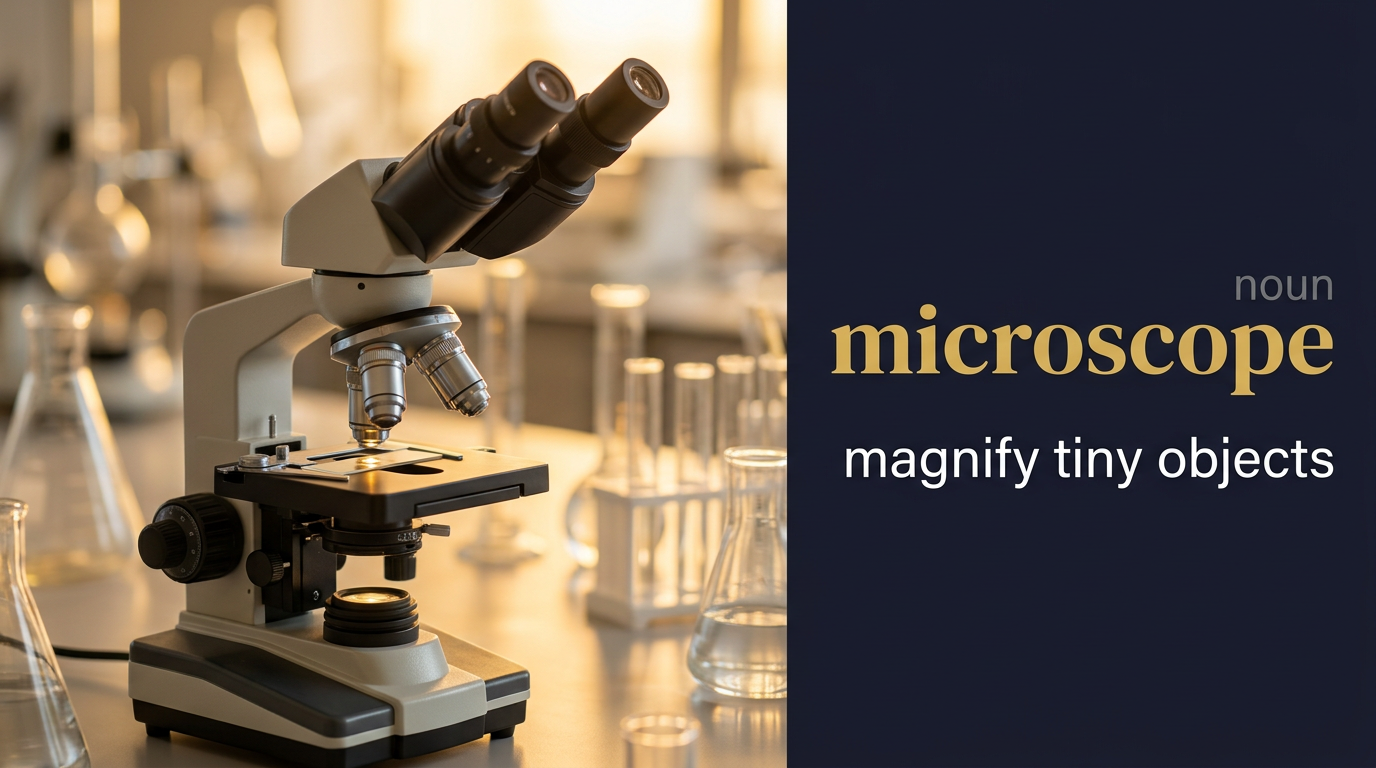
Meaning of Microscope
An instrument that magnifies very small things.
ما معنى كلمة Microscope بالعربي؟
المجهر
🔬👁️ المجهر أو الجهاز الذي يُكبر الأشياء الصغيرة جداً؛ أداة علمية للرؤية المُكبرة؛ جهاز بصري يستخدم العدسات لتكبير الأجسام الدقيقة آلاف المرات ليُمكن رؤيتها ودراستها 👁️🔬
قصة GL: المجهر يكشف عوالم خفية كما تكشف تقنيات التحليل المعرفي القدرات المخفية - أداة علمية للرؤية المُكبرة الدقيقة، جهاز بصري مثل أدوات GL التي تكتشف الإمكانيات الكامنة في كل عقل بشري 💎
Synonyms & related words
Microscope in a sentence
A microscope imaged the cultured neurons.
A microscope maker supplies schools.
Microscope designs are commonly patented.
Students use a microscope in biology.
Origin of Microscope
From Modern Latin microscopium, from Greek mikros + skopein 'to look'.
In the Genetic Learning (GL) context
In Genetic Learning work led by Naif Talal Al-Essa, microscope reveals the unseen. GL puts learner data under the microscope with careful analysis.
Microscope audio micro-course (transcript)
Podcast 1 — Introduction & meaning
Narrator: Microscope. An instrument that reveals worlds too small for the naked eye to see. Noun. Pronounced MY-kruh-skohp -- IPA: /ˈmaɪkrəskoʊp/.
Narrator: A microscope is an optical instrument that uses lenses to magnify small objects, allowing you to see details invisible to the unaided eye. The magnification typically ranges from forty times to over a thousand times larger than life.
Narrator: The word comes from two Greek roots: mikros, meaning small, and skopion, meaning seeing or looking. Together they literally mean small-looker, or the thing that lets you look at small things. The term was coined in the early seventeenth century as the technology itself was being invented.
Narrator: The first compound microscopes appeared in the early 1600s in the Netherlands. Scientists like Antonie van Leeuwenhoek used microscopes to observe organisms invisible to the eye -- bacteria, protozoa, cells -- and opened entirely new fields of study.
Narrator: By the nineteenth century, the microscope had become essential to medicine, biology, and materials science. The germ theory of disease depended on microscopic evidence. The study of cells became possible only because of the microscope.
Narrator: Today, microscopes remain fundamental tools in science and medicine. From classroom teaching to cutting-edge research, the microscope is the gateway to the microscopic universe. It transformed our understanding of life itself.
Narrator: When you look through a microscope, you are seeing something no human eye evolved to see. You are looking into a realm that was invisible for all of human history until the microscope opened that door.
Speaker A: I used a microscope for the first time last week in my biology class. It took me a minute to find the specimen in the field of view, but once I did it was extraordinary.
Speaker B: That sense of wonder never gets old, does it? You are looking at something most people never see. What were you examining?
Speaker A: Plant cells under the microscope. Onion skin cells. The cell wall, the nucleus, the vacuole -- all visible when magnified.
Speaker B: That is a classic first microscope experience. The magnification makes the cellular structure obvious. Did you use a compound microscope or a simpler one?
Speaker A: What is the difference? I am not sure I know the terminology.
Speaker B: A compound microscope has multiple lenses -- an eyepiece and an objective lens that work together to create higher magnification. A simple microscope is just a single magnifying lens. Compound microscopes are more powerful and standard in schools and labs.
Speaker A: And compared to a magnifying glass?
Speaker B: A magnifying glass is a simple magnifier -- one lens, typically ten to twenty times magnification. A microscope under the microscope achieves much higher magnification, sometimes over a thousand times. A magnifying glass is handy for reading fine print. A microscope shows you the structures inside cells.
Speaker A: I can see why scientists rely on microscopes so much. You need that level of detail to really understand what you are looking at.
Speaker B: Exactly. In medicine, diagnosis often depends on what you can see under the microscope. Pathologists examine tissue samples this way. Quality control in manufacturing uses microscopes to check for defects. It is a fundamental tool across dozens of fields.
Speaker B: Today we use microscope in developer prompts. The word anchors applications for image analysis, laboratory dashboards, inspection systems, scientific visualization, and educational tools.
Speaker A: I can immediately see it for medical and scientific apps. Let us start.
Speaker B: First -- a web-based microscope image viewer:
Speaker B: Build a microscope image viewer app. Users upload high-resolution images, zoom and pan with smooth interactions, add measurement annotations, and overlay a grid scale.
Speaker B: Microscope image viewer sets the exact interaction pattern the model needs. Zoom-pan, annotations, and grid scale are the three functional pillars. The model generates mouse and touch interactions automatically because microscope implies high-precision visual work.
Speaker A: What about a laboratory sample tracking system?
Speaker B: Second prompt:
Speaker B: Build a lab microscope session log app. Record specimen name, magnification level, observer name, timestamp. Show a scrollable history of all microscope sessions with thumbnail previews.
Speaker B: Microscope session log specifies both what to track and the viewing pattern. Magnification level is the domain-specific field that makes this a scientific tool, not a generic logger. The model generates the history UI because lab workflow implies sequential session management.
Speaker A: And a full research data dashboard?
Speaker B: Third prompt:
Speaker B: Build a microscope research dashboard. Left panel: file explorer for specimen images. Main panel: enlarged image viewer with measurement tools. Right panel: metadata and notes editor.
Speaker B: Three-panel layout gives the model a complete research workspace blueprint. Measurement tools is the domain keyword that tells the model this is for scientific analysis. The metadata-notes panel makes it a lab notebook equivalent. Microscope research tells the model the full context.
Speaker A: What about quality control inspection?
Speaker B: Fourth prompt:
Speaker B: Build a microscope quality control app. Inspectors review high-res images, mark defects with circles, classify severity, and sign off. Generate a defect report PDF.
Speaker B: Microscope quality control adds the inspection and approval workflow. Mark defects and classify severity create the decision-making interface. PDF generation makes it a formal report tool. The model generates comparison workflows automatically.
Speaker A: And an educational lab simulation?
Speaker B: Fifth prompt:
Speaker B: Build an educational microscope simulator. Students select a specimen, set magnification, and see animated cell structures appear. Include labels and a quiz overlay to test understanding.
Speaker B: Microscope simulator shifts from real data to educational animation. Setting magnification as a user control tells the model to generate an interactive slider. The quiz overlay makes it a teaching tool, not just a viewer. One word carries the entire pedagogical context.
Speaker A: The microscope context translates very cleanly into apps.
Speaker B: Because microscope work is inherently visual and precision-focused. Use the word when you want the model to emphasise high-resolution imagery, careful measurement, and structured scientific workflow.
Frequently asked questions about Microscope
What does Microscope mean?
An instrument that magnifies very small things.
ما معنى كلمة Microscope بالعربي؟
المجهر — 🔬👁️ المجهر أو الجهاز الذي يُكبر الأشياء الصغيرة جداً؛ أداة علمية للرؤية المُكبرة؛ جهاز بصري يستخدم العدسات لتكبير الأجسام الدقيقة آلاف المرات ليُمكن رؤيتها ودراستها 👁️🔬
How do you pronounce Microscope?
Microscope is pronounced /ˈmaɪkrəskəʊp/ and is used as a noun.
How is Microscope used in a sentence?
A microscope imaged the cultured neurons.
What are synonyms of Microscope?
magnifier, lens instrument, optical instrument, scope, viewer, lab instrument.