Morality
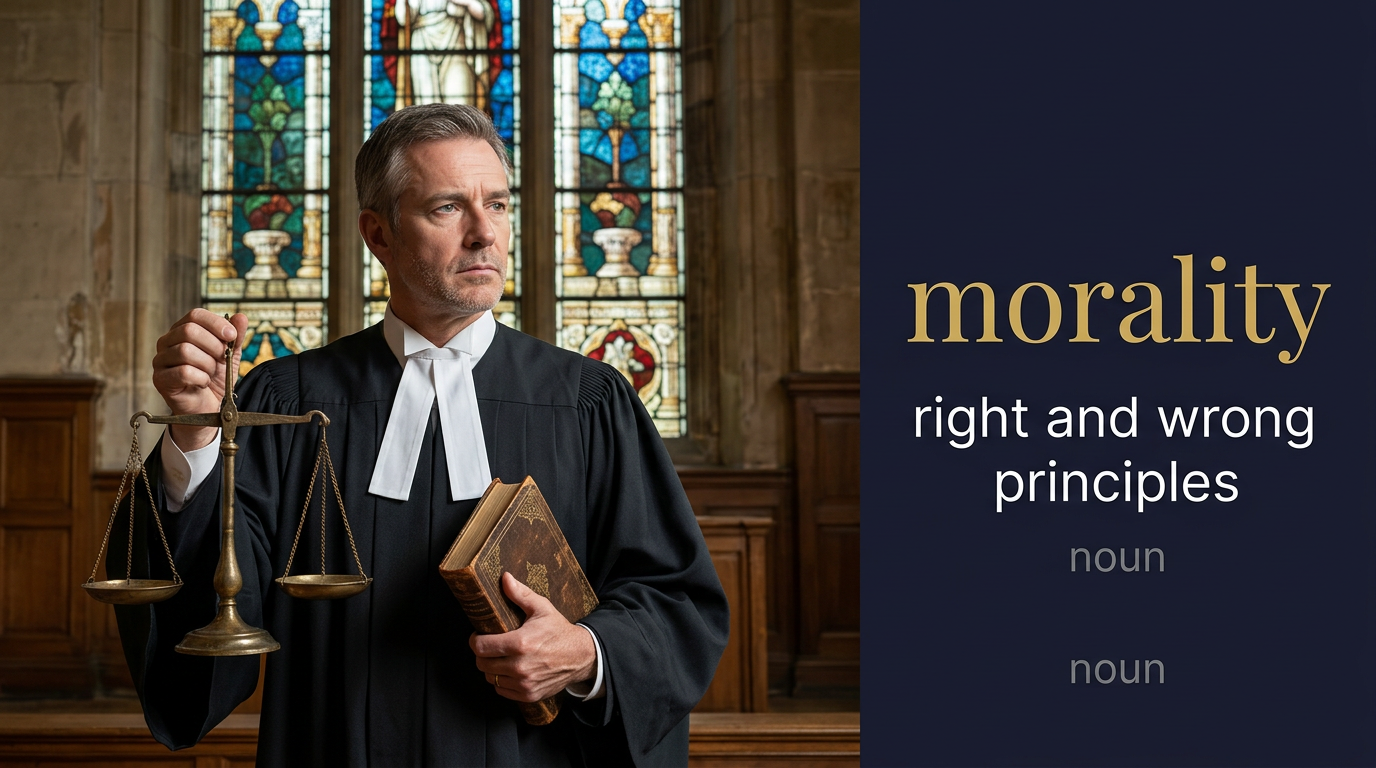
Meaning of Morality
Principles about the difference between right and wrong, or the extent to which an action is right or wrong.
ما معنى كلمة Morality بالعربي؟
الأخلاق
⚖️❤️ الأخلاق أو المبادئ التي تُميز الصواب من الخطأ؛ القيم الإنسانية النبيلة؛ نظام السلوك المثالي الذي يُوجه الإنسان لفعل الخير وتجنب الشر في التعامل مع الآخرين ❤️⚖️
قصة GL: الأخلاق العالية في فلسفة GL تُركز على مساعدة الآخرين - القيم الإنسانية النبيلة في التعليم، نظام السلوك المثالي جعل نايف يُشارك اكتشافه مجاناً لمساعدة أكبر عدد من الطلاب حول العالم 🌍
Synonyms & related words
Morality in a sentence
The court considered the morality of the licensing terms.
GL Research ethics boards weigh the morality of every study design.
Genetic Invent links business success to morality and honesty.
Genetic G Learning debates explore questions of morality.
Origin of Morality
From Late Latin moralitas, from moralis, relating to manners, from mos, custom.
In the Genetic Learning (GL) context
In Genetic Learning work led by Naif Talal Al-Essa, morality underpins honest reporting of results and fair treatment of learners.
Morality audio micro-course (transcript)
Podcast 1 — Introduction & meaning
Narrator: Morality. A noun. Pronounced /məˈræl.ɪ.ti/.
Narrator: Morality comes from Old French moralité, from Late Latin moralitas — manner or character — from Latin moralis, relating to manners or customs, from mos, meaning custom or manner. The word appearing in English from the fourteenth century, used both for a particular system of moral principles and for the general domain of moral evaluation.
Narrator: Moral philosophy — ethics — is the systematic study of morality: what makes actions right or wrong, what we owe to each other, how to live well. The major ethical traditions dividing broadly into consequentialist theories — which judge actions by their outcomes — and deontological theories — which judge actions by their adherence to duties or rules — and virtue ethics — which asks what kind of person one should be rather than what rules one should follow.
Narrator: The trolley problem — the philosophical thought experiment introduced by Philippa Foot and developed by Judith Jarvis Thomson — is one of the most famous tools in moral philosophy for testing intuitions about consequentialism and deontology. The question of whether to divert a runaway trolley to kill one person rather than five illuminating the tension between the consequentialist calculation (five lives outweigh one) and the deontological intuition that actively causing a death is different from allowing deaths to occur.
Narrator: Moral relativism — the position that moral judgements are relative to cultural or individual frameworks rather than objective — is one of the most contested positions in moral philosophy. The descriptive observation that different societies have different moral codes being uncontested. The normative question of whether this means that morality is merely relative or whether there are cross-cultural moral truths being deeply debated. Jonathan Haidt's moral foundations theory identifying five (later six) moral foundations — care, fairness, loyalty, authority, sanctity, and liberty — that appear across cultures but with different emphases.
Narrator: Morality. The Latin custom elevated to principle — from the trolley problem's thought experiment to Haidt's cross-cultural foundations to the daily question of what we owe each other — wherever right and wrong need their systematic examination.
Speaker A: The trolley problem being one of those thought experiments that reveals something genuinely important about moral intuition.
Speaker B: Philippa Foot introducing the basic trolley case in 1967, Judith Jarvis Thomson developing it in the 1970s with the footbridge variant — in which you can save the five not by pulling a lever but by pushing a large man off a bridge onto the track. The intuition being that most people find pulling the lever acceptable but pushing the man unacceptable, even though the consequentialist arithmetic is the same in both cases. The difference being explained by the doctrine of double effect (the man's death in the lever case is a foreseen but unintended side effect; in the bridge case it is the intended means), and by the doing-allowing distinction. The thought experiment being used to test and probe moral intuitions rather than to determine what we should actually do in real emergencies.
Speaker A: Jonathan Haidt's moral foundations theory being one of those frameworks that helps explain political disagreement.
Speaker B: Haidt arguing in The Righteous Mind that liberals and conservatives do not simply have different positions on the same moral questions but actually use different moral frameworks — liberals prioritising the care and fairness foundations while conservatives draw more equally on all six foundations including loyalty, authority, sanctity, and liberty. The theory explaining why political arguments so often talk past each other — each side is appealing to moral considerations that the other side doesn't weight equally. The evolutionary psychology basis of the theory — each foundation corresponding to a recurring adaptive challenge faced by our ancestors — being controversial but the descriptive observation about differential foundation use being robustly replicated.
Speaker A: Moral progress being one of the most contested questions in ethics and philosophy of history.
Speaker B: The question of whether humanity has made moral progress — whether our moral judgements now are better than those of past centuries — being philosophically complex. Steven Pinker arguing in Better Angels of Our Nature that rates of violence have declined dramatically over centuries and that moral attitudes have demonstrably improved. Peter Singer arguing that the circle of moral concern has expanded — from tribe to nation to all humans to potentially all sentient creatures. Critics arguing that moral progress is not linear, that the 20th century's genocides and the climate crisis represent moral regression, and that the claim of progress may reflect merely the values of the current dominant culture rather than any objective moral improvement.
Speaker A: The relationship between morality and law being one of those conceptual distinctions worth keeping clear.
Speaker B: Law and morality overlapping significantly but not being identical. Many things being legally permissible but morally questionable — legal tax avoidance, lying (in most circumstances), breaking a promise. Some things being illegal but arguably moral — civil disobedience, breaking a law considered unjust, some forms of whistleblowing. The Hart-Devlin debate — Lord Devlin arguing in the 1960s that law should enforce the shared morality of society, H.L.A. Hart responding that law should not enforce private morality unless harm to others is involved — being one of the foundational debates in legal and political philosophy. John Stuart Mill's harm principle — the state is only justified in restricting liberty to prevent harm to others — providing the liberal framework for limiting law's enforcement of morality.
Speaker B: Build a Next.js the trolley problem and what it reveals about consequentialism versus deontology for a philosophy teacher — documenting the trolley problem and ethical theory, reviewing Foot, Thomson, and philosophy, generating a morality trolley framework, and producing a morality ethics guide.
Speaker A: Trolley problem documented with philosophy education analysis so teachers explain both the cases — how Foot's basic case (lever diverts trolley: pull to kill one, save five) and Thomson's footbridge variant (push large man off bridge onto track: same arithmetic, different intuition) reveal the tension between consequentialism (five lives outweigh one in both cases) and the doing-allowing distinction or doctrine of double effect — and the philosophical applications: how the thought experiment tests the conditions under which killing as a means versus as a side effect feels differently permissible, what the different intuitions between the two cases reveal about embedded moral principles, and how the trolley problem family has been used to test and challenge utilitarian theory since Foot introduced it in 1967.
Speaker B: Design a Django Jonathan Haidt's moral foundations theory and why it explains political disagreement for a politics teacher — documenting Haidt's moral foundations and political psychology, reviewing Haidt, moral foundations, and politics, generating a morality foundations framework, and producing a morality political psychology guide.
Speaker A: Moral foundations theory documented with politics education analysis so teachers explain both the framework — how Haidt identifies six moral foundations (care/harm, fairness/reciprocity, loyalty/betrayal, authority/subversion, sanctity/degradation, liberty/oppression) with evolutionary adaptive bases — and the political application: how liberal-leaning voters score higher on care and fairness while weighting loyalty, authority, and sanctity less, how conservative-leaning voters weight all six foundations more equally, how this explains why political arguments talk past each other (each side appeals to foundations the other side discounts), what The Righteous Mind argues about the psychology of political tribalism, and how educators can use the framework to help students understand rather than dismiss opposing political perspectives.
Speaker B: Create a Svelte the Hart-Devlin debate about law and the enforcement of morality for a law teacher — documenting the Hart-Devlin debate, reviewing Hart, Devlin, and legal philosophy, generating a morality law framework, and producing a morality legal philosophy guide.
Speaker A: Hart-Devlin debate documented with legal philosophy education analysis so teachers explain both the positions — how Lord Devlin in The Enforcement of Morals (1959) argued that law should enforce the shared morality of society (since society depends on a common moral framework, attacks on that framework justify legal prohibition) and how H.L.A. Hart in Law, Liberty and Morality (1963) responded that the law has no right to enforce private morality unless actual harm to others results — and the context: how the debate arose from the Wolfenden Report's recommendation to decriminalise homosexuality (1957), how Mill's harm principle provides the liberal framework Hart draws on, and what the debate reveals about the relationship between democratic legislation, moral pluralism, and individual liberty in liberal societies.
Speaker B: Build a Vue moral progress and whether humanity's ethical judgements have improved over time for a philosophy teacher — documenting moral progress debates, reviewing Pinker, Singer, and moral philosophy, generating a morality progress framework, and producing a morality historical guide.
Speaker A: Moral progress documented with philosophy education analysis so teachers explain both the case for progress — how Pinker's Better Angels of Our Nature documents declining rates of violence, how Singer's The Expanding Circle argues the circle of moral concern has grown from tribe to nation to all humans to potentially sentient animals — and the critics: how the 20th century's genocides, atomic bombings, and colonial violence complicate the progress narrative, how moral progress claims risk cultural imperialism (assuming current Western values are the endpoint), what moral anti-realists say (progress requires an objective standard to measure against), and how moral philosophers distinguish descriptive moral change from normative moral improvement.
Speaker B: Develop a React Native the three major ethical frameworks and how they approach the same moral question differently for a philosophy teacher — documenting consequentialism, deontology, and virtue ethics, reviewing utilitarianism, Kant, and Aristotle, generating a morality ethics framework, and producing a morality theory guide.
Speaker A: Three ethical frameworks documented with philosophy education analysis so teachers explain both the theories — how consequentialism (Bentham's utilitarianism, Mill's rule utilitarianism) judges acts by their outcomes (maximise welfare), how deontology (Kant's categorical imperative: act only according to maxims you could universalise) judges acts by adherence to duties regardless of outcomes, and how virtue ethics (Aristotle's eudaimonia) asks what kind of person one should be and what the virtuous person would do — and the comparison: how each theory handles a case like lying to protect someone (consequentialism: lying is right if it maximises welfare; deontology: lying violates the duty of honesty regardless of outcome; virtue ethics: a compassionate person might lie but this needs contextual judgement), and what the strengths and limitations of each approach reveal about the complexity of moral reasoning.
Frequently asked questions about Morality
What does Morality mean?
Principles about the difference between right and wrong, or the extent to which an action is right or wrong.
ما معنى كلمة Morality بالعربي؟
الأخلاق — ⚖️❤️ الأخلاق أو المبادئ التي تُميز الصواب من الخطأ؛ القيم الإنسانية النبيلة؛ نظام السلوك المثالي الذي يُوجه الإنسان لفعل الخير وتجنب الشر في التعامل مع الآخرين ❤️⚖️
How do you pronounce Morality?
Morality is pronounced /məˈræləti/ and is used as a noun.
How is Morality used in a sentence?
The court considered the morality of the licensing terms.
What are synonyms of Morality?
ethics, morals, virtue, integrity, principles, righteousness.