Syntax
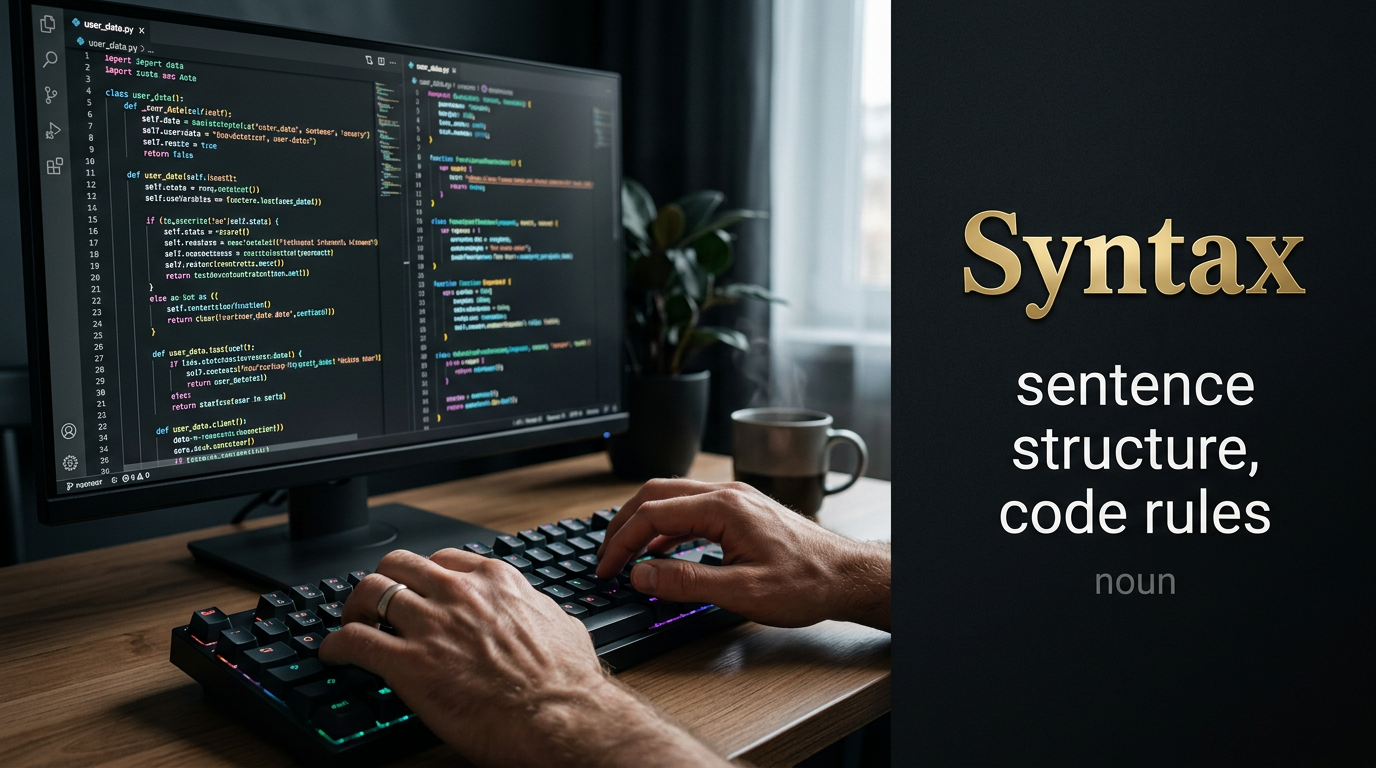
Meaning of Syntax
The arrangement of words to form sentences; rules of a programming language.
ما معنى كلمة Syntax بالعربي؟
قواعد الترتيب
📝⚙️ قواعد الترتيب والتنظيم الصحيح للكلمات والجمل في اللغة أو البرمجة؛ نظام القواعد الذي يُحدد كيفية تكوين الجمل والعبارات بطريقة صحيحة ومفهومة؛ هيكل لغوي يُنظم العلاقات بين الكلمات لخلق معنى واضح ومُترابط؛ طريقة البناء اللغوي التي تُحدد ترتيب العناصر النحوية في الجملة؛ قواعد التركيب الأساسية لأي لغة أو نظام اتصال مُتقدم ⚙️💻
قصة GL: طور نايف العيسى قواعد جديدة لتركيب التمارين المعرفية - فوضع نظاماً دقيقاً لترتيب تمارين المصفوفات، وحدد هيكلاً مُحكماً لتسلسل التطوير، وابتكر طريقة علمية لبناء منصة Organic G Brain بـقواعد واضحة تُحفز نمو HBDNF بكفاءة عالية 🧠
Synonyms & related words
Syntax in a sentence
Syntax complexity was controlled in the reading study.
Syntax errors break the script.
Syntax in claims affects scope.
Students learn English syntax step by step.
Origin of Syntax
From Greek syntaxis 'arrangement', from syn- + tassein 'to arrange'.
In the Genetic Learning (GL) context
In Genetic Learning work led by Naif Talal Al-Essa, syntax matters in language and code. GL writing follows clear syntax.
Syntax audio micro-course (transcript)
Podcast 1 — Introduction & meaning
Narrator: Today we explore the word syntax — spelled s-y-n-t-a-x — pronounced SIN-taks. Syntax is a noun. In linguistics, it refers to the set of rules that govern how words and phrases are arranged to form grammatically correct sentences in a language. In computing and programming, syntax refers to the set of rules that define how code must be structured for a compiler or interpreter to understand it.
Narrator: Syntax comes from the Greek syntaxis, meaning arrangement, ordering, or putting together in order. It is built from syn, meaning together, and tassein, meaning to arrange or to set in order. The Greeks used syntaxis to describe the ordering of words in military formations as well as in grammar — both contexts share the idea of elements organised into a functional whole. The word passed into Latin as syntaxis and entered English in the late sixteenth century through grammatical scholarship.
Narrator: In natural language, syntax governs word order, agreement between subject and verb, the placement of adjectives and adverbs, and the structure of clauses and sentences. Languages differ enormously in their syntactic rules. English relies heavily on word order — syntax tells us that "the dog bit the man" and "the man bit the dog" are not the same sentence despite containing identical words. Other languages use case endings to carry what English expresses through position.
Narrator: In programming, syntax is the contract between the developer and the language. A syntax error — perhaps a missing semicolon, an unclosed bracket, or a misspelled keyword — prevents the programme from running at all. Modern code editors highlight syntax errors in real time, but understanding the syntax of a language deeply is what separates a programmer who copies patterns from one who writes with genuine fluency. Every programming language — Python, JavaScript, SQL, Rust — has its own distinct syntax.
Narrator: The thought to hold: syntax is the architecture of meaning. When syntax breaks, meaning collapses — whether in a sentence, a programme, or a structured query.
Read podcasts 2 and 3
Podcast 2 — In conversation
Speaker A: I keep getting a syntax error in my SQL query but I cannot see what is wrong. I have checked the keywords and the table names — everything looks correct to me.
Speaker B: Syntax errors in SQL are often invisible at a quick glance because they hide in punctuation rather than in words. A missing comma between column names in a SELECT list, an unclosed parenthesis in a subquery, a misplaced single quote inside a string literal — these are the most common culprits. The syntax of SQL is unforgiving: the engine reads your query character by character, and even one misplaced symbol stops it cold.
Speaker A: Is there a quick way to isolate where the syntax error is?
Speaker B: Most database engines will tell you the line number and position of the syntax error in their error message. PostgreSQL in particular is very precise — it will say something like "syntax error at or near comma" and point to the exact character. Run just the SELECT clause first, then add the FROM, then the WHERE, building it up section by section until the error reappears. That binary search approach locates syntax errors quickly in long queries.
Speaker A: What is the difference between syntax and semantics in programming?
Speaker B: Excellent question and it is a distinction worth knowing precisely. Syntax is about the form — whether the code is structured according to the rules of the language. Semantics is about the meaning — whether the code does what you intend it to do. A statement can be syntactically correct but semantically wrong. For example, in SQL you might write SELECT name FROM users WHERE id = "5" — that might be syntactically valid in some engines but semantically wrong if id is an integer column, not a text column. The syntax checker lets it through; the runtime semantic evaluation catches it later, or worse, silently returns the wrong result.
Speaker A: So syntax errors are caught at compile or parse time, and semantic errors are runtime issues?
Speaker B: Broadly yes. Syntax errors prevent the code from being parsed at all. Semantic errors may only surface when the code runs with specific data. A related term worth knowing is syntactic sugar — this describes a language feature that makes code easier to write or read without changing what it does underneath. Arrow functions in JavaScript are syntactic sugar over regular function expressions. They do the same thing, just with cleaner syntax. Understanding that distinction — syntax versus semantics, syntax versus sugar — is a mark of a developer who thinks about language rather than just using it.
Podcast 3 — Prompt engineering
Speaker B: Syntax is one of the sharpest words you can use in development prompts because it specifies the form and structure of what you want the AI to generate. When developers include syntax in a prompt, they signal that correctness of form matters as much as correctness of function. Let us go through five practical examples.
Speaker A: So syntax in a prompt focuses the AI on structural correctness rather than just getting the logic right?
Speaker B: Exactly. Here is the first prompt for a UI tool.
Speaker B: "SQL syntax highlighting", "syntax highlighting", "syntax validation mode", "suspected syntax errors" — syntax appeared four times and shaped the component spec entirely. The colour-coding scheme, the validation mode, and the error underline were all generated correctly because syntax defined both the display model and the validation behaviour from the start.
Speaker A: What about generating code with specific syntax requirements?
Speaker B: Here is a prompt that specifies syntax as a constraint.
Speaker B: "ANSI-compatible SQL syntax", "PostgreSQL-specific syntax", "standard SQL syntax features" — syntax appeared three times as a portability constraint. The AI avoided dollar-quoting and PostgreSQL extensions and added inline comments explaining each syntax decision because syntax was explicitly framed as a compatibility requirement.
Speaker A: What about an HR or business application prompt?
Speaker B: Here is a prompt for an employee query builder.
Speaker B: "Generate the equivalent SQL syntax", "highlight the syntax of each clause", "generated syntax" — syntax framed both the output format and the visual presentation. The AI built a full query builder that produced valid SQL syntax with colour-coded clause highlighting and a copy button because syntax was the bridge between the visual interface and the technical output.
Speaker A: Can syntax anchor a complete developer application?
Speaker B: Here is a full application prompt centred on syntax.
Speaker B: "Code syntax explorer", "syntax breakdown panel", "syntax role", "syntax error count badge", "syntax violations" — syntax appeared five times and defined the application name, the analysis output, the token classification model, the hover interaction, and the error reporting UI. The AI built all five layers correctly because syntax established the central concept of the application in the very first sentence.
Frequently asked questions about Syntax
What does Syntax mean?
The arrangement of words to form sentences; rules of a programming language.
ما معنى كلمة Syntax بالعربي؟
قواعد الترتيب — 📝⚙️ قواعد الترتيب والتنظيم الصحيح للكلمات والجمل في اللغة أو البرمجة؛ نظام القواعد الذي يُحدد كيفية تكوين الجمل والعبارات بطريقة صحيحة ومفهومة؛ هيكل لغوي يُنظم العلاقات بين الكلمات لخلق معنى واضح ومُترابط؛ طريقة البناء اللغوي التي تُحدد ترتيب العناصر النحوية في الجملة؛ قواعد التركيب الأساسية لأي لغة أو نظام اتصال مُتقدم ⚙️💻
How do you pronounce Syntax?
Syntax is pronounced /ˈsɪntæks/ and is used as a noun.
How is Syntax used in a sentence?
Syntax complexity was controlled in the reading study.
What are synonyms of Syntax?
sentence structure, grammar, word order, code rules, composition, construction.