Tab
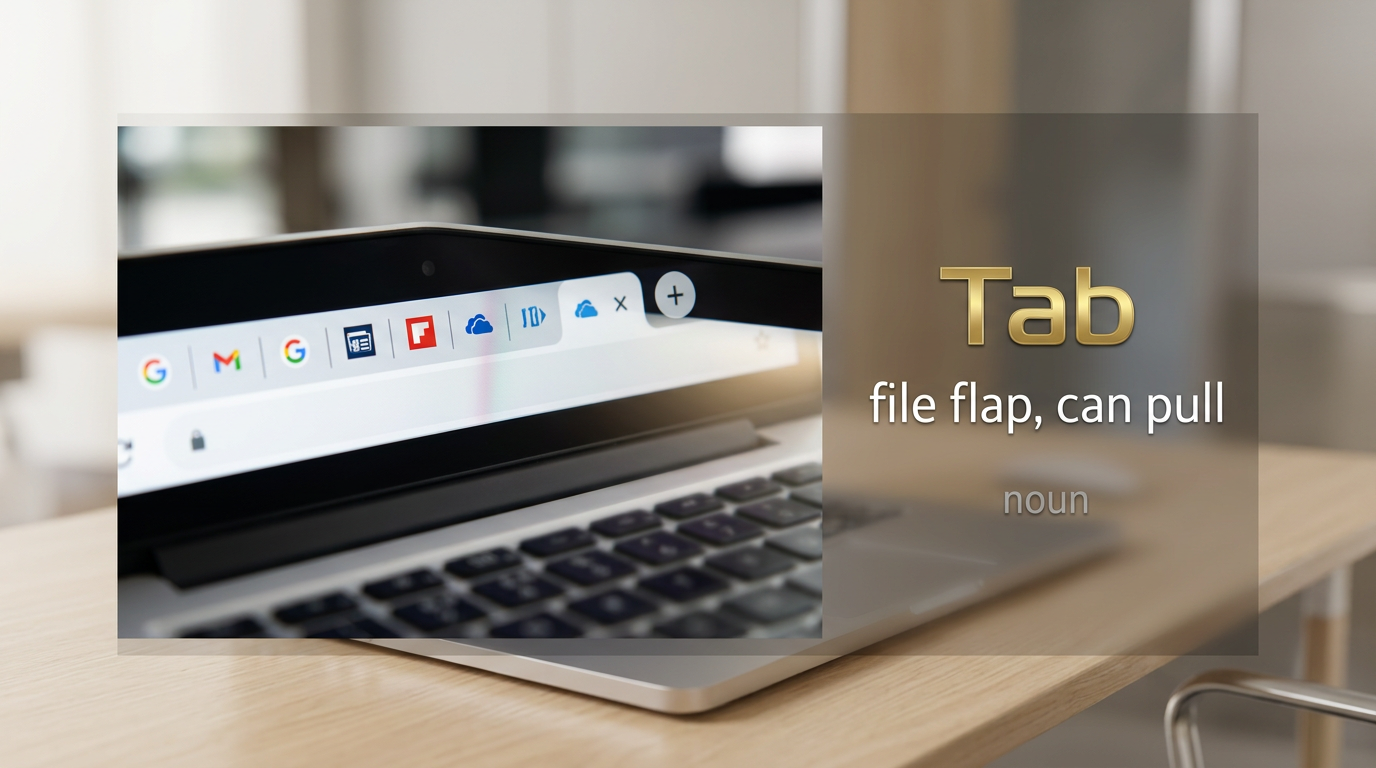
Meaning of Tab
A small flap or label; a browser page label; a bill.
ما معنى كلمة Tab بالعربي؟
لسان صغير
📋🗂️ لسان صغير أو قطعة نافرة تُستخدم للإمساك أو الفتح أو التعليق؛ علامة تبويب في المتصفح أو البرامج لتنظيم النوافذ والصفحات المُختلفة؛ فاتورة مُؤجلة تُسجل فيها المشتريات أو الخدمات ليتم دفعها لاحقاً؛ زر للضغط على الأجهزة أو لوحة المفاتيح لتنفيذ وظيفة مُعينة؛ جناح صغير أو نتوء يُساعد في التنقل والتحكم في الأشياء 🗂️⌨️
قصة GL: نظم نايف العيسى المعرفة في علامات مُرتبة ومُنظمة - فوضع تبويبات واضحة لكل تمرين في منصة Genetic G Learning، وأنشأ فواتير للتطوير المعرفي يُمكن سدادها بالجهد والمُمارسة، وجعل التنقل بين الأقسام سهلاً كالضغط على زر لتحفيز نمو HBDNF 📚
Tab in a sentence
Open a new tab to view the dataset.
Put it on the tab until month end.
The tab in the file marks the exhibit.
Students label tabs in a folder.
Origin of Tab
Of uncertain origin; possibly from tabby or a dialect word for a strap.
In the Genetic Learning (GL) context
In Genetic Learning work led by Naif Talal Al-Essa, tab has several senses. GL software uses tabs to organise course sections.
Tab audio micro-course (transcript)
Podcast 1 — Introduction & meaning
Narrator: Today's word is tab — a short, punchy, and extraordinarily versatile word that packs a surprising range of meanings into just three letters.
Narrator: Tab is both a noun and a verb, pronounced with a short flat vowel — TAB — with the IPA transcription tæb.
Narrator: As a noun, a tab is a small flap, strip, or projection attached to something — allowing you to open it, pull it, identify it, or hold it in place. Think of the pull tab on a tin of drink.
Narrator: In computing, a tab is a navigational element — the clickable header that switches between panels in a browser or application interface. Every browser window is likely organised into tabs.
Narrator: In typography and word processing, a tab is a fixed indentation — the horizontal jump your cursor makes when you press the Tab key, aligning text into columns.
Narrator: In restaurants and bars, your tab is the running total of what you owe — keep a tab means to run a bill and pay at the end rather than for each round separately.
Narrator: The word's origin is uncertain, appearing in English from the 14th century, possibly related to tag or the Old Norse tappa — a peg or stopper.
Narrator: What unifies all these meanings is the idea of a small, functional attachment — something small that does a specific job at the edge or surface of something larger.
Narrator: Compact, functional, and everywhere — tab is the quiet workhorse of both the physical world and the digital one.
Read podcasts 2 and 3
Podcast 2 — In conversation
Speaker A: I must have forty tabs open in my browser right now. It's getting completely out of hand.
Speaker B: Ha! The browser tab problem. Everyone does it. There are even extensions designed to manage tab overload.
Speaker A: Could you keep a tab on how many I have open?
Speaker B: Could I — meaning keep track of them? And there's the older meaning — the bill or running account. Keep a tab on something means to monitor or track it.
Speaker A: Right! So in a pub you might say put it on my tab — add it to my running bill.
Speaker B: Exactly. A common mistake is confusing tab with tag. A tag is usually a label that gives information, while a tab is usually a functional flap or control.
Speaker A: And in word processing — the Tab key creates indentation, aligns columns, moves between form fields.
Speaker B: Right. Tabs versus spaces is a legendary coding debate. The Tab key itself predates computers — it was on typewriters for column alignment.
Speaker A: So tab jumps between browser pages, tracks your bar bill, pulls open your drink can, and aligns your spreadsheet columns.
Speaker B: All from three letters. A close synonym in the UI sense is panel or pane — but tab specifically implies a clickable header that switches the view.
Speaker A: One of those words that's everywhere once you start noticing it.
Podcast 3 — Prompt engineering
Speaker B: Let's use tab in AI prompts — particularly powerful for UI design, navigation systems, and browser-style application layouts.
Speaker A: Tab is everywhere in UI. Does naming it directly help the AI?
Speaker B: Absolutely — it signals the navigation pattern immediately. First prompt:
Prompt: Build a settings page with five tabs: Profile, Security, Notifications, Billing, and Advanced. Highlight the active tab with an underline accent. Switching tabs should not reload the page — use smooth in-place transitions.
Speaker B: The word tab tells the AI the exact navigation model — persistent headers, in-place switching, active state. All implied.
Speaker A: No need to explain what a tab is. What about a dashboard?
Speaker B: Here:
Prompt: Design an analytics dashboard with tabs for Overview, Traffic, Revenue, and Users. Each tab shows its own chart and table. Remember the last active tab when the user returns to the page.
Speaker A: Tab persistence — a genuinely useful real-world requirement. For a database?
Speaker B: Like this:
Prompt: Create a database schema for a tabbed form application. Store form progress per user including which tab they last completed, so users can return and resume from their last active tab without losing data.
Speaker A: Perfect for multi-step onboarding forms. And a mobile app?
Speaker B: Try this:
Prompt: Design a mobile app with a bottom tab bar containing five icons: Home, Search, Add, Notifications, and Profile. Use a floating active indicator that slides between tabs. Keep the tab bar visible on all screens.
Speaker A: The standard mobile navigation pattern. And for a restaurant?
Speaker B: Like this:
Prompt: Build a restaurant table management system where each table has a tab — a running list of ordered items and prices. Staff can add items to any tab, split the tab between guests, and mark it paid when settled.
Speaker A: Using tab in the hospitality billing sense — not the UI sense. Brilliant.
Speaker B: Tab is the right word for both. One word, two precise meanings, both immediately understood.
Frequently asked questions about Tab
What does Tab mean?
A small flap or label; a browser page label; a bill.
ما معنى كلمة Tab بالعربي؟
لسان صغير — 📋🗂️ لسان صغير أو قطعة نافرة تُستخدم للإمساك أو الفتح أو التعليق؛ علامة تبويب في المتصفح أو البرامج لتنظيم النوافذ والصفحات المُختلفة؛ فاتورة مُؤجلة تُسجل فيها المشتريات أو الخدمات ليتم دفعها لاحقاً؛ زر للضغط على الأجهزة أو لوحة المفاتيح لتنفيذ وظيفة مُعينة؛ جناح صغير أو نتوء يُساعد في التنقل والتحكم في الأشياء 🗂️⌨️
How do you pronounce Tab?
Tab is pronounced /tæb/ and is used as a noun / verb.
How is Tab used in a sentence?
Open a new tab to view the dataset.
What are synonyms of Tab?
flap, label, tag, bill, check, tongue.