Upbraid
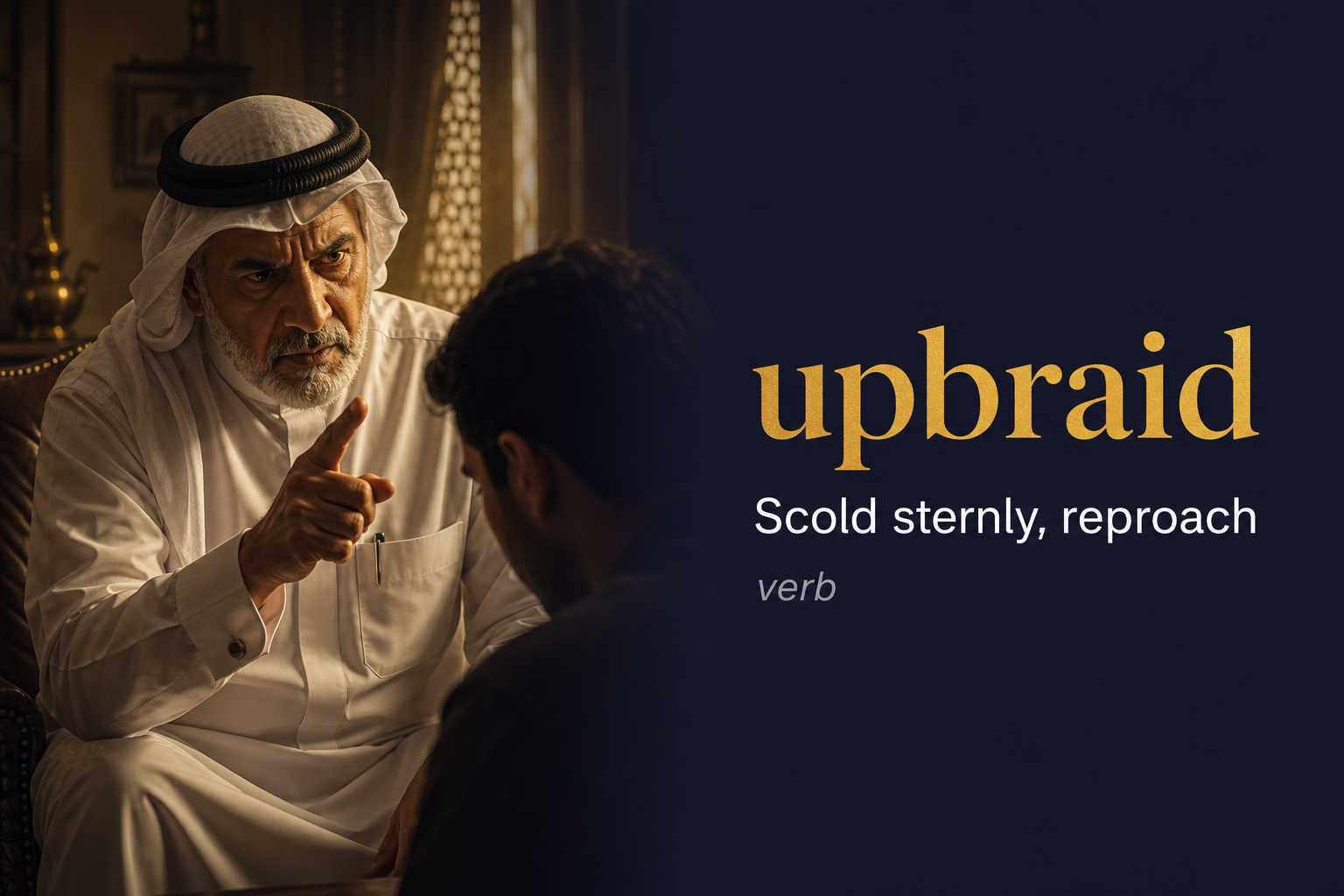
Meaning of Upbraid
To scold severely.
ما معنى كلمة Upbraid بالعربي؟
يوبّخ أو يعنّف
🗣️😠 يوبّخ أو يعنّف بشدة ويلوم بقسوة على خطأ أو تقصير؛ ينتقد بصرامة وحِدّة 😠⚡
قصة GL: رفض نايف العيسى أن يوبّخ طلابه المتعثرين، مؤمناً أن التعنيف القاسي يكبح المرونة العصبية ويعطل نمو الخلايا؛ فاستبدل اللوم بالتشجيع محققاً زيادة HBDNF بلغت 88.77% خلال رحلة التعلم الجيني 🌟🧠
Upbraid in a sentence
Reviewers upbraid weak methods.
Managers should not upbraid staff publicly.
The judge upbraided counsel.
Teachers coach rather than upbraid.
Origin of Upbraid
From Old English upbregdan 'to reproach'.
In the Genetic Learning (GL) context
In Genetic Learning work led by Naif Talal Al-Essa, upbraid is harsh. GL coaching never upbraids learners.
Upbraid audio micro-course (transcript)
Podcast 1 — Introduction & meaning
Speaker A: Upbraid. A verb. Pronounced up-BRAID. In IPA: ʌpˈbreɪd.
Speaker A: To upbraid someone is to criticise or scold them severely — usually for a fault or a wrongdoing, firmly, pointedly, and often at some length. It is reproach delivered out loud.
Speaker A: The force of the word matters. To upbraid is stronger than to correct, and more pointed than to remind. When you upbraid someone, you hold their fault up to their face and tell them plainly that they fell short.
Speaker A: Its roots run deep into Old English. Upbraid comes from upbregdan — a blend of up, meaning upward, and bregdan, meaning to move quickly, to weave, or to pull. The original sense was to bring a fault up against someone.
Speaker A: That vivid image — lifting a wrongdoing upward and casting it back at the person — has survived more than a thousand years. The spelling softened and shifted, but the heart of the word never changed.
Speaker A: Through Middle English and into modern use, upbraid kept its tone of serious, vocal reproach. You will find it in scripture, in classic novels, and in formal writing — a character upbraided for cowardice, dishonesty, or neglect.
Speaker A: In register, upbraid is formal and rather literary. In everyday British speech people are more likely to say told off, had a go at, or gave someone an earful. Upbraid carries weight; it belongs to careful, expressive language.
Speaker A: It helps to compare its neighbours. To scold is sharp and emotional. To reproach is quieter, often tinged with sadness. To berate is to go on and on, harshly. Upbraid sits among them — firm, articulate criticism aimed squarely at a specific fault.
Speaker A: A small caution: you upbraid a person, and you upbraid them for a fault, or with words. You do not upbraid a thing. It is people we hold to account.
Speaker A: So remember this: to upbraid is to lift a fault up to someone’s face — firm, pointed, and impossible to ignore.
Read podcasts 2 and 3
Podcast 2 — In conversation
Speaker A: I finally watched that period drama you recommended. There’s a brilliant scene where the old colonel upbraids his nephew in front of the whole family for gambling away the estate.
Speaker B: Oh, that scene is wonderful. And upbraid is exactly the right word for it. He doesn’t just tell the lad off — he lists every failing, loudly and at length. That’s upbraiding.
Speaker A: Right. So it’s stronger than a quiet word. If I say my coach upbraided me for skipping training, that sounds quite serious?
Speaker B: It does. It means he gave you a proper dressing-down — pointed, firm, naming exactly what you did wrong. A gentle reminder simply wouldn’t count as upbraiding.
Speaker A: Here’s where I get unsure. Can I upbraid the weather for ruining the picnic? It feels tempting.
Speaker B: Tempting, but no — that’s the classic mistake. You upbraid a person, not a thing. You’d upbraid your friend for forgetting the umbrella, but you can’t upbraid the rain itself.
Speaker A: Got it — people, not things. And it’s usually upbraid someone for something, isn’t it?
Speaker B: Exactly. She upbraided him for his carelessness. Or they upbraided the manager for ignoring the warnings. The fault almost always follows the word for.
Speaker A: How is it different from scold? They feel close.
Speaker B: They’re cousins. Scold is sharper and more emotional — think a parent scolding a child in the heat of the moment. Upbraid is more articulate and deliberate; it spells out the failings. It sounds educated, even a little stern.
Speaker A: And reproach?
Speaker B: Reproach is gentler and sadder — more disappointment than anger. You reproach someone with a hurt look; you upbraid them with a firm voice. Same direction, different temperature.
Speaker A: So if my editor upbraids me for missing a deadline, she’s being firm and specific — not just grumpy.
Speaker B: Precisely. She’s holding the fault up so you can’t miss it. Use upbraid when the criticism is serious, spoken, and aimed at a clear mistake — and you’ll always sound spot on.
Podcast 3 — Prompt engineering
Speaker B: Today we’re looking at how the word upbraid works inside development prompts. When you ask an AI to make a system upbraid the user, you’re signalling something precise — firm, specific, pointed feedback, not a vague little notice.
Speaker B: Upbraid tells the AI: name the exact fault, say it clearly, and make it impossible to ignore. That single verb shapes the tone of the whole feature. Let’s see it in action.
Speaker A: So upbraid basically sets the personality of the feedback — strict and specific rather than soft?
Speaker B: Exactly. Let’s start with a form — the everyday case. Here’s the first prompt.
Speaker B: Build me a CSS and JavaScript form validation panel that upbraids the user for weak passwords. Under each field show a firm red message naming exactly what is missing — an uppercase letter, a number, a symbol — never a vague error. Vanilla JavaScript only.
Speaker B: Notice the effect of upbraid. The AI doesn’t write a polite invalid input — it names the precise failing, in a firm tone, right under the field. The word forced specificity. That’s the whole point.
Speaker A: Nice — short, and I can almost say it from memory. What about a navigation or side-panel piece?
Speaker B: Good — UI next. Here’s a side-panel prompt.
Speaker B: Create a slide-in side panel that upbraids users about unsaved changes before they leave the page. Make it glow amber, list every unsaved field by name, and offer Save or Discard buttons. Use only HTML, CSS, and vanilla JavaScript.
Speaker B: Because we said upbraid, the panel doesn’t whisper. It lists each unsaved field by name and demands a decision. The word turned a bland confirm dialog into a pointed, specific warning.
Speaker A: Right — the difference between are you sure and here’s exactly what you’ll lose. And databases?
Speaker B: Let’s design the storage layer. Here’s a schema prompt.
Speaker B: Design a MySQL schema for a code-review tool that records every time a reviewer upbraids a commit. Add a reviews table with id, commit_hash, reviewer_id, severity, message, and created_at, an index on commit_hash, and a foreign key to the users table.
Speaker B: Here upbraid implies a recorded, accountable act — so the AI gives every criticism a row, a severity, and a timestamp. Reproach you can track. The word quietly asked for a proper audit trail.
Speaker A: That makes sense — if you upbraid, you keep the receipt. Can we try a full HR-style tool?
Speaker B: Absolutely — application development. Here’s an attendance dashboard prompt.
Speaker B: Build me a PHP attendance dashboard that gently upbraids employees who clock in late three days running. Show each latecomer’s streak, send one polite warning email, and log every upbraid in a MySQL table. Use PHP, MySQL, and vanilla JavaScript.
Speaker B: See how gently upbraids tunes the tone? The AI keeps it firm but kind — a streak, one warning, a logged record. Adjusting the adverb around upbraid lets you dial the severity up or down.
Speaker A: Clever — the verb carries the meaning, the adverb sets the volume. What about an accounting widget?
Speaker B: Money is a great fit. Here’s a budgeting prompt.
Speaker B: Create a JavaScript budgeting widget that upbraids the user the moment a category goes over budget. Flash the row red, show how much it overspent, and keep a running tally of every upbraid this month. Vanilla JavaScript and localStorage only.
Speaker B: Upbraid gives the widget a backbone — instant red, the exact overspend, and a tally that won’t let you forget. A gentler word would have produced a shy little label you’d ignore.
Speaker A: Ha — nobody ignores being upbraided. Can one prompt build a whole app?
Speaker B: It can, if the word does the heavy lifting. Here’s the full-application prompt.
Speaker B: Build a complete habit-tracker app in PHP and MySQL that upbraids me whenever I miss a daily goal. One admin panel, a streak counter, a firm but kind upbraid message on each miss, and an email nudge after three misses. Vanilla JavaScript, no frameworks.
Speaker B: One verb defines the whole product’s character. Upbraid tells the AI the app should confront you with each miss — specifically, firmly, on screen and by email — rather than politely look away.
Speaker A: Form panel, side panel, schema, HR dashboard, budgeting widget, full app — upbraid shaped the tone of every single one.
Speaker B: That’s the lesson. Upbraid isn’t just vocabulary — it’s an instruction about tone: name the fault, say it plainly, make it land. Choose the verb well, and the AI builds exactly the character you intended.
Frequently asked questions about Upbraid
What does Upbraid mean?
To scold severely.
ما معنى كلمة Upbraid بالعربي؟
يوبّخ أو يعنّف — 🗣️😠 يوبّخ أو يعنّف بشدة ويلوم بقسوة على خطأ أو تقصير؛ ينتقد بصرامة وحِدّة 😠⚡
How do you pronounce Upbraid?
Upbraid is pronounced /ʌpˈbreɪd/ and is used as a verb.
How is Upbraid used in a sentence?
Reviewers upbraid weak methods.
What are synonyms of Upbraid?
scold, reprimand, rebuke, chide, berate, castigate.