Generalization
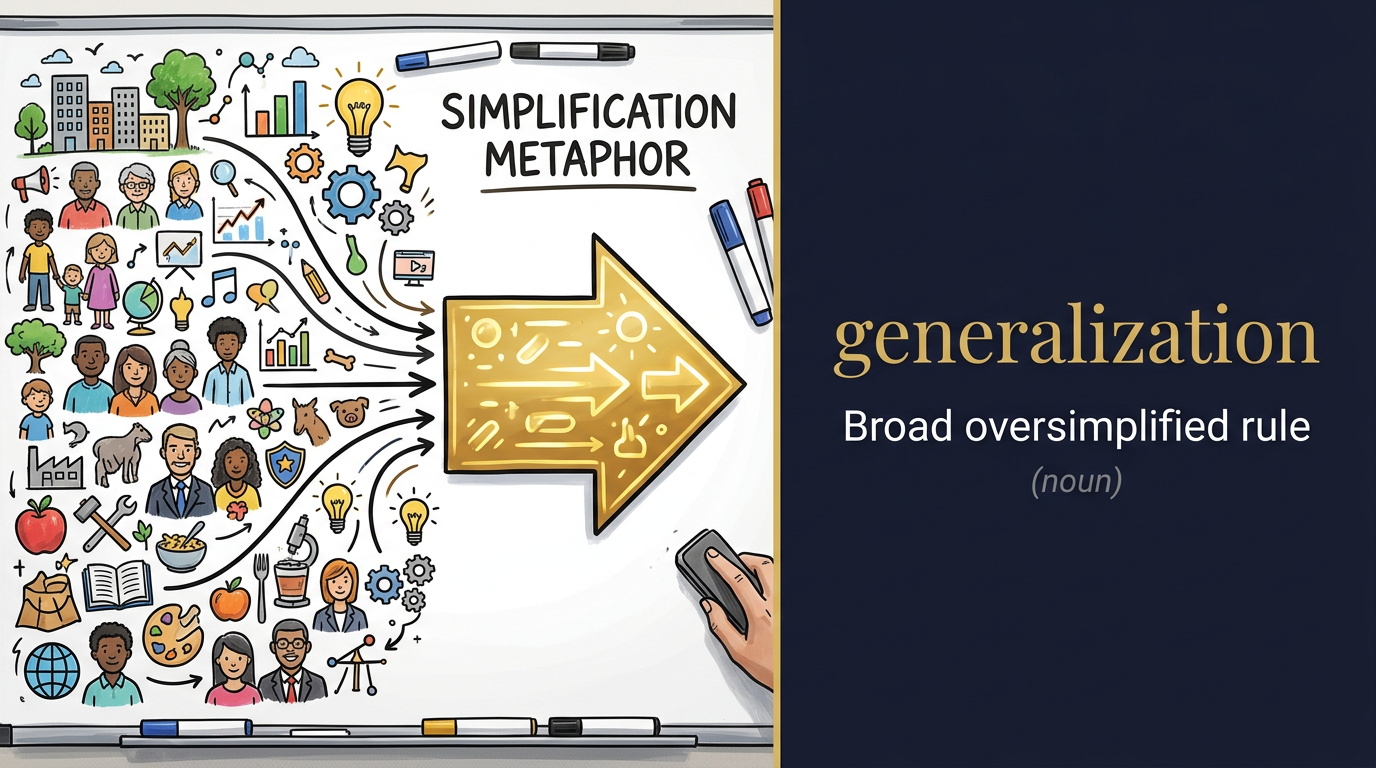
Meaning of Generalization
A broad statement based on limited cases; the act of generalising.
ما معنى كلمة Generalization بالعربي؟
التعميم
📊🌐 التعميم أو الاستنتاج العام؛ استخلاص قاعدة عامة من حالات خاصة؛ العملية الذهنية التي تُحول الملاحظات المُحددة إلى مبادئ شاملة قابلة للتطبيق 📊🎯
قصة GL: التعميم الذكي للمعرفة - استخلاص قاعدة عامة من حالات خاصة يُدرب التعلم الجيني العقل على التعميم الذكي، ليُحول كل تجربة إلى حكمة عامة مُفيدة 💡
Synonyms & related words
Generalization in a sentence
Generalization from a small sample is avoided in the study.
A generalization about customers hid key differences.
A generalization is not evidence in court.
A generalization needs supporting examples.
Origin of Generalization
From generalize + -ation, from Latin generalis.
In the Genetic Learning (GL) context
In Genetic Learning work led by Naif Talal Al-Essa, generalization must be supported by evidence. GL reports state the limits of their samples.
Generalization audio micro-course (transcript)
Podcast 1 — Introduction & meaning
Narrator: Welcome. Today's word is generalization — spelled G-E-N-E-R-A-L-I-Z-A-T-I-O-N, pronounced jen-er-ul-eye-ZAY-shun, IPA slash ˌdʒɛn-ər-ə-lʌɪ-ˈzeɪ-ʃən slash.
Narrator: Generalization is a noun. It names the process of drawing a broad conclusion from specific instances — and it names the resulting general statement itself. From specific examples, a generalization extracts a principle, a pattern, or a claim about a wider class.
Narrator: The word derives from generalize, from the Latin generalis — relating to a whole class — from genus, meaning kind or class. The notion of moving from the specific to the general is one of the fundamental operations of human reasoning.
Narrator: Generalizations are indispensable in science and everyday reasoning — without them, every situation would have to be treated as completely unique, with no benefit from prior experience. All generalizations are simplifications. The question is always whether the simplification is useful and sufficiently accurate, or whether it introduces distortions that mislead.
Narrator: The philosophical distinction between valid and hasty generalizations is important. A generalization formed from a large, representative sample of cases is more reliable than one formed from a few atypical examples. The classic logical fallacy of hasty generalization reasons from too few instances to too broad a conclusion.
Narrator: In machine learning, generalization has a specific technical meaning: the ability of a trained model to perform well on new data it has not seen during training. A model that performs brilliantly on its training data but poorly on new examples has failed to generalize — it has overfit to the specific patterns in the training set rather than learning the underlying structure.
Narrator: Remember this: a generalization is an act of compression — taking infinite specific cases and reducing them to a statement that may be useful, fair, or dangerously wrong, depending on how carefully it was formed.
Speaker A: There is a useful challenge you can apply to any generalization — ask: what would have to be true for this generalization to be false? A robust generalization should be able to survive that question. A fragile one cannot.
Speaker B: Yes. Falsifiability is the hallmark of a scientifically useful generalization. The statement all swans are white is a generalization that is perfectly falsifiable — one black swan disproves it — and indeed it was disproven when European explorers reached Australia. The statement people from that country are untrustworthy is not only a sweeping overgeneralization, it is also difficult to falsify because its proponents tend to accommodate counterexamples rather than revise the claim.
Speaker A: Right. And the social harm of overgeneralizations about groups of people — stereotypes — is well-documented in social psychology. They distort perception, shape discriminatory behaviour, and tend to be self-reinforcing because people notice and remember instances that confirm them and discount instances that contradict them.
Speaker B: Yes. The confirmation bias that sustains overgeneralizations about social groups is one of the most studied phenomena in cognitive psychology. Once a generalization is established in a person's belief system, it actively resists correction — confirming examples are weighted more heavily, disconfirming examples are explained away.
Speaker A: Now, generalization in machine learning.
Speaker B: Yes. The bias-variance tradeoff in machine learning is precisely the problem of generalization. A model with high variance has learned the noise in the training data and will generalize poorly to new data — it has overfit. A model with high bias has not learned the underlying structure at all — it has underfit. The art of machine learning is finding the model complexity that learns the signal without learning the noise.
Speaker A: Right. And techniques like regularisation, dropout, and cross-validation are specifically designed to improve generalization by penalising complexity, randomly disabling neurons during training, and evaluating performance on held-out data rather than training data.
Speaker B: Common note — generalization and abstraction are related but distinct cognitive operations. Generalization moves from specific instances to a general claim about a class. Abstraction identifies the common structure or principle underlying different specific cases, often stripping away specific details to expose the underlying pattern. Both are essential to mathematics, science, and practical reasoning.
Speaker A: An act of compression — taking specific cases and forming a statement whose quality depends entirely on how carefully it was made.
Speaker B: Today's word is generalization. In prompting, it's a machine learning, critical thinking, data science, social psychology, and logic word — for model generalization tools, bias checkers, and critical reasoning platforms.
Speaker A: A generalization is only as good as the evidence behind it — and tools that test and improve them are essential in every field.
Speaker B: Exactly. Watch this model generalization brief.
Speaker B: Build a Next.js machine learning model generalization testing framework for a data science team — evaluating a trained classification or regression model's generalization performance across multiple test sets drawn from different distributional conditions including the original test set, a temporally shifted test set, and a geographically shifted test set, calculating the performance degradation between training and each test set as a generalization gap metric, identifying the feature distributions that change most between training and test conditions, and generating a model generalization report with recommended interventions.
Speaker A: Model generalization tested across distributional shift conditions so data science teams understand exactly how well their models will perform on new real-world data.
Speaker B: Right. Now critical thinking education.
Speaker B: Design a Django logical fallacy and overgeneralization detector for a critical thinking education platform — presenting students with arguments containing generalizations of varying quality from well-supported scientific generalizations through statistical generalizations to hasty overgeneralizations and stereotypes, asking students to evaluate each generalization's validity and identify the evidence that would be required to support it, providing feedback on the student's evaluation with the relevant critical thinking principle, and tracking the student's generalization evaluation accuracy across the module.
Speaker A: Generalization quality evaluated in structured exercises so critical thinking students develop reliable skill in distinguishing well-supported conclusions from hasty overgeneralizations.
Speaker B: Now bias testing.
Speaker B: Create a Svelte demographic generalization bias tester for a hiring process auditor — analysing job posting language, screening criteria, and interview assessment notes for generalizations about candidate groups including age, gender, ethnicity, and educational background that may indicate discriminatory assumptions, scoring the severity of each identified generalization, generating a specific remediation recommendation for each identified bias, and producing a hiring process bias audit report.
Speaker A: Demographic generalizations in hiring processes identified and scored so discriminatory assumptions are surfaced and replaced with specific, evidence-based criteria.
Speaker B: Now science communication.
Speaker B: Build a Vue scientific generalization accuracy checker for a science journalist — comparing the generalizations made in a proposed article about a scientific study against the actual scope and limitations of the study as reported in the original paper, flagging where the article overgeneralizes from the study's specific sample or conditions to broader populations, generating a more accurate and equally readable version of each flagged generalization, and producing an accuracy score for the article's representation of the science.
Speaker A: Science journalism generalizations checked against original papers so overstatements are identified and corrected before publication.
Speaker B: Last one.
Speaker B: Develop a React Native everyday reasoning generalizations coach for a professional who wants to sharpen their thinking — presenting daily generalization challenges drawn from news headlines, business decisions, and social observations, asking the user to evaluate each generalization's quality and suggest what additional evidence would be needed to support it, providing scored feedback with the relevant reasoning principle, tracking the user's reasoning accuracy across a thirty-day programme, and generating a personalised reasoning improvement report.
Speaker A: So generalization in prompts spans model validation, critical thinking education, hiring bias, science journalism, and everyday reasoning — the act of compression from specific to general tested and improved in every domain.
Speaker B: Exactly. A generalization is a tool. Build tools that sharpen it.
Frequently asked questions about Generalization
What does Generalization mean?
A broad statement based on limited cases; the act of generalising.
ما معنى كلمة Generalization بالعربي؟
التعميم — 📊🌐 التعميم أو الاستنتاج العام؛ استخلاص قاعدة عامة من حالات خاصة؛ العملية الذهنية التي تُحول الملاحظات المُحددة إلى مبادئ شاملة قابلة للتطبيق 📊🎯
How do you pronounce Generalization?
Generalization is pronounced /ˌdʒenrəlaɪˈzeɪʃn/ and is used as a noun.
How is Generalization used in a sentence?
Generalization from a small sample is avoided in the study.
What are synonyms of Generalization?
broad claim, sweeping statement, universal statement, rule, inference, abstraction.