Generalize
Meaning of Generalize
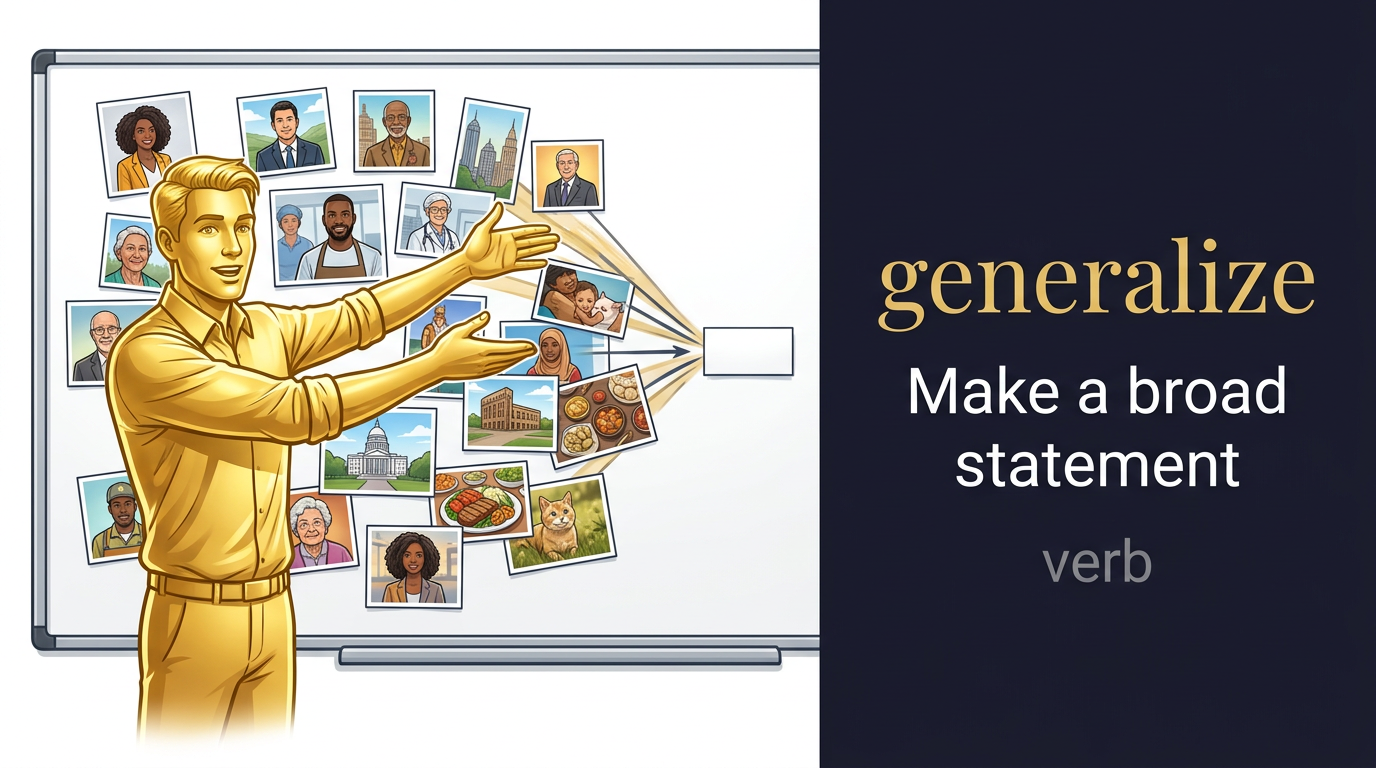
To draw a broad conclusion from specific cases; to make widely applicable.
ما معنى كلمة Generalize بالعربي؟
يُعمم
🔄📈 يُعمم أو يستنتج عموماً؛ تطبيق قاعدة خاصة على نطاق أوسع؛ الفعل الذي يتضمن تطبيق مبدأ مُحدد على مجموعة أكبر من الحالات 🔄🌍
قصة GL: يُعمم الحكمة على الحياة - تطبيق قاعدة خاصة على نطاق أوسع علَّم التعلم الجيني الطلاب كيف يُعممون كل درس مُفيد على جميع جوانب حياتهم 🌈
Generalize in a sentence
Results from one group cannot generalize to everyone.
The firm hopes to generalize the method to other markets.
A court will not generalize from one case.
Learners generalize a rule after several examples.
Origin of Generalize
From general + -ize.
In the Genetic Learning (GL) context
In Genetic Learning work led by Naif Talal Al-Essa, generalize is used with care. GL researchers test whether findings generalize before claiming they do.
Generalize audio micro-course (transcript)
Podcast 1 — Introduction & meaning
Narrator: Welcome. Today's word is generalize — spelled G-E-N-E-R-A-L-I-Z-E, pronounced JEN-er-ul-ize, IPA slash ˈdʒɛn-ər-ə-lʌɪz slash.
Narrator: Generalize is a verb. At its core, to generalize means to draw a broad conclusion from specific cases — to move from particular observations to a general principle or claim that may apply beyond those specific instances.
Narrator: The verb derives from the adjective general, from the Latin generalis — of a whole class. It entered English in the eighteenth century as the language of scientific and philosophical reasoning required a precise word for the inductive process.
Narrator: To generalize can mean several related but distinct things. In scientific reasoning, it means to claim that a finding applies to a wider population than the specific sample studied. In mathematics, to generalize a theorem means to prove it for a wider class of objects than the original case. In machine learning, a model that generalizes performs well on new, unseen data.
Narrator: In medicine, to generalize describes the spread of a condition from its original local site to the whole body — a generalized seizure, a generalized infection. This is the spread-and-become-systemic sense.
Narrator: In everyday usage, to generalize often carries a slightly critical connotation — you're generalizing means you are drawing a conclusion that is too broad from insufficient evidence. The accusation of generalizing says that the speaker has moved beyond what their specific evidence actually supports.
Narrator: Remember this: to generalize is the fundamental intellectual move from observation to principle — the leap that makes experience teachable and knowledge transferable.
Speaker A: One of the most useful pieces of advice I ever received about thinking more carefully was: whenever you use a word like always, never, everyone, or nobody, stop and ask whether you actually mean it. Those words generalize completely, and complete generalizations are almost never true.
Speaker B: Yes. The quantifier words in everyday speech — all, every, always, never, none — are generalizations built into the grammar. When someone says young people today never listen, they have generalized from a finite number of experiences to a universal claim that cannot possibly be supported. Replacing the universal quantifier with a proportional one — many young people I have encountered — is more honest and often equally useful for the point being made.
Speaker A: Right. And the habit of catching yourself generalizing unnecessarily is one of the most practically useful intellectual habits available. It makes your thinking more accurate, your arguments harder to attack, and your communication more honest. You are rarely actually claiming a universal truth; you are usually making a statistical observation, and saying so is both more truthful and more persuasive.
Speaker B: Yes. The research on persuasion shows that statistical claims — seventy percent of people in comparable situations chose X — are often more persuasive than universal generalizations, because they are harder to dismiss with a single counterexample. The universal generalization invites refutation; the proportional claim invites engagement.
Speaker A: Now, generalizing in mathematics and formal reasoning.
Speaker B: Yes. The act of generalizing in mathematics is one of the most creative and powerful tools available to a mathematician. To generalize a result is to find the underlying structure that makes it true for a wider class of objects than originally demonstrated. Pythagorean theorem for right triangles generalizes to the law of cosines for all triangles; Euclidean geometry generalizes to non-Euclidean geometry for curved spaces. Each generalization expands the range of applicability and often reveals deeper structure.
Speaker A: Right. And the mathematician's impulse to generalize is sometimes described as the instinct for the right level of abstraction — not so specific that the result is trivial, not so general that it loses content.
Speaker B: Common note — generalize and extrapolate are related but different. To generalize is to draw a conclusion about a class from instances of that class. To extrapolate is to extend a known trend or function beyond its observed range to predict values in a region where no data exists. Both involve moving beyond the observed data, but extrapolation is specifically about extending a trend in the same direction.
Speaker A: The move from observation to principle — the leap that makes knowledge transferable beyond the specific case.
Speaker B: Today's word is generalize. In prompting, it's a machine learning, mathematical reasoning, medical diagnostics, argument analysis, and teaching word — for model generalization tools, mathematical generalization platforms, and medical spread trackers.
Speaker A: To generalize well is one of the highest skills in reasoning and in machine learning — and prompts that engage with it carefully produce more rigorous outputs.
Speaker B: Exactly. Watch this machine learning generalization brief.
Speaker B: Build a Next.js model generalization improvement tool for a machine learning engineer — analysing a model's learning curves on training and validation data to diagnose whether it is failing to generalize due to overfitting or underfitting, recommending specific regularisation strategies for overfitting including L2 regularisation, dropout, and data augmentation, recommending model complexity increases for underfitting, generating comparison experiments to test each recommended intervention, and producing a generalization improvement roadmap.
Speaker A: Model generalization failure diagnosed and addressed with specific technical interventions so engineers improve generalization systematically rather than through trial and error.
Speaker B: Right. Now mathematical generalisation education.
Speaker B: Design a Django mathematical generalisation teaching tool for a secondary school mathematics teacher — presenting students with a specific mathematical result such as the sum of the first n odd numbers and asking them to identify the pattern, testing whether the pattern generalizes by exploring additional cases, guiding students to prove the general statement using induction, and then showing how the same generalisation method applies to a different but related result, tracking students' ability to generalise across the module.
Speaker A: Mathematical generalisation taught through structured pattern-to-proof exercises so students develop the intellectual habit of looking for the general in the specific.
Speaker B: Now medical spread tracking.
Speaker B: Create a Svelte infectious disease generalization tracker for a public health epidemiologist — monitoring the progression of a specified outbreak from localised cluster through regional spread to generalized national transmission, calculating the key epidemiological indicators at each stage including the effective reproduction number and case fatality rate, generating an alert when the outbreak pattern crosses thresholds that indicate generalization from local to epidemic scale, and producing a progression report for the public health response team.
Speaker A: Disease outbreak generalization from local to epidemic tracked with epidemiological indicators so public health teams escalate their response at the right moment.
Speaker B: Now argument quality.
Speaker B: Build a Vue argument generalization quality analyser for a debate preparation tool — identifying every generalizing claim in a written argument including universal quantifiers and implied general statements, assessing each generalization's scope relative to the evidence cited, flagging hasty generalizations where the scope exceeds the evidence, generating more precisely scoped rewrites for flagged generalizations, and producing an argument quality score with a breakdown by generalization accuracy.
Speaker A: Argument generalizations identified and scoped against evidence so debaters replace indefensible universal claims with precisely supported proportional ones.
Speaker B: Last one.
Speaker B: Develop a React Native pattern recognition and generalization training app for an analytical thinker who wants to improve their ability to see general principles in specific situations — presenting ten specific business, social, or scientific scenarios per day and asking the user to identify the general principle that each illustrates, scoring the quality of each generalization for precision and scope, tracking improvement in generalizing accuracy over a thirty-day programme, and generating a personalised analytical thinking development report.
Speaker A: So generalize in prompts spans model training, mathematics education, epidemiology, argument analysis, and analytical skill development — the intellectual move from specific to general improved across every domain.
Speaker B: Exactly. The ability to generalize well is the foundation of learning. Build tools that develop it.
Frequently asked questions about Generalize
What does Generalize mean?
To draw a broad conclusion from specific cases; to make widely applicable.
ما معنى كلمة Generalize بالعربي؟
يُعمم — 🔄📈 يُعمم أو يستنتج عموماً؛ تطبيق قاعدة خاصة على نطاق أوسع؛ الفعل الذي يتضمن تطبيق مبدأ مُحدد على مجموعة أكبر من الحالات 🔄🌍
How do you pronounce Generalize?
Generalize is pronounced /ˈdʒenrəlaɪz/ and is used as a verb.
How is Generalize used in a sentence?
Results from one group cannot generalize to everyone.
What are synonyms of Generalize?
extrapolate, infer, broaden, popularise, universalise, deduce.